What does VAT withholding (tevkifat) mean: who deducts it, and who pays whom?
In some jobs the buyer does not pay you part of the VAT on the invoice but pays it straight to the state on your behalf. This is called VAT withholding. Using a cleaning firm's invoice to a bank branch, we see who pays what to whom, the 2026 amount threshold, and when a small business comes across this deduction.
VAT withholding means that part or all of the VAT on an invoice is paid straight to the state by the buyer, not to the seller. The buyer makes the deduction and pays it in with its own return (KDV-2); the seller collects only the remaining part of the VAT and is responsible for that part. A small business mostly comes across this when it does jobs such as cleaning, maintenance and repair or construction for public bodies, banks or large firms; in some jobs such as cleaning, every VAT-taxpayer firm also makes the deduction; in 2026 partial withholding applies to transactions above 12,000 lira including VAT.
Osman Bey the cleaner's short payment
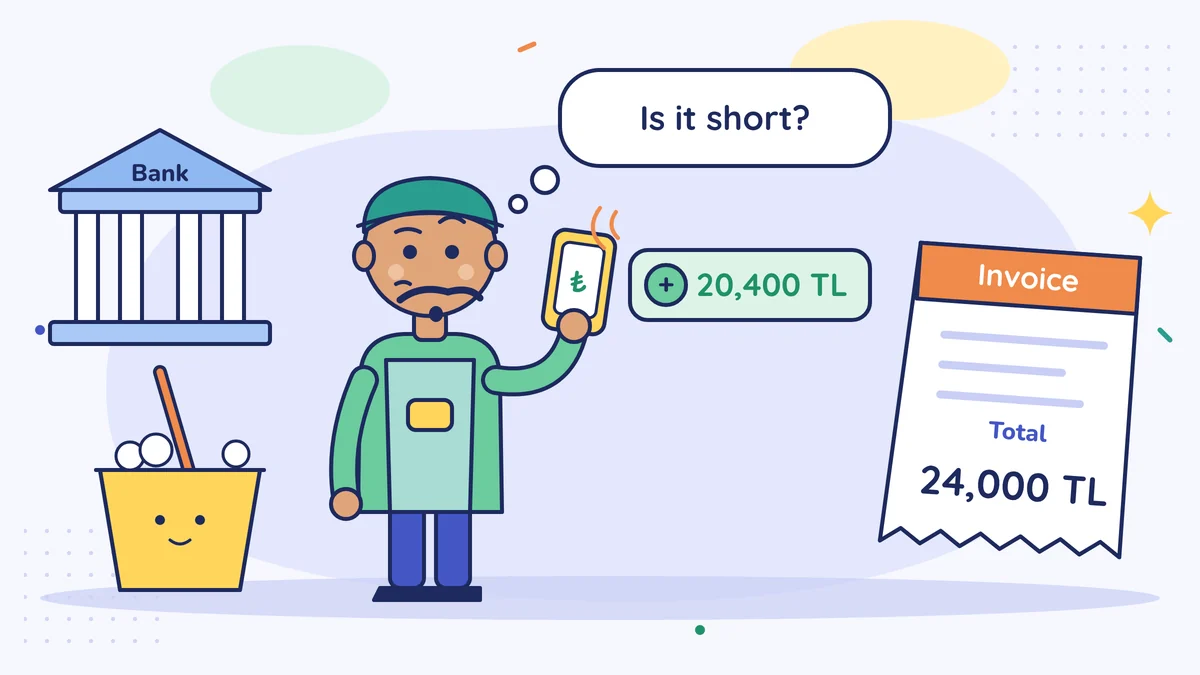
Osman Bey has a small cleaning firm. For the first time he made a deal with a bank branch. At the end of the month he issued the invoice: 20,000 lira for cleaning, plus 20% VAT, 24,000 lira in total. 20,400 lira came into his bank account.
At first Osman Bey thought the bank had paid the wrong amount. Then his mali müşavir (accountant) explained: "It's not short. The bank pays most of the VAT to the state on your behalf. This is called VAT withholding (KDV tevkifatı)."
Tevkifat simply means deduction. In this lesson we look at who makes the deduction, who pays what to whom, and when you will come across it.
Like the building maintenance fee
In a home you rent, you sometimes pay the building maintenance fee not to the landlord but straight to the building manager. The money still goes to the same place, but it doesn't change hands on the way. That way there is no worry about "did the landlord pay the fee?"
With VAT withholding too, in some jobs the state does not want the VAT to pass through the seller's hands. Instead of giving part of the VAT to the seller, the buyer pays it in itself. The aim is to make sure the VAT reaches the state.
Osman Bey's invoice, item by item
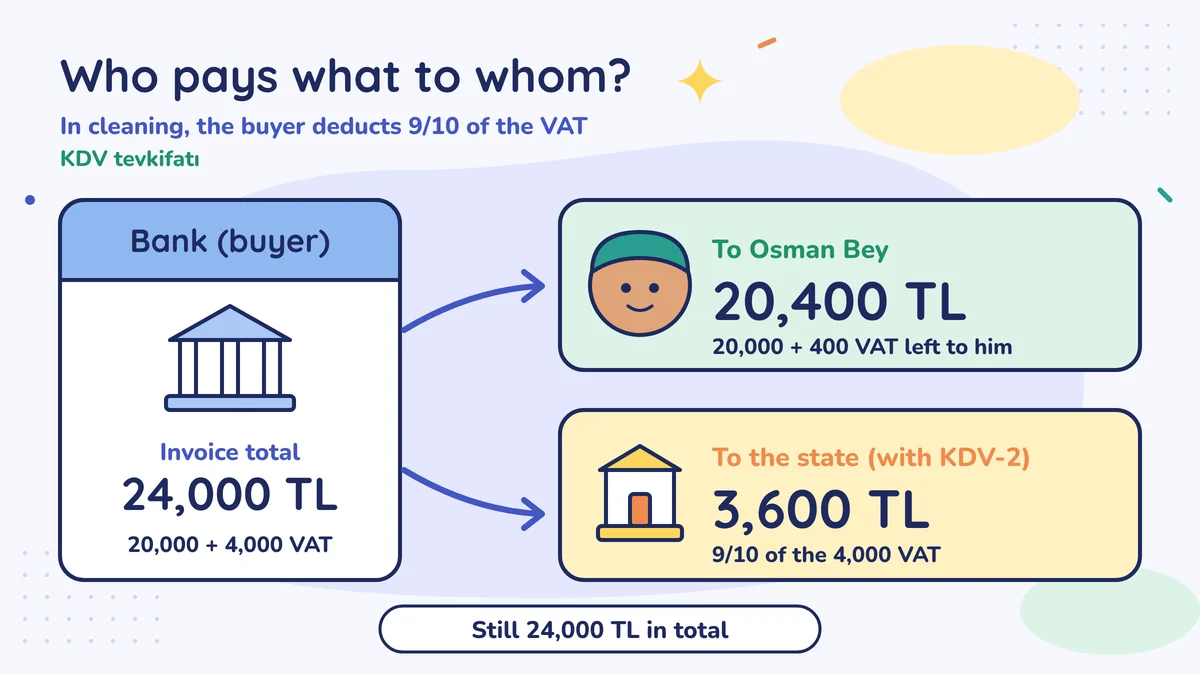
According to the VAT General Implementation Communiqué (section I/C-2.1.3.2.10), in cleaning, environmental and garden maintenance services the buyer deducts nine-tenths (9/10) of the VAT. The buyers who must make the deduction fall into two groups: every firm that is a VAT taxpayer, and the bodies listed one by one in the communiqué, the "designated buyers" (such as public bodies, banks, insurance companies and companies traded on the stock exchange). The bank is in the second group.
| Item | Amount |
|---|---|
| Cleaning fee (excl. VAT) | 20,000 |
| Output VAT (20%) | 4,000 |
| VAT deducted by the bank (9/10 of 4,000) | 3,600 |
| VAT left to Osman Bey (1/10) | 400 |
| What the bank paid Osman Bey | 20,400 |
| What the bank paid to the state | 3,600 |
In total, 24,000 lira was still paid: 20,400 lira to Osman Bey and 3,600 lira to the state.
Who does what, with which return?
The buyer (the bank). It declares and pays the 3,600 lira it deducted as the responsible party, that is, as the person obliged to pay it even though it is not its own tax, with VAT return No. 2 (KDV-2 in accountants' language). Under current practice the last day is the 25th of the following month: the communiqué sets the 21st for filing and the 23rd for payment; with Tax Procedure Law Circular No. 164, GİB extended both to the 25th. If the last day falls on a weekend or a holiday, it moves to the first working day. If the buyer is a VAT-taxpayer firm, it can also use this amount it paid in as deductible VAT in its own VAT calculation, provided it files return No. 2 and pays on time.
The seller (Osman Bey). He issues the invoice as an invoice with withholding: the invoice shows the full VAT, the part deducted and the part left to him, each separately. In his own monthly VAT return, the full VAT and the part deducted by the bank appear separately; the part Osman Bey is responsible for is the 400 lira left to him. He also deducts the deductible VAT on his own purchases from this amount.
If you don't know how to issue the invoice, first see the lesson Issue your first invoice, and when you issue an invoice with withholding for the first time, be sure to ask your mali müşavir. Correcting a wrongly issued invoice is harder than issuing it correctly in the first place.
When does a small business come across it?
As a seller. This is the most common case. You come across it when you do work for public bodies, banks and some large firms listed in the communiqué. In some jobs, for example cleaning, garden maintenance, labour supply and contract textile work (such as sewing another firm's fabric), the deduction is made even if the buyer is an ordinary VAT-taxpayer firm. The jobs in the communiqué include services such as cleaning, maintenance and repair, catering and construction work, and some sales of goods. In construction work, who makes the deduction depends on the buyer and the size of the job; ask your mali müşavir about this too. Each job has its own withholding rate. When you start working with a new corporate customer, ask your mali müşavir: "Is this job subject to withholding?"
As a buyer. If you are a VAT taxpayer and you buy one of these jobs (for example, cleaning your shop) for a price above 12,000 lira including VAT, you make the deduction: you pay the seller the remaining part and pay in the VAT you deducted with KDV-2. If you forget to deduct it, you are held responsible for that VAT. Also, when you buy a service from a firm abroad (for example, a software subscription or online advertising from abroad), you often declare and pay the VAT yourself; you can then deduct the amount you paid. Be sure to send these invoices to your mali müşavir too.
If you are under simplified taxation. Because you do not collect VAT on sales and do not file a VAT return, this topic mostly does not concern you. If you buy services from abroad, still ask your mali müşavir about your situation.
The amount threshold: 12,000 lira for 2026
Partial withholding, that is, transactions in which part of the VAT is deducted, is not applied to every small invoice. With VAT Communiqué No. 50 (since 1 March 2024), the threshold was tied to the invoicing threshold in Tax Procedure Law art. 232. For 2026 this threshold is 12,000 lira including VAT. In transactions subject to partial withholding whose VAT-inclusive amount does not exceed this, no deduction is made. The 2026 amount was set by Tax Procedure Law General Communiqué No. 588. Splitting a job into several invoices to stay below the threshold does not remove the deduction; the split parts are assessed together.
Because Osman Bey's invoice was 24,000 lira including VAT, the deduction was made. If he had done a job for the same bank for 10,000 lira plus 2,000 lira VAT, 12,000 lira in total, there would have been no withholding because it did not exceed the threshold.
A side effect of withholding: VAT builds up
If most of Osman Bey's sales are subject to withholding, the VAT left to him gets smaller every month. But on purchases such as cleaning supplies and machines he pays the full VAT. In this case the purchases pan is always heavier and carried-forward VAT builds up. There is a separate refund route for this build-up; your mali müşavir knows its conditions and documents. You saw the logic of carried-forward VAT in the lesson Calculating VAT line by line.
Osman Bey's new routine
Now, when Osman Bey gives a quote to a corporate customer, he writes two figures: the VAT-inclusive total of the invoice and the amount that will come into his account. He plans his cash according to the second. The 20,400 lira from the bank is no longer a surprise.
Do this this week
Write your corporate customers (public bodies, banks, large firms) in a list. Look at their recent invoices: is the amount that came into your account less than the VAT-inclusive total of the invoice? If so, ask your mali müşavir whether the difference is withholding and whether the invoice was issued correctly. Also add the invoices for subscriptions and advertising you bought from abroad to this month's package.
Common mistakes
- Thinking a short payment means "the customer underpaid". It is normal for a corporate customer to deduct part of the VAT and pay it to the state; first check whether the invoice should have been issued with withholding.
- Issuing a job subject to withholding with a normal invoice. If the buyer makes the deduction, the full VAT appears in your return but the collection falls short. Ask your mali müşavir before issuing the first invoice to a corporate customer.
- Not sending the invoice for a service bought from abroad to your mali müşavir. For these services the buyer often declares the VAT; if the invoice doesn't reach your mali müşavir, the return is incomplete too.
Sources
- Value Added Tax Law No. 3065, art. 9 (party responsible for the tax) and art. 29 (deduction) (mevzuat.gov.tr)
- KPMG: Amendment by VAT General Implementation Communiqué No. 50 (tying the withholding threshold to the Tax Procedure Law art. 232 invoicing threshold, KDV-2 deadlines)
- İSMMMO: VAT General Implementation Communiqué Serial No. 50 (Official Gazette text, PDF)
- Alomaliye: Tax Procedure Law General Communiqué No. 588 (2026 invoicing threshold 12,000 TL)
- GİB, Tax Procedure Law Circular No. 164 (10.02.2024): filing and payment period for VAT return No. 2 is the 25th of the following month (Alomaliye copy)
- GİB announcement, VAT return No. 2 (last day for the April 2026 period 25.05.2026) (Alomaliye copy)
- EY Türkiye: Services within the scope of partial VAT withholding (buyer groups that must withhold, amount threshold)
- Official Gazette 16.02.2021, VAT Communiqué Serial No. 35: raising the rate for cleaning services to 9/10 (TÜRMOB copy, PDF)
- Muhasebenews: VAT withholding in cleaning, environmental and garden maintenance services (9/10)
- Alomaliye: Current practice in VAT withholding (buyer groups that must withhold, by service)
- Alomaliye: Municipalities' VAT withholding obligation
Translated from the Turkish lesson. Last checked against Turkish rules: 12 October 2026. Not yet reviewed by a licensed accountant.
This is general information about Turkish rules, not financial, tax or legal advice. Rules change; check the date and the sources, and ask a licensed accountant (mali müşavir) about your own situation. Disclaimer