Issue your first invoice: line by line
What goes on which line of an invoice? We fill in Nuray the hairdresser's sample invoice line by line: who, to whom, when, what you sold, VAT and the total. At the end you learn the 7-day rule.
An invoice answers five questions: who to whom, when, for what, how much and what its VAT is. The seller's and buyer's details, the date, the work done, the VAT rate and the total must be complete. Under the Tax Procedure Law (Vergi Usul Kanunu) 231/5, an invoice is issued within 7 days at the latest from the delivery of the goods or the service.
Nuray the hairdresser's first invoice
Nuray Hanım has opened a small hair salon. She keeps books on the business account basis (işletme hesabı esası), so she adds VAT (KDV) to her invoices. Her first big customer is Sevgi Hanım: she had a haircut, colouring and a blow-dry, and asked for an invoice. Nuray has an empty invoice screen in front of her. What goes in which box?
An invoice (fatura) is an official paper that says "this sale happened". If you fill it in wrongly, correcting it later is a hassle. So let's look at it line by line. (We saw why an invoice is different from a receipt (fiş) in the Level 0 lesson; here we move on to practice.)
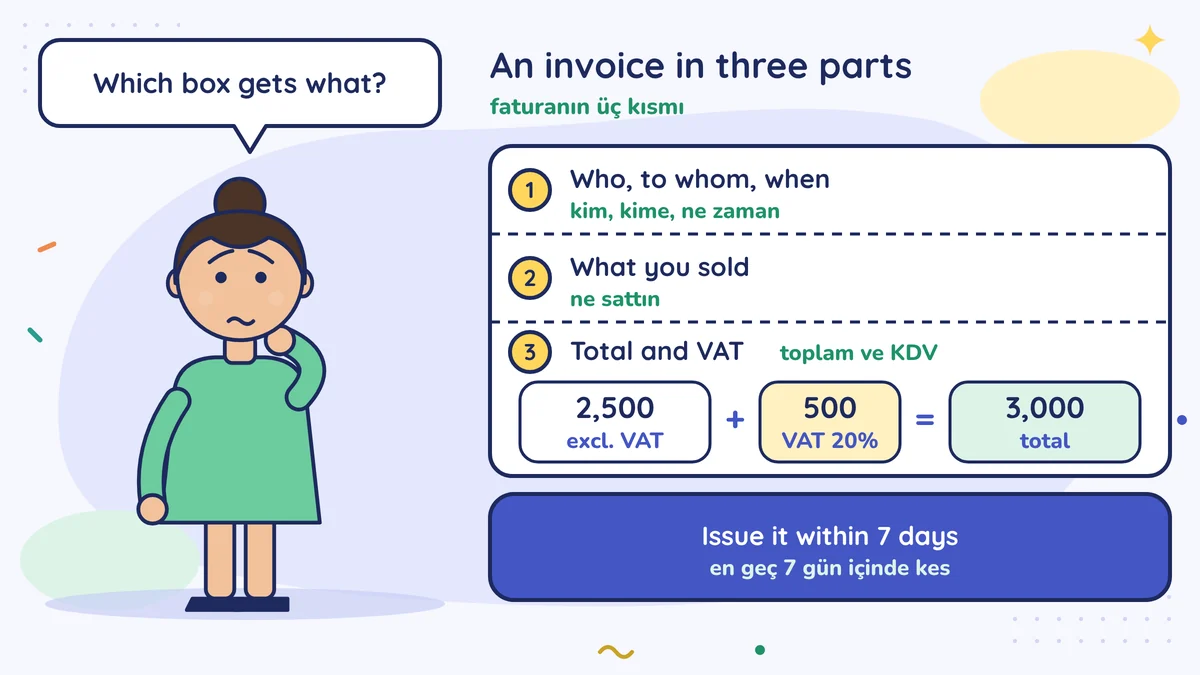
The top part of the invoice: who, to whom, when?
| Field | What the example says | What it means |
|---|---|---|
| Seller's name | Nuray Demir, Güzel Saç Kuaför | You are the one issuing the invoice; your name and your workplace name |
| Seller's tax no. | 1234567890 (example) | Your tax identification number (vergi kimlik numarası, VKN). In a sole proprietorship it can also be your T.C. identity number. |
| Seller's address and tax office | Shop address, the tax office (vergi dairesi) you are attached to | The program or portal usually brings these from your records; enter them correctly once |
| Buyer | Sevgi Yıldız | The person who received the service |
| Buyer's TCKN | 12345678901 (example) | If the buyer is a person, their T.C. identity number; if a company, its tax identification number |
| Buyer's address | Sevgi Hanım's address | If you are invoicing a company, its address and tax office are also written |
| Invoice date | 15.10.2026 | The day you issue the invoice; here, the same day as the service |
| Invoice number | Given by the system | In e-Archive (e-Arşiv), the portal or program gives the number itself |
| Invoice type | e-Archive (sales) | The buyer is not in the e-Invoice (e-Fatura) system |
These boxes are not left empty. Especially the date, buyer and number lines: if your mali müşavir (accountant) or the tax office later asks "who was this invoice for, and when?", the answer is here.
The middle part of the invoice: what did you sell?
| No. | Goods/service | Quantity | Unit price (lira) | Amount (lira) |
|---|---|---|---|---|
| 1 | Haircut | 1 | 500 | 500 |
| 2 | Hair colouring | 1 | 1,500 | 1,500 |
| 3 | Blow-dry | 1 | 500 | 500 |
Where to be careful: write the description short but clear. Instead of a single vague line such as "service fee", writing the work you did item by item makes things easier for both the customer and the accounting.
The bottom part of the invoice: total and VAT
| Line | Amount (lira) |
|---|---|
| Goods/service total (excluding VAT) | 2,500 |
| VAT rate (example) | 20% |
| Calculated VAT | 500 |
| Total payable (including VAT) | 3,000 |
VAT, value added tax (katma değer vergisi), is the tax the customer pays but you pass on to the state. When you pass it on, you deduct from it the VAT you paid on your own purchases and pay the rest. Its name in the law is "deduction" (indirim) (VAT Law (KDV Kanunu) art. 29). The example uses the general rate of 20%. This rate can change depending on the service and the goods: in 2026 the general rate is 20%, and there are 10% and 1% rates for some items. Which rate does your business fall under? Ask your mali müşavir; don't write your own guess on the invoice. There is an article What is VAT? about what VAT is.
The calculation is simple: 2,500 x 20% = 500. 2,500 + 500 = 3,000. Sevgi Hanım pays 3,000 lira; 500 lira of this is not yours, it is the state's.
Does this apply to you? If you are taxed under simplified taxation (basit usul), your sales are exempt from VAT (VAT Law art. 17/4-a). In that case you don't add VAT to your invoice; the VAT calculation in this lesson does not fit you. Note: if you write VAT by mistake, you may have to pay that VAT to the state (VAT Law art. 8/2). Ask your mali müşavir which method you are under.
If the price was quoted including VAT
You often tell the customer "3,000 lira"; this figure includes VAT. On the invoice, though, you first need to find the amount excluding VAT. The formula is simple: divide the amount including VAT by 1.20 (if the rate is 20%). For Nuray: 3,000 divided by 1.20 equals 2,500. The difference, 500 lira, is VAT.
Do this on paper once, and then it becomes a habit. Doing it the other way round and taking 20% of 3,000 is a common mistake: it gives 600, which is wrong. Because the 20% VAT was added on top of 2,500, not 3,000. A wrong calculation spoils both the invoice total and its VAT; correcting it later may require cancelling the invoice. That is why, when you tell a customer a price, ask yourself: "Is this including VAT or excluding VAT?"
Box-by-box checklist
Before sending the invoice, check these five things:
- Are the buyer's name and number correct? If one digit of the number is wrong, the invoice has been issued to the wrong person.
- Is the date correct, and has it not gone past 7 days after the service?
- Is the work you did written line by line?
- Is the VAT rate correct, and does the total add up?
- Is the invoice type (e-Archive, e-Invoice) correct? See the lesson Which one do I issue?
The 7-day rule
Don't hold the invoice back with "we'll issue it later". Under article 231/5 of the Tax Procedure Law (Vergi Usul Kanunu), an invoice is issued within 7 days at the latest from the delivery of the goods or the performance of the service. In Nuray's example the service was given on 15 October; the invoice must be issued by 22 October at the latest. An invoice issued after this period is treated in the eyes of the law as never having been issued, and there is a penalty for it.
Don't confuse the invoice with the customer's payment day: even if the payment comes later, the seven days count from the moment you did the work. Some details of how the rule is applied (month end, collective invoices) are debated; ask your mali müşavir about your own situation. For more detail, see the article When is an invoice issued?
The lesson Nuray learned
When Nuray issued her first invoice, she noticed something: it all comes down to the same place. From whom to whom, when, for what, how much. Every invoice that answers these five questions is a sound invoice. The rest is screen layout.
Do this this week
Think of an imaginary sale: you did a 1,000 lira job for a customer. Draw the table above on paper and fill it in with your own details. Calculate the VAT (with the example rate); if you are under simplified taxation, there is no VAT line. Then ask your mali müşavir, "Which VAT rate applies to my business?"
Common mistakes
- Writing the buyer's number wrongly. One wrong digit makes the invoice issued to someone else; correcting it later is a hassle.
- Holding the invoice back with "I'll issue it later". It must be issued before 7 days have passed since the service.
- Writing the VAT rate by guesswork. Not every service has the same rate; when you are not sure, ask your mali müşavir.
Sources
- Tax Procedure Law (Vergi Usul Kanunu), Law No. 213, articles 229-232, the invoice and the information it must contain (mevzuat.gov.tr)
- Alomaliye, the invoice issuing period under the VUK (7 days), Mustafa Bahadır Altaş
- Lexpera, GİB ruling (özelge): deliveries and services of simplified-taxation taxpayers are exempt from VAT (VAT Law 17/4-a)
- GİB, e-Archive Portal (e-Arşiv Portal)
Translated from the Turkish lesson. Last checked against Turkish rules: 7 October 2026. Not yet reviewed by a licensed accountant.
This is general information about Turkish rules, not financial, tax or legal advice. Rules change; check the date and the sources, and ask a licensed accountant (mali müşavir) about your own situation. Disclaimer