The 30-minute month-end checklist
Set aside half an hour on the last day of the month: do cash, bank and card sales match, is any work left without an invoice, who owes whom, have the amounts from the mali müşavir been paid, are next month's payments in the calendar? What happens if you missed something, and how to put it right.
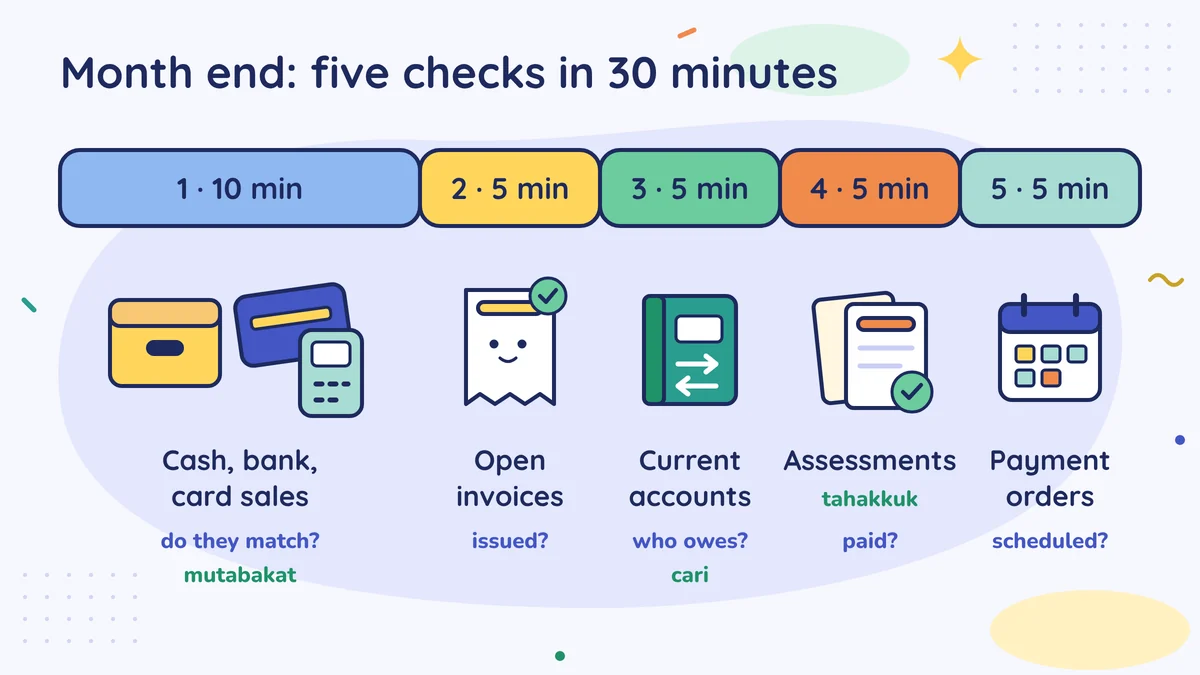
At the end of the month, look at five things in half an hour: do the cash, bank and card sales match the records; is there work without an invoice or a purchase invoice that hasn't arrived; what receivables and debts are overdue; have the tax and premium amounts from the mali müşavir (accountant) been paid; are next month's payments in the calendar. If you missed a payment and the return was filed on time, generally late payment interest runs rather than a penalty; pay on the day you notice and tell your mali müşavir.
İsmail Bey the hardware dealer's half hour
At İsmail Bey's hardware shop, on the last Friday evening of every month, the shutter comes halfway down. The tea is brewed, the ledger is opened. Half an hour. Like checking the car's oil, water and tyres before a long journey: a five-minute check is better than breaking down on the road.
In this lesson we split that half hour into five steps. The aim is not for you to do the accounting; it is to hand the mali müşavir (accountant) a clean month and to see next month's payments in advance.

1. Cash, bank, card sales (10 minutes)
The name of what you do here is reconciliation (mutabakat): checking whether two records match each other.
- Cash: Count the cash in the drawer. Compare it with the amount in the cash book or the program. If there is a 500 lira difference, look for it today; in a month you won't find it.
- Bank: Open the statement. For each incoming item ask "who is this from, is there an invoice?", and for each outgoing item "what is this for, is there a document?" Note the lines without a document and tell your mali müşavir about them separately.
- Card sales (POS): Compare the total of card sales during the month with the amount that reached the bank. The bank deducts its commission; and depending on your agreement with the bank, the money can arrive the next day, a few days later or weeks later (this is called the blocking period). If the difference is just this, it is normal. If there is a bigger difference, ask your bank.
We talked about why cash, bank and your own pocket are kept separate in the lesson Cash, bank and the money in your pocket.
2. Open invoices (5 minutes)
Ask two questions. Has an invoice been issued for every job I did this month? Has every purchase invoice that should come to me arrived?
The invoice for work finished in the last days of the month is issued within seven days, and its VAT belongs, as a rule, to that month; the details are in the lesson The VAT return month. Ask the supplier today for any purchase invoice that hasn't arrived.
3. Current account balances (5 minutes)
The current account, that is, the credit book: who owes you, and whom do you owe?
- Look at the list of your overdue receivables. Call those more than 30 days overdue this week.
- With customers and suppliers you do a lot of business with, confirm balances now and then: "Our records show we owe you 12,000 lira; is that what you have too?" If the two records don't match, finding the difference now is easier than finding it at the end of the year.
The logic of the current account is in the lesson Credit sales and current accounts.
4. Assessments from the mali müşavir (5 minutes)
The tax assessment slip (tahakkuk fişi) is the paper showing the amount of tax or premium to pay and its last day. By the time you reach the end of the month, the previous month's muhtasar and VAT should have been paid, and the SGK and Bağ-Kur premiums paid or about to be paid. If you keep an operating account book or balance sheet books, there is also provisional tax once every three months; under simplified taxation there is none.
Look at each one:
- Is the amount close to what you expected? You made an estimate for VAT in the middle of the month. If it is very different, ask your mali müşavir why; asking is your right.
- Has it been paid? If it has been paid, put the receipt next to the assessment slip. Keep them all in a folder, month by month.
We laid out what happens on which day of the month in the lesson A month's calendar.
5. Payment orders (5 minutes)
Put next month's payments in the calendar now: rent, wages, supplier due dates, tax and premium days. For payments that come at the same amount every month, like Bağ-Kur, you can give your bank a standing payment order. If you have given an order, check once a month that it is working; if there is no money in the account, the order doesn't pay either.
If you missed something
It happens. Act on the day you notice.
- If you paid tax late: If the return was filed on time, generally no penalty is written; late payment interest (gecikme zammı) runs for the period you didn't pay. The sooner you pay, the less it comes to. The rate and calculation are in the article What happens if I pay tax late? (in Turkish).
- If a return was missed: This is a different situation from delaying a payment. Tell your mali müşavir immediately; they know the way to correct it voluntarily before the tax office notices.
- If you paid the SGK premium late: At SGK, both a late payment penalty and late payment interest are added to a premium paid late (Law No. 5510 art. 89); SGK calculates the amount. In addition, that month's premium discount and incentives can be lost (What is an incentive?). For your own Bağ-Kur premium too, the 5-point discount is lost for a month not paid on time.
- If you know you won't be able to pay: Don't wait for the last day; tell your mali müşavir now. There are ways such as filing the return on time and applying to the tax office to have the payment put into instalments. Instalments have interest too; your mali müşavir calculates which one suits you.
İsmail Bey's October card
| Check | Result |
|---|---|
| Cash | 8,000 lira in the book, 7,500 lira in the drawer; a 500 lira purchase receipt turned up in the wallet and was entered in the book |
| Bank | 2 incoming items with no description; both are customer payments and have invoices |
| Card sales | 40,000 lira of sales, 39,000 lira reached the bank; the difference is commission and the last day's sales |
| Open invoices | There was 1 job without an invoice; it has been issued |
| Current accounts | The debts of 3 customers are more than 30 days overdue; they will be called on Monday |
| Assessments | September muhtasar and VAT paid; SGK premium paid today |
| Orders | Rent and Bağ-Kur orders in place |
The half hour is up. The shutter goes up; İsmail Bey puts the card on top of the October documents that will go to the mali müşavir.
Do this this week
Open a 30-minute "month-end" appointment in your calendar on the last working day of this month and have it repeat every month. The first time, do only two things: compare the cash in the till with the record, and mark the lines on the bank statement that have no document. Add what you find as a note to the month-end documents that will go to your mali müşavir.
Common mistakes
- Leaving a cash difference, saying "I'll look at it later". A small difference becomes impossible to find a month later, and it grows. Looking for it the same day takes five minutes.
- Not telling the mali müşavir about a bank transaction with no document. Both incoming and outgoing items without documents are things the mali müşavir needs to know; asking is better than hiding.
- Thinking late payment and a late return are the same thing. If the return was filed on time and payment was delayed, generally late payment interest runs; if a return was missed, the situation is different and the mali müşavir must be told immediately.
Sources
- KPMG: Late payment interest rate redetermined by Presidential Decision No. 10556
- Law No. 6183 on the Collection Procedure of Public Receivables, art. 48 and 51 (mevzuat.gov.tr)
- Tax Procedure Law No. 213, art. 231/5 and 371 (mevzuat.gov.tr)
- Law No. 5510 on Social Insurance and General Health Insurance, art. 88–89 (mevzuat.gov.tr)
- SGK: Premium payment procedures for employers
- Alomaliye: 4/b Bağ-Kur 5-point premium discount 2026
Translated from the Turkish lesson. Last checked against Turkish rules: 12 October 2026. Not yet reviewed by a licensed accountant.
This is general information about Turkish rules, not financial, tax or legal advice. Rules change; check the date and the sources, and ask a licensed accountant (mali müşavir) about your own situation. Disclaimer