Deciding on discounts and promotions with figures
Sevgi Hanım the boutique owner is thinking of a 20% discount. We see how much a discount eats into profit, how many times more you have to sell to make the same profit, when a discount pays off, and the 2026 rule on the old price in discount advertising.
A discount lowers the price but not the purchase cost; so it shrinks the contribution margin by a much bigger percentage than the percentage drop in price. Sales increase needed for the same profit = discount rate ÷ (contribution margin ratio − discount rate). On a product with a 40% contribution margin ratio, a 20% discount requires sales to double; a discount pays off most when clearing goods that would otherwise sit on the shelf and when filling idle capacity.
Sevgi Hanım the boutique owner's promotion
The rules described in this lesson are those of Turkish law.
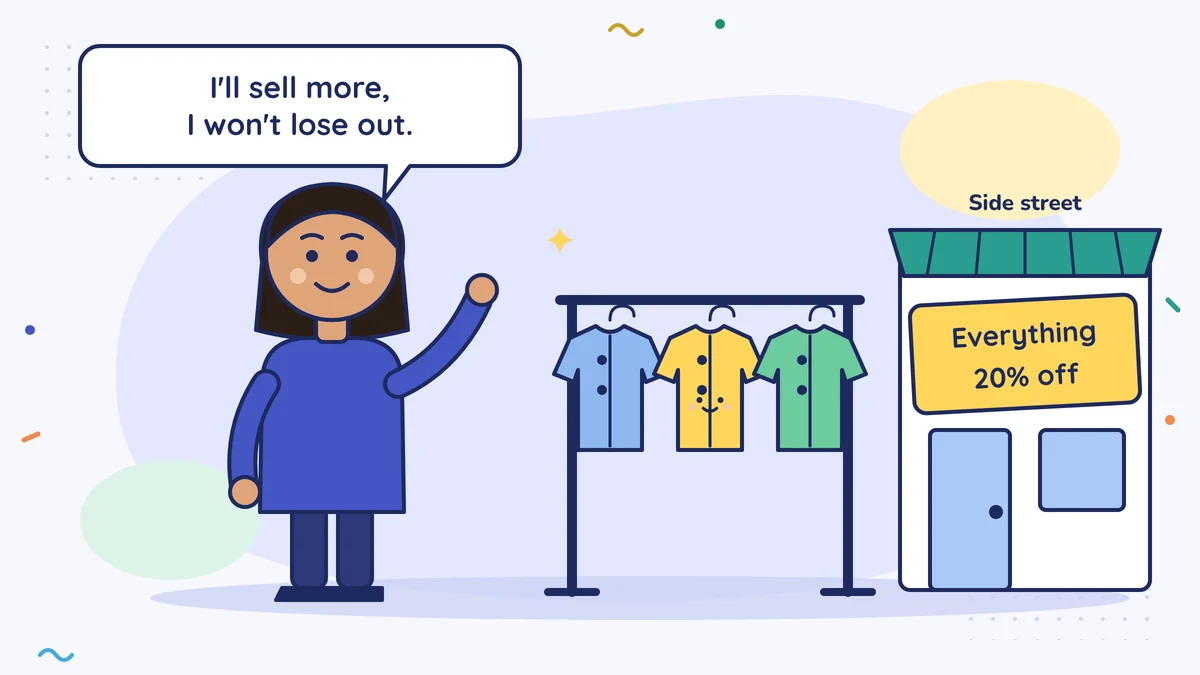
Sevgi Hanım has a clothing boutique. In mid-October sales slowed down; the shop in the next street put up a poster saying "Everything 20% off". Sevgi Hanım is thinking of doing the same: "I'll sell more, I won't lose out."
Maybe. But first let's see in figures how much a discount eats into profit. You saw the first step of a discount's effect on margin in the lesson Profit margin. In this lesson we generalise the calculation and talk about when a promotion works.
The market trader's evening discount
In the late afternoon a market trader lowers the price of his tomatoes. Because the next day those tomatoes won't sell. This discount pays off: unsold goods are worth nothing. The same trader doesn't give a discount at nine in the morning; at that hour the tomatoes sell at full price anyway.
A good promotion decision asks the same two questions: "Can I sell these goods, or this empty hour, without a discount?" and "How much more do I have to sell with the discount?"
How much does a discount eat into profit?
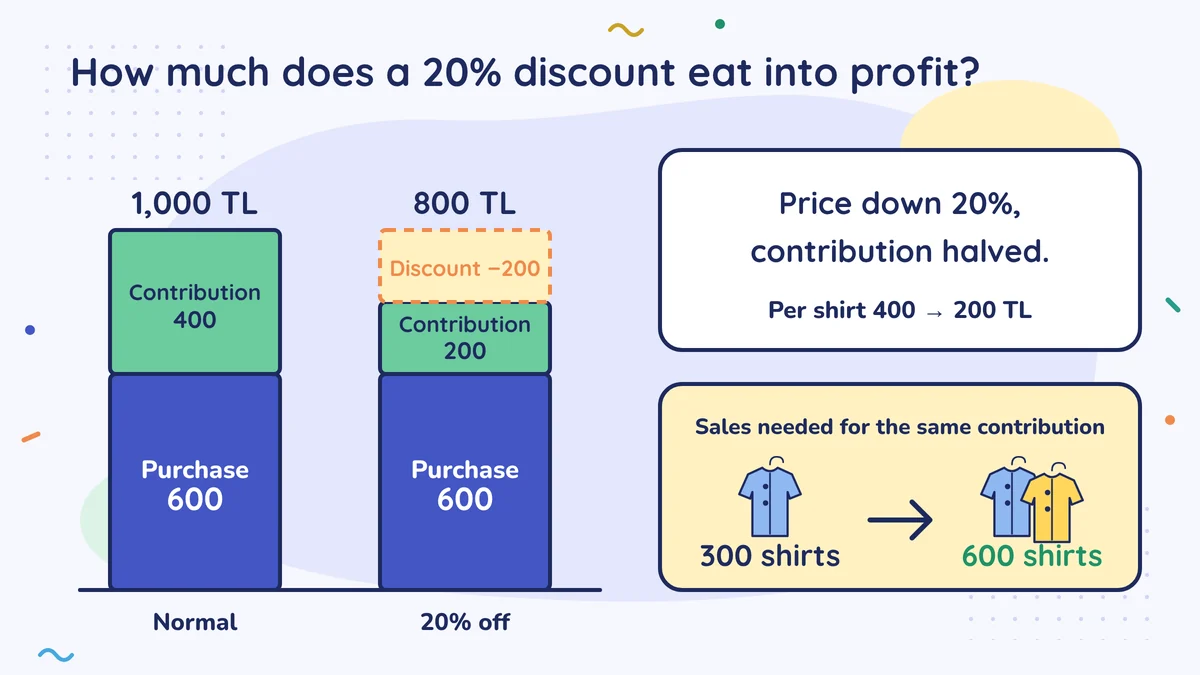
Sevgi Hanım's shirt is 1,000 lira excluding VAT. The purchase price is 600 lira. The contribution margin (katkı payı) per shirt is 400 lira, that is, 40% of the price (what is the contribution margin?).
With a 20% discount, the price falls to 800 lira. The purchase price doesn't change. The contribution margin falls from 400 to 200: the price fell by 20%, the contribution per shirt halved.
If she sells 300 shirts a month, normally 300 × 400 = 120,000 lira of contribution is left. To make the same 120,000 lira with the discount, she needs to sell 120,000 ÷ 200 = 600 shirts. If sales don't double, the promotion reduces profit.
How many times more do you have to sell?
| Discount | Discounted price | Contribution per shirt | Sales needed for the same contribution | Increase needed |
|---|---|---|---|---|
| None | 1,000 | 400 | 300 | — |
| 10% | 900 | 300 | 400 | 33% |
| 20% | 800 | 200 | 600 | 100% |
| 30% | 700 | 100 | 1,200 | 300% |
The general rule:
Sales increase needed = discount rate ÷ (contribution margin ratio − discount rate)
For Sevgi Hanım with a 20% discount: 0.20 ÷ (0.40 − 0.20) = 1, that is, 100%. As the discount gets closer to the contribution margin ratio, the increase needed grows fast; if the discount equals the contribution margin ratio, nothing is left to contribute towards fixed costs, however much you sell.
In the café in the profit margin lesson, the share left per cup (gross margin) was 60%; for a 10% discount, 20% more sales were enough. In the boutique the contribution margin ratio is 40%; the same 10% discount requires 33% more sales. The thinner your margin, the more expensive a discount is.
When does a discount pay off?
1. When clearing goods that would otherwise sit on the shelf. Sevgi Hanım has 80 linen shirts left over from the summer in her stockroom. They will be hard to sell in the new season, and if she waits until next summer they may go out of fashion. With these goods the question is not "I bought them for 600 lira" but "what happens if I keep them?" Selling them at a discount both clears the shelf and turns the money tied up in the goods back into cash (Stock: money waiting on the shelf). But selling below the purchase price with a discount shows up as a loss in your profit table; do it knowingly.
2. When filling idle capacity. In service businesses the variable cost is low. A hairdresser does a blow-dry for 500 lira, with a variable cost of 50 lira: a contribution margin ratio of 90%. If she gives a 20% discount for an empty chair on Tuesday morning, the increase needed is 0.20 ÷ (0.90 − 0.20) = about 29%. At an hour that is empty anyway, that increase is easy to find. The same discount on a Saturday afternoon, however, means selling a full chair cheaply.
3. When bringing in new customers. A discount on the first purchase pays off if the customer comes back. Count how many of those who came with the promotion return the following month at full price.
The hidden costs of a promotion
- Sales pulled forward. The customer was going to buy the shirt next week anyway; seeing the discount, she bought it this week. When the promotion ends, sales drop for a while. When measuring the result of a promotion, count the following two weeks as well.
- Less trust in the full price. In a shop that has a discount every month, customers don't buy at full price; they wait for the next discount.
- A gift is also a discount. The cost to you of the socks given with the shirt is their purchase price. A pair of socks bought for 60 lira that the customer values at 150 lira takes 60 lira out of the contribution; a 10% discount takes 100 lira. Before the promotion, ask your mali müşavir (accountant) how to show the gift on the sales receipt or invoice; goods that leave without a document show up as a stock shortfall at the count.
The rules
- The "old price" in advertising. If you announce a discount on a shop-window poster, on social media or in a leaflet, since 1 August 2026 the price before the discount is the lowest price you applied in the last 10 days before the promotion. For perishable goods such as fruit and vegetables, and for services, the price immediately before the discounted price is used. Promotions tied to a condition ("a discount if you buy this much") are also subject to these rules. The basis is the amendment to the Commercial Advertising and Unfair Commercial Practices Regulation (Ticari Reklam ve Haksız Ticari Uygulamalar Yönetmeliği) published in the Official Gazette of 1 July 2026. For the label inside the shop there is a separate 30-day rule set in the Price Label Regulation (Fiyat Etiketi Yönetmeliği) in 2022. Before the promotion, ask your mali müşavir or lawyer which rule applies to your poster and your label.
- A discount shown on the document also reduces VAT. If the discount (iskonto) is shown on a sales document such as an invoice or receipt, VAT is calculated on the discounted amount (VAT Law art. 25/a). If you are a VAT taxpayer, do the promotion calculation with prices excluding VAT.
What did Sevgi Hanım do?
Instead of a 20% discount on the whole shop, she made two decisions. She put the 80 linen shirts left over from the summer on a separate rail at 30% off. She gave no discount on new-season products; instead, she gave a pair of socks bought for 60 lira as a gift to anyone buying two items. When the promotion ends, she will write down the number of units sold, the total contribution and the sales of the following two weeks, and build her next promotion on these figures.
Do this this week
Before your next promotion, write four figures on a sheet of paper: the product's price excluding VAT, its purchase price or variable cost, the discount rate you are considering, and the sales increase needed that you find with the formula in this lesson. If the increase is not realistic, make the discount smaller or apply it only to the goods you want to clear.
Common mistakes
- Thinking the discount rate is the rate taken off profit. On a product with a 40% contribution margin ratio, a 20% discount halves the contribution per product.
- Measuring the result of a promotion only by the number of units sold. Also look at the total contribution and at sales in the two weeks after the promotion ends; sales may only have been pulled forward.
- Writing an arbitrary old price in an advertisement. Since 1 August 2026, the old price in a discount advertisement is the lowest price of the last 10 days before the promotion; conditional promotions also fall under this rule.
Sources
- DHA: Regulation against misleading discount perceptions in force on 1 August (Official Gazette 01.07.2026/33297)
- Dünya: Amendment to the Commercial Advertising and Unfair Commercial Practices Regulation (Ticari Reklam ve Haksız Ticari Uygulamalar Yönetmeliği, Official Gazette 01.07.2026/33297, in force 1 August 2026): the pre-discount price is the lowest price of the last 10 days
- Alomaliye: A new era in discounted sales (2 September 2026)
- Amendment to the Price Label Regulation (Fiyat Etiketi Yönetmeliği), Official Gazette 18.02.2022/31754 (art. 11: 30-day rule for the pre-discount price), Alomaliye copy
- Value Added Tax Law No. 3065 (Katma Değer Vergisi Kanunu), art. 25 (discounts shown on invoices and similar documents are not included in the amount on which VAT is calculated) (mevzuat.gov.tr)
- Alomaliye (Nuri Değer, YMM): VAT applicable to turnover discounts
- Dr. Uğur Demir, Cost–Volume–Profit Relationships and Profit Planning (Maliyet Hacim Kâr İlişkileri ve Kâr Planlaması, Ankara University lecture notes): contribution margin and contribution margin ratio
Translated from the Turkish lesson. Last checked against Turkish rules: 12 October 2026. Not yet reviewed by a licensed accountant.
This is general information about Turkish rules, not financial, tax or legal advice. Rules change; check the date and the sources, and ask a licensed accountant (mali müşavir) about your own situation. Disclaimer