Seeing several companies in one table
Adding up two companies' figures one under the other counts the sales between the sister companies twice. Through the statements of Melek Hanım, who owns a café and a bakery workshop, we see how to keep the books and bank accounts separate and build a one-page combined view each month.
The books, bank accounts and tax returns of several companies stay separate; the combined view is only a management table you make for yourself. First you write each company's figures side by side and add them up, then you take the companies' sales to each other out of both sales and purchases, and their amounts owed to and by each other out of both sides. What is left shows the group's sales to outsiders, its real debts and its cash.
Melek Hanım's two statements
The rules described in this lesson are those of Turkish law.
Melek Hanım has two limited companies. One runs a café in the market district. The other is a workshop making cakes and börek (filled pastries); it sells what it produces both to Melek Hanım's café and to other cafés and grocery shops in the neighbourhood.
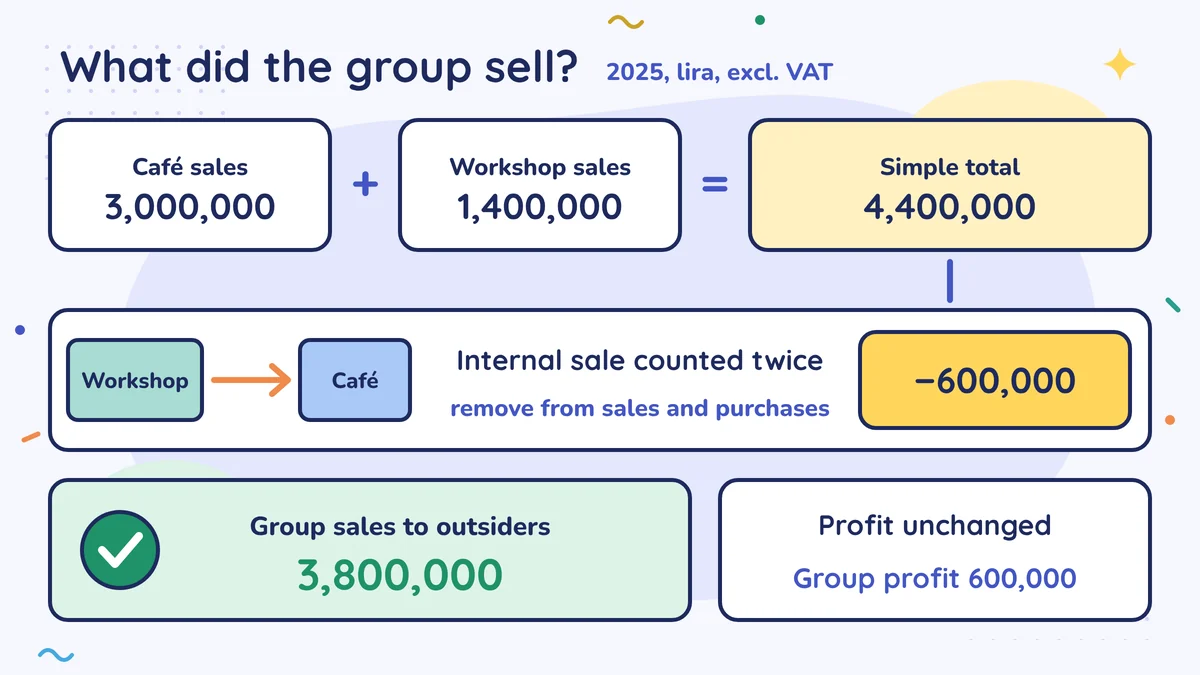
In March her mali müşavir (accountant) sent the 2025 statements of the two companies separately. Melek Hanım added them together: "Our total turnover is 4,400,000 lira." A friend of hers at the bank looked at the table and asked: "How much of this is sales to outsiders?"
Melek Hanım could not answer. In this lesson we talk about seeing several companies correctly on one page. You saw how to read the statements one by one in the lessons The income statement line by line and The balance sheet.

Two separate wallets
Imagine a couple in a family who each have their own wallet. The husband gives his wife 1,000 lira for the shopping. The family has not earned 1,000 lira this month; the money has only moved from one pocket to another. When you look at the family budget, you do not count this change of hands.
Sister companies are the same. Goods one sells to the other are not the group's sales to outsiders.
Rule 1: the books and the bank stay separate
Seeing them in one table does not mean merging the records. Each company has its own books, its own bank account and its own tax returns. One company's invoice is not paid with the other's money; if it is, that is a debt between the two companies and is recorded as such. You saw in the previous lesson, Invoices, loans and interest between companies, that the price between companies must be the arm's length price (emsal bedel).
The combined view is a management table you make for yourself. It is not an official consolidated statement. Official consolidated statements are prepared, within the rules of the Turkish Commercial Code and the Public Oversight Authority (Kamu Gözetimi Kurumu), for groups that are subject to independent audit and meet the conditions; ask your mali müşavir about your situation.
Rule 2: add up, then take out the internal transactions
Melek Hanım's 2025 figures, rounded and excluding VAT:
| Line | Café | Workshop | Simple total | Internal transaction | Group |
|---|---|---|---|---|---|
| Sales | 3,000,000 | 1,400,000 | 4,400,000 | −600,000 | 3,800,000 |
| Materials and goods purchased | −1,000,000 | −500,000 | −1,500,000 | +600,000 | −900,000 |
| Staff | −900,000 | −400,000 | −1,300,000 | −1,300,000 | |
| Rent and other expenses | −800,000 | −200,000 | −1,000,000 | −1,000,000 | |
| Profit before tax | 300,000 | 300,000 | 600,000 | 0 | 600,000 |
The workshop sold 600,000 lira of products to the café during the year. This amount sits in the workshop's sales and in the café's purchases. In the simple total it is counted twice: once as the workshop's turnover, and once inside the cakes the café sold to its customers.
Once the internal transaction is taken out of both lines, the table tells the truth: the group made 3,800,000 lira of sales to outsiders, not 4,400,000. Profit did not change, because the internal sale was recorded as income in one company and as an expense in the other; the two cancel each other out.
A warning: if at year end the café has not yet sold some of the products it bought from the workshop, the workshop's profit inside that stock has not yet been earned from the group's point of view. In a bakery this amount is small; in businesses that hold stock it can be large. If needed, ask your mali müşavir for this adjustment.
Rule 3: receivables and debts cancel each other out too
At year end the café owes the workshop 150,000 lira. The workshop's balance sheet (bilanço) shows a receivable of 150,000 lira, and the café's balance sheet shows a debt of 150,000 lira. For the group, this debt does not exist; both are taken out.
| Line | Café | Workshop | Internal transaction | Group |
|---|---|---|---|---|
| Bank | 250,000 | 180,000 | 430,000 | |
| Receivables from customers | 20,000 | 210,000 | −150,000 | 80,000 |
| Debts to suppliers | 230,000 | 90,000 | −150,000 | 170,000 |
The group has 430,000 lira in the bank. It is owed 80,000 lira by outsiders and owes 170,000 lira to outsiders. To be able to take these out, the balances the two companies show with each other must be the same; if not, you first do an account reconciliation (cari mutabakat): you compare the two companies' records invoice by invoice, payment by payment, and find the difference.
One page a month
Melek Hanım now fills in a one-page table at the end of every month:
- Take each company's sales, expenses and profit from its own records.
- Find the sales between the companies and take them out of both lines.
- Compare the balances the two companies owe to and are owed by each other; if they match, take them out.
- Add up the bank balances.
- Write one sentence underneath: "What did the group sell to outsiders this month, and what is left in the cash box?"
The same logic works if one of the businesses is a sole proprietorship. But in a sole proprietorship, the money the owner draws is not an expense; show it on a separate line when you build the table. A sole proprietorship that keeps a business book (işletme defteri) does not produce a balance sheet; you take the bank, receivable and debt figures from your own lists.
In one sentence
To see several companies in one table, keep the books separate, add up the figures, then take the companies' sales to each other and their debts to each other out of both sides; what is left is the business the group did with the outside world.
Do this this week
Write last month's figures for each company in its own column: sales, expenses, profit and bank balance. Open one more column next to them and write the total, excluding VAT, of the invoices the companies issued to each other that month. Take this amount out of the sales line, and out of whichever line it was recorded on in the other company (goods purchased, rent or service expenses), and fill in the group column; for the first time you will see the group's sales to outsiders as a single figure.
Common mistakes
- Adding turnovers one under the other. Goods one sister company sells to the other are counted twice; the group looks bigger than it is.
- Doing the merging in the records. The books and the bank stay separate; the combined view is only a management table and does not go into the tax return.
- Taking out internal balances without comparing them. If one company shows 150,000 and the other 120,000, find the difference first; otherwise the table will give a wrong result.
Sources
- Turkish Commercial Code No. 6102, art. 64–88 (bookkeeping, financial statements and consolidation) (Türk Ticaret Kanunu) (mevzuat.gov.tr)
- Public Oversight Authority: the financial reporting and independent audit system in Turkey in 20 questions (TFRS, BOBİ FRS, consolidated statements) (Kamu Gözetimi Kurumu)
- General Communiqué on the Application of the Accounting System No. 1: layout of the income statement and balance sheet (1 Sıra No'lu Muhasebe Sistemi Uygulama Genel Tebliği) (Alomaliye copy)
- Corporate Tax Law No. 5520, art. 13 (transactions with related persons) (Kurumlar Vergisi Kanunu) (mevzuat.gov.tr)
- TÜRMOB (Union of Chambers of Certified Public Accountants of Turkey)
Translated from the Turkish lesson. Last checked against Turkish rules: 13 October 2026. Not yet reviewed by a licensed accountant.
This is general information about Turkish rules, not financial, tax or legal advice. Rules change; check the date and the sources, and ask a licensed accountant (mali müşavir) about your own situation. Disclaimer