The annual budget: comparing the plan with the actual figures
A budget is writing the year's income statement in advance, month by month. Through Bora Bey the bicycle seller's nine-month plan and actual table, we see how to build a budget, how to split the difference into quantity and price, and which variances are worth looking into.
The annual budget is the plan in which you write next year's sales, expenses and profit in advance, month by month; you write sales as quantity and price separately. Every month or every three months you compare it with the actual figures and split the big differences according to whether they come from quantity or from price: the quantity variance is (actual quantity − planned quantity) × planned price, and the price variance is (actual price − planned price) × actual quantity. You usually do not change the budget during the year; you open a year-end forecast column next to it.
Bora Bey the bicycle seller's nine months
The rules described in this lesson are those of Turkish law.
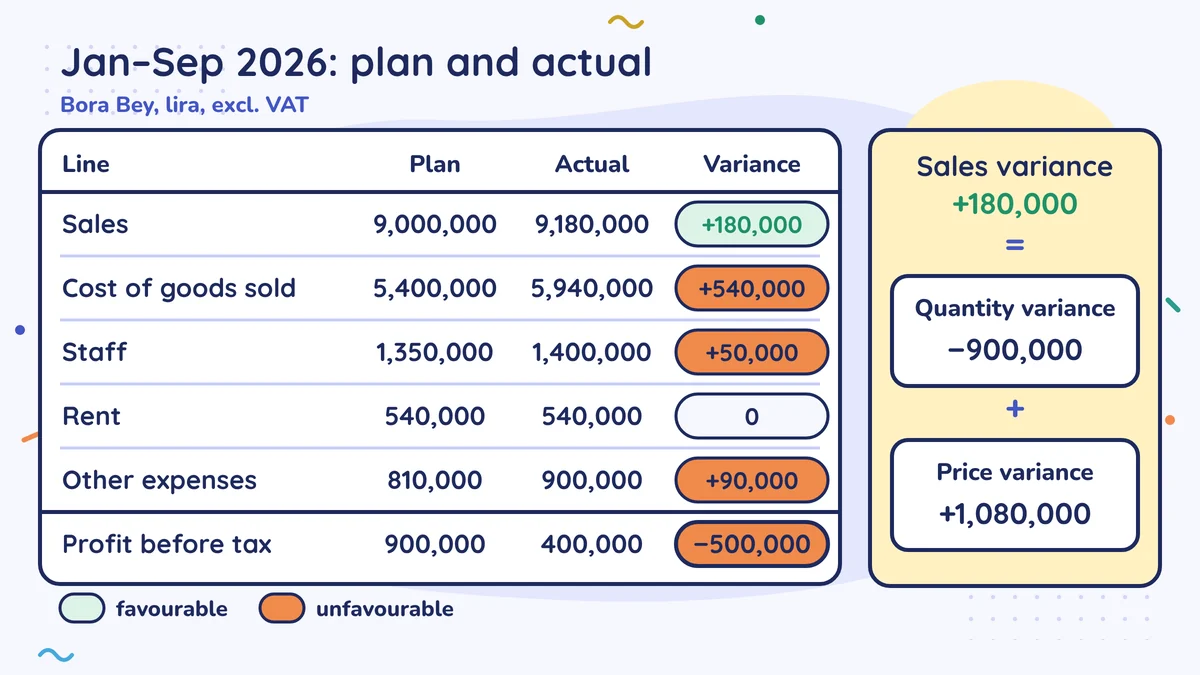
Bora Bey's limited company sells bicycles and also runs a repair workshop. In November last year he made a budget for 2026 for the first time: month by month he wrote down what he would sell and what he would spend on what. In October 2026 he got the actual figures for January–September from his mali müşavir (accountant) and put them side by side with the plan.
Turnover almost hit the plan. Profit, however, is less than half of the plan. Bora Bey's question: "If sales hit the plan, where did the money go?"

A wedding budget
A family talks to a wedding hall: 300 guests, 1,000 lira per person, 300,000 lira in total. On the wedding day the bill comes to 330,000 lira. The difference is 30,000 lira, but there can be two reasons for it: either the number of guests went up to 330, or the hall raised the price per person. In the first case the family is pleased that "more people came"; in the second, they have a word with the hall.
Comparing the budget with the actual figures is the same: finding the difference is not enough; you need to separate whether the difference comes from quantity or from price.
What is a budget, and how is it different from a cash plan?
A budget is writing a year's income statement (gelir tablosu) in advance, month by month: sales, cost of goods sold, staff, rent, other expenses and profit. The budget answers the question "how much will we earn this year?" The cash plan answers the question "what will be in the cash box in which week?" (The 13-week cash plan). The two complement each other.
How do you build a budget?
- Write last year's actual figures month by month. Your mali müşavir's statements and your own records are enough.
- Write sales as quantity and price. For example, "70 bicycles a month at 15,000 lira each". If you write a single turnover figure, you will not be able to find the reason for a difference later.
- Take the season into account. Bicycles sell in spring and summer; do not divide evenly across the months.
- Write the expenses one by one. The increase clause in the rental contract, salary increases, energy. Update figures tied to the year once they are announced; for example, the 2027 minimum wage had not been announced as of 12 October 2026, so write an assumption into the budget and add a note next to it. If you are a sole proprietorship, the money you set aside for yourself is not an expense; write it in the budget as a separate line below profit.
- Write an inflation assumption for prices. Note which rate you chose; you saw how to read lira figures in the lesson Comparing with last year.
Bora Bey's table
January–September 2026, excluding VAT, rounded figures:
| Line | Plan | Actual | Variance | Variance % |
|---|---|---|---|---|
| Sales | 9,000,000 | 9,180,000 | +180,000 | +2% |
| Cost of goods sold | 5,400,000 | 5,940,000 | +540,000 | +10% |
| Staff | 1,350,000 | 1,400,000 | +50,000 | +3.7% |
| Rent | 540,000 | 540,000 | 0 | 0% |
| Other expenses | 810,000 | 900,000 | +90,000 | +11.1% |
| Profit before tax | 900,000 | 400,000 | −500,000 | −55.6% |
On an income line, a positive variance counts as favourable; on an expense line, a positive variance counts as unfavourable. In Bora Bey's table, sales are favourable, while cost of goods sold and other expenses are unfavourable.
In figures for part of the year, the cost of goods sold depends on stock: the mali müşavir calculates the closing stock from the count or estimate you give. In a figure produced without counting the stock, the cost line can be misleading; if you see a big difference in cost, count the stock first.
Split the variance in two: quantity and price
Plan: 600 bicycles at 15,000 lira each. Actual: 540 bicycles at 17,000 lira each.
- Quantity variance (adet farkı): (540 − 600) × 15,000 = −900,000. 60 fewer bicycles were sold than planned.
- Price variance (fiyat farkı): (17,000 − 15,000) × 540 = +1,080,000. Each bicycle was sold for 2,000 lira more.
- Total: −900,000 + 1,080,000 = +180,000. Exactly the sales variance in the table.
The same split applies to cost: the plan was 9,000 lira purchase cost per bicycle, the actual was 11,000 lira. The purchase price rose by 22%, and Bora Bey covered this by raising his selling price by 2,000 lira. The margin left per bicycle did not change: 15,000 − 9,000 = 6,000 in the plan, and 17,000 − 11,000 = 6,000 lira in the actual figures. But 60 fewer bicycles were sold: 60 × 6,000 = 360,000 lira less gross profit. The remaining 140,000 lira came from the increase in staff and other expenses.
The answer to Bora Bey's "where did the money go" question: when he raised the price, he sold fewer bicycles, and expenses also crept up a little. Turnover looked on target because the higher price hid the lower quantity.
Don't look at every difference, look at the big ones
Investigating every difference on every line is a waste of time. Set yourself a threshold: for example, differences bigger than both 5% and 50,000 lira. In Bora Bey's table, cost and other expenses cross this threshold; the difference in staff (3.7% and 50,000 lira) exceeds neither.
For each big difference, ask three questions: Did it come from quantity or from price? Is it one-off or lasting? What will I do?
Update during the year
The budget is written once at the start of the year and is usually not changed during the year; the comparison is made against it. But one more column is opened next to it: the year-end forecast. Every three months, the actual figures for the months that have ended are added to a new estimate for the remaining months. Bora Bey's annual plan had 1,000,000 lira of profit: 900,000 for January–September and 100,000 for the last three months. His expectation for the last three months did not change. Adding the nine months' actual 400,000 to the last three months' estimate of 100,000 gives a year-end forecast of 500,000 lira; 500,000 lira less than the annual plan. This figure helps you see in advance the tax and cash to be paid at year end; provisional tax (geçici vergi), however, is calculated on the real profit in the books, not on the forecast.
In October Bora Bey started on the 2027 budget. This time he wrote quantity and price separately on the sales line, and asked his supplier for a written price list for purchase prices.
In one sentence
A budget is writing the year's income statement in advance; every month you compare it with the actual figures, split the big differences into quantity and price, and decide according to the cause.
Do this this week
Get this year's actual sales for January–September (your mali müşavir prepares the September figures for the third-period provisional tax return, whose last day is 17 November 2026; if they are not ready yet, start with January–June), your three biggest expense lines and your profit before tax from your mali müşavir or from your own records. Next to them, write a "what was I expecting at the start of the year?" column; if you have no budget, write the figure you had in mind. Mark the lines where the difference is bigger than 5% and 50,000 lira, and next to each one write "quantity or price?".
Common mistakes
- Writing sales as a single figure. If quantity and price are not written separately, you will not see a fall in quantity when turnover hits the plan.
- Correcting the budget to match the actual figures. The plan stays as it was at the start of the year; you write your new expectation in a separate year-end forecast column.
- Investigating every small difference. Set a threshold (for example, 5% and 50,000 lira); spend your time on the big, lasting differences.
Sources
- General Communiqué on the Application of the Accounting System No. 1: layout of the income statement (1 Sıra No'lu Muhasebe Sistemi Uygulama Genel Tebliği) (Alomaliye copy)
- TÜİK (Turkish Statistical Institute), Consumer Price Index bulletins (for the inflation assumption)
- TÜRMOB (Union of Chambers of Certified Public Accountants of Turkey)
Translated from the Turkish lesson. Last checked against Turkish rules: 13 October 2026. Not yet reviewed by a licensed accountant.
This is general information about Turkish rules, not financial, tax or legal advice. Rules change; check the date and the sources, and ask a licensed accountant (mali müşavir) about your own situation. Disclaimer