Keeping documents in order: which document goes where, and how long is it kept?
When documents sit in a box, finding one invoice takes an evening. A simple filing system that asks each document its month and direction, where electronic invoices go, the deadline for objecting to an invoice you receive, rent bank slips, and the retention period for tax: 5 years, and 10 in some cases.
Put each document first under the month it belongs to, then into one of the files for sales, purchases and expenses, bank and card, or employees; the rent contract and fixed-asset invoices go in a separate permanent file. For tax purposes, books and documents are kept for 5 years from the start of the year following the year they relate to (VUK art. 253); the period is longer in cases such as commercial books and documents, SGK documents and invoices for fixed assets subject to depreciation. If you are not sure, keep everything for at least 10 years; for assets expensed over a very long period, such as a building, the period is even longer.
Nermin Hanım the florist's shoebox
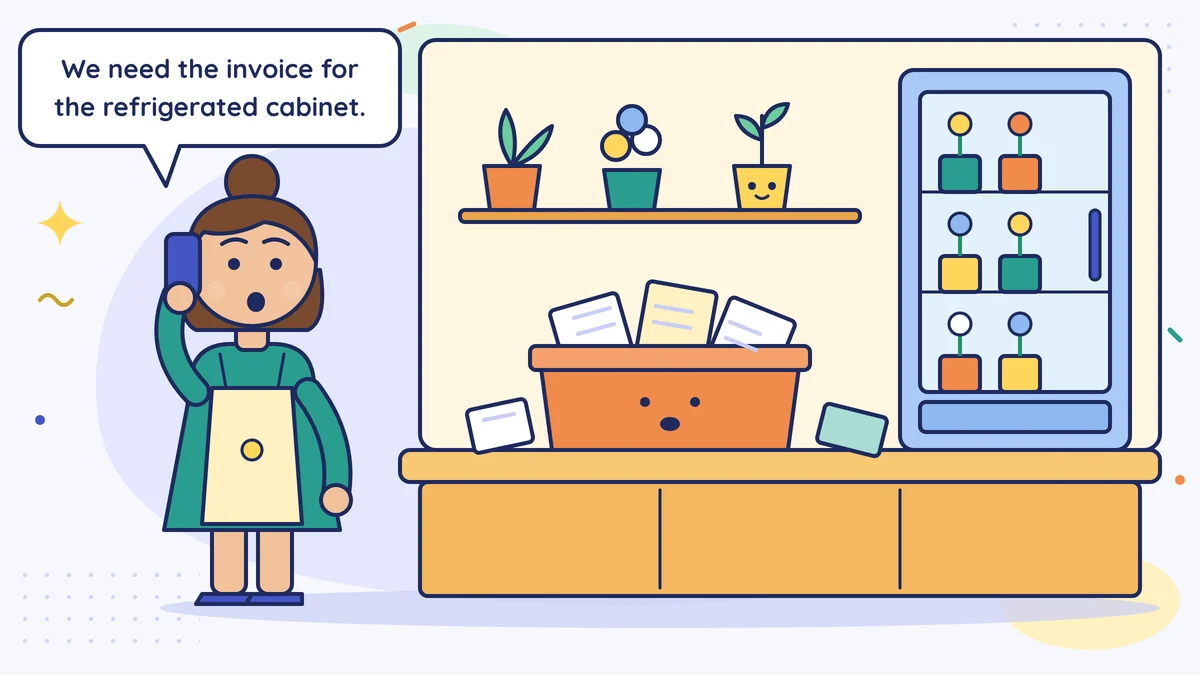
In Nermin Hanım's flower shop the documents sit in a shoebox. Invoices, receipts, bank slips, the rent contract, all in the same box. Last week her mali müşavir (accountant) called: "We need the invoice for the refrigerated cabinet you bought in March last year." Nermin Hanım spent an evening emptying the box. The invoice turned up, but the box never went back to how it was.
In this lesson we set up a simple system in which every document has an address, and we see how long to keep each document. We talked about why a document is essential in the lesson Invoices, receipts and documents; here we move on to keeping them in order.
Two questions, one address
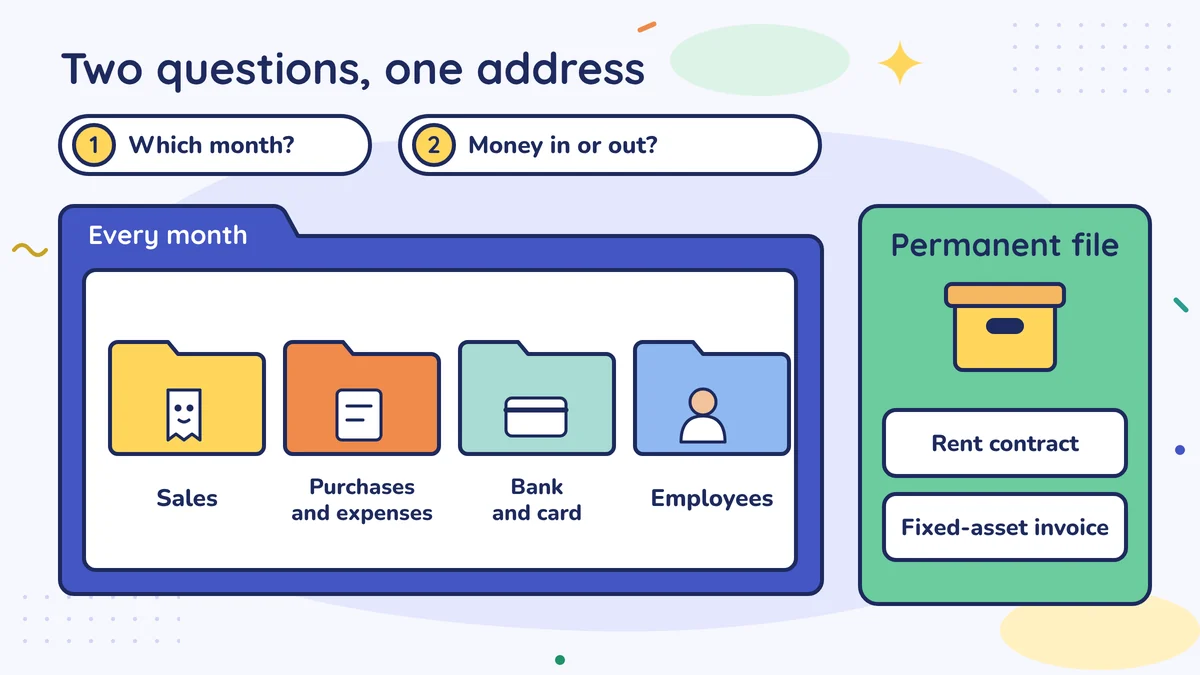
Ask every document two questions:
- Which month does it belong to? Look at the document's date.
- Did money come in or go out? Is it the document for something you sold, or something you bought?
These two answers are the document's address. One folder for the year, one section for each month, and four files inside each month:
- Sales: invoices you issued, cash register end-of-day reports.
- Purchases and expenses: invoices you received, receipts.
- Bank and card: bank slips, bank and credit card statements, POS statements.
- Employees: if you have any, payslips, wage bank slips, SGK papers.
And a permanent file that sits outside the months: the rent contract, the tax certificate, the start-of-business papers, fixed-asset invoices (things you will use for years, such as a cabinet, a machine or a vehicle). These don't change every month and are kept longer.
Which document goes where
| Document | Where | Watch out |
|---|---|---|
| Invoice you issued (e-Archive, e-Invoice, paper) | Month / Sales | Get the monthly list of electronic ones from the program or the portal |
| Cash register receipt and end-of-day report | Month / Sales | Put the end-of-day reports in order |
| Invoice you received | Month / Purchases and expenses | Is it issued in the business's name and tax number? |
| Small expense receipt | Month / Purchases and expenses | Thermal paper fades; take a photo, and keep the original too |
| Bank slip and statement | Month / Bank and card | The statement is taken once at the end of the month |
| Rent bank slip | Month / Bank and card | The contract itself is in the permanent file |
| Fixed-asset invoice | Permanent file | Put a copy in the month's purchases file too |
In this system Nermin Hanım's refrigerated cabinet invoice would have been in two places: a copy in that month's purchases file, the original in the permanent file. Her mali müşavir's question would have been answered in two minutes.
Electronic invoices also go somewhere
The e-Invoice (e-Fatura) and the e-Archive invoice (e-Arşiv fatura) are electronic documents. The ones you issue are kept in the program or portal you use. The ones sent to you arrive by e-mail or through the e-Invoice system.
- Save an invoice that arrives by e-mail on your computer or phone, in a folder with the same structure: year, month, purchases.
- Even if you print it on paper, don't delete the electronic version.
- If you change your invoicing program or the company you get the service from, ask in advance how you will reach your old invoices throughout the retention period.
A note if you are under simplified taxation or keep an operating account book: until the end of 2026 you can issue only small-amount invoices on paper; from 1 January 2027, whatever the amount, every invoice will be e-Archive (VUK General Communiqué No. 509, as amended by No. 589). If you still issue paper invoices, talk to your mali müşavir about which invoices can stay on paper and how to prepare for the switch.
Check an invoice you receive the week it arrives: are the amount, date and business name correct? If there is a mistake in a commercial invoice, object within 8 days from the day you received it; if you don't, you are deemed to have accepted its content (Turkish Commercial Code art. 21/2). Object in a way that leaves a trace (e-mail, KEP (registered electronic mail) or a notary); saying it on the phone can't be proven later. You saw how a wrong invoice is corrected in the lesson How to correct an invoice issued by mistake.
A separate note for rent
You must pay workplace rent through a bank or PTT, whatever the amount; this obligation belongs to both the tenant and the landlord (Income Tax General Communiqué Serial No. 328, Official Gazette 17.10.2024). Rent paid by hand has no proof. In the description on the bank slip, write which month's rent it is, for example "October 2026 workplace rent". The contract stays in the permanent file, and each month's bank slip in that month's bank file. If the landlord is an individual and you need to withhold tax from the rent, your mali müşavir calculates it; the day is in the lesson A month's calendar.
How long are they kept?
For tax purposes the basic rule is Tax Procedure Law art. 253: books and documents are kept for 5 years starting from the beginning of the calendar year following the year they relate to. An invoice for 2026 is kept for 5 years from 1 January 2027, that is, until the end of 2031. Whether it is electronic or paper doesn't change the period.
For some documents the period is longer:
- Commercial Code: Businesses that count as merchants (tacir), including all companies, keep their books and documents for 10 years (TTK art. 82).
- Employee documents: Documents and records relating to SGK are kept for 10 years (Law No. 5510 art. 86).
- Fixed-asset invoices: If the cost of a machine is expensed by spreading it over years (this is called depreciation), the year in which the last share is expensed can also be examined for 5 years from the start of the following year, and the examiner will ask for the invoice that share is based on. So the purchase invoice is kept for 5 more years from the start of the year after the spreading ends. This is not a separate article in the law; it is an established practice that follows from the tax statute of limitations (VUK art. 114). So the invoice for a cabinet expensed over 5 years stays in the file for about 10 years; for things expensed over a longer period, such as a building, the period is even longer.
- Prior-year loss: If a year's loss is carried forward to later years, that year's documents are also kept longer.
If you are not sure which of these applies to you, keeping everything for at least 10 years is the safest way; for a fixed-asset invoice, calculate the period as above. The details are in the article How many years are invoices and books kept? (in Turkish).
Close the folder at the end of the month
On the last working day of the month, look over the four files once. Is anything empty or looking incomplete? Ask for any invoice that hasn't arrived that week. Then write a short note on top of the file: "October 2026: 30 sales invoices, 18 purchase invoices, 25 receipts, 2 statements." Send this note and the documents to your mali müşavir. Discuss with your mali müşavir whether the originals will stay with them or with you; whoever keeps them, the obligation to retain them stays with you. The full monthly handover list is in the lesson What to send your mali müşavir every month.
Nermin Hanım's shelf
Nermin Hanım put the shoebox away and set a box with twelve compartments on the shelf. On her phone she also created folders with the same names. A month later her mali müşavir called again: "The invoice for the flowerpots in September?" Nermin Hanım found it without hanging up.
Do this this week
Prepare a file or envelope with four sections for this month's documents: sales, purchases and expenses, bank and card, employees. Create folders with the same names on your phone or computer and save invoices that arrive by e-mail there. Move the rent contract and fixed-asset invoices into a separate permanent file.
Common mistakes
- Keeping only a photo of a receipt. A photo helps you remember but doesn't replace the original; keep the original of the thermal receipt too.
- Printing an invoice that came by e-mail and deleting the electronic version. The electronic version of an electronic document must be kept too; when changing program or company, ask in advance how you will reach your old invoices.
- Not taking back the documents for past years when changing mali müşavir. The obligation to retain them stays with you. Take over the folders and electronic records held by the old mali müşavir against a list; the retention period is counted from the start of the year following the year the document relates to.
Sources
- Tax Procedure Law No. 213, art. 253 (duty of retention) and art. 114 (statute of limitations) (mevzuat.gov.tr)
- TÜRMOB: retention periods for books and documents under the VUK and special cases (depreciable assets, prior-year loss, SGK 10 years)
- VUK General Communiqué No. 509, as amended by No. 589: e-Archive invoice obligation regardless of amount for simplified taxation and the operating account basis from 1 January 2027 (Official Gazette 31.12.2025; Alomaliye)
- Turkish Commercial Code No. 6102, art. 21/2 (objecting to an invoice within 8 days) and art. 82 (10-year retention) (mevzuat.gov.tr)
- Social Insurance and General Health Insurance Law No. 5510, art. 86 (mevzuat.gov.tr)
- Income Tax General Communiqué Serial No. 328 (Official Gazette 17.10.2024, 32695; repealed Communiqué Serial No. 268): rent collections and payments to be made through a bank or PTT (Cott summary)
- Ekonomi Gazetesi: the obligation to document rent collection (Serial No. 328, repeal of No. 268)
Translated from the Turkish lesson. Last checked against Turkish rules: 12 October 2026. Not yet reviewed by a licensed accountant.
This is general information about Turkish rules, not financial, tax or legal advice. Rules change; check the date and the sources, and ask a licensed accountant (mali müşavir) about your own situation. Disclaimer