What do you send your mali müşavir every month? The monthly handover list
A mali müşavir (accountant) works with the documents that reach them. A document that doesn't arrive means work with no record. In this lesson we give the things you will hand over every month as a checklist, and we link to the detailed lesson on documents.
Every month you should send your mali müşavir (accountant) that month's sales invoices, the invoices and receipts you received, your bank transactions and your cash position. If you have employees, information that affects pay, such as leave, sick notes and advances, is also needed; and tell them about a new hire before the person starts work, without waiting for the end of the month. Sending in the first days of the month keeps you relaxed on tax return days.
The neighbourhood carrier's monthly bag
Mehmet Usta runs a small transport business. All month long, the fuel documents are in his pocket, the freight invoices in the glove box and the bank card statements on his phone. When the end of the month comes, he calls his mali müşavir (accountant): "I'll send whatever I have." The mali müşavir sighs, because they can't do the work with missing documents.
The solution is simple: fill in the same list every month. Do as Mehmet Usta does and prepare an envelope or a folder within the first three days of the month.
In this lesson we give the list. You can find in detail why each document is needed in the article Documents to give your mali müşavir. You can also read why documents matter in the lesson Invoices, receipts and documents: why everything needs a document.
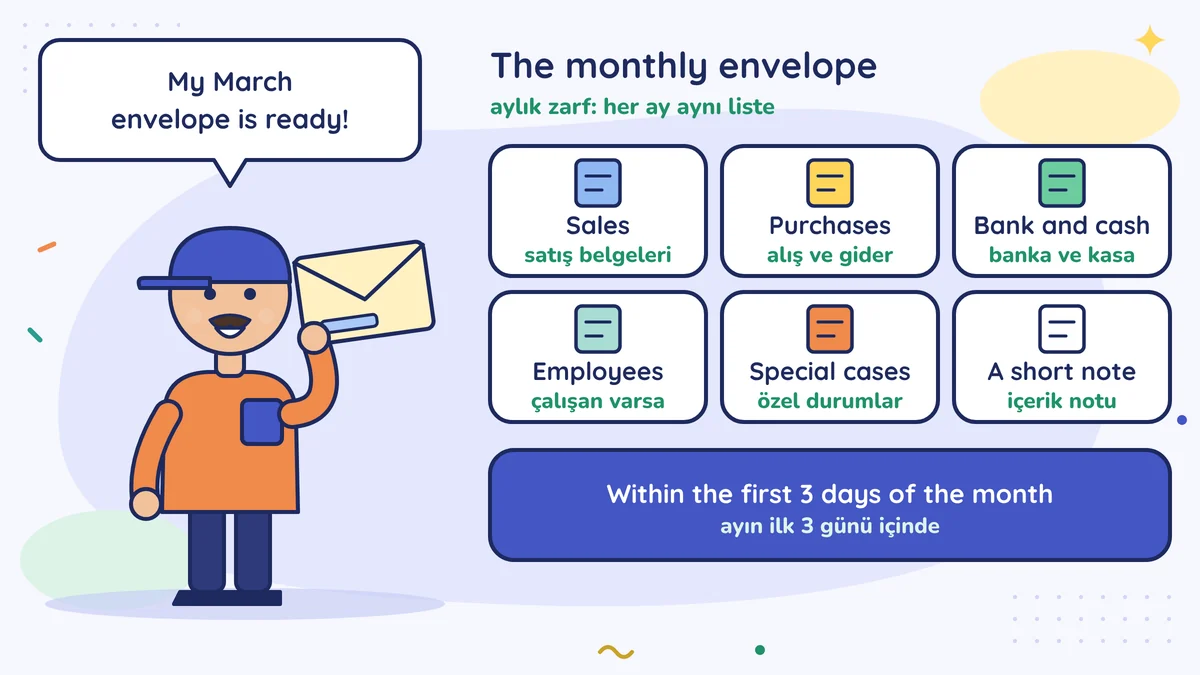
Monthly checklist
1. Sales documents
- All the invoices you issued (paper or electronic).
- If you had sales where you gave a receipt instead of an invoice, their documents. Every sale has a document: an invoice, a cash register receipt (yazar kasa fişi) or another document depending on your business. Ask your mali müşavir which one you need to give.
- If you use a cash register (yazar kasa, a payment recording device), that month's daily Z reports, that is, the end-of-day reports you take every evening when you close the till. Your mali müşavir may also ask for the month-end total report; ask which ones they want.
2. Purchase and expense documents
- All the invoices for goods or services you bought.
- Receipts for meals, parking and small purchases. You will see which of these can be recorded as an expense in the article Which expenses can be recorded?
- The documents for the fuel you bought for your work vehicle. Note: since 1 July 2025 it has been compulsory for a vehicle used for work to be fitted with a vehicle recognition chip (National Vehicle Recognition System, Ulusal Taşıt Tanıma Sistemi, UTTS for short) and for fuel to be bought with this chip (for vehicles using only LPG, since the start of 2026). The document for fuel bought without the chip is treated as non-existent for tax purposes: it cannot be recorded as an expense, and the VAT (KDV) you paid when buying it cannot be deducted from the VAT you collect from customers on sales. If your vehicle has no chip, or if you are under simplified taxation (basit usul), ask your mali müşavir straight away.
- The rent payment receipt (dekont). Workplace rent, whatever the amount, is paid through a bank or PTT (the post office). If the property owner is a private person and you are not under simplified taxation, you may need to deduct tax from the rent (withholding tax, stopaj); your mali müşavir calculates this.
- Electricity, water, phone and internet bills.
3. Bank and cash
- The month's bank account statement. If your business account is separate, add that, and if you have card sales (POS), add the POS account too. If you made business purchases with a credit card, send the card statement too.
- The cash position in the till: start of the month and end of the month.
- Lists of collections and payments: what you received from whom, what you paid to whom.
4. If you have employees
- If someone left the job, tell your mali müşavir straight away without waiting for the end of the month; the time limit for notifying SGK (social security) of the exit is short.
- If someone new is going to start, don't leave it for the monthly envelope: tell your mali müşavir at least one day before they start work. The start-of-employment notification to SGK must be made before the person starts work; if it is late, the penalty comes to you.
- Things that will affect pay, such as overtime, leave, sick notes and advances.
- If you paid salaries through the bank, the payment receipts. Since 1 July 2025, an employer with 3 or more employees has had to pay salaries through the bank.
- (You will find what to do when you have employees in the article When hiring your first employee.)
5. Special situations
- If you made a large purchase (a vehicle, a machine, furniture), point out the invoice separately.
- If you took out a loan or borrowed money, send the contract.
- If there is a return or discount from a customer, write down the reason.
How will you collect them during the month?
Collecting at the end of the month is hard; collecting during the month is easy. Set aside a box or an envelope in the shop; every receipt and invoice goes in there on the day it arrives. Also open a folder on your phone such as "March documents", and save the invoices that arrive by e-mail there. A receipt forgotten in your wallet is a lost receipt at the end of the month. Once a week, for example on Friday evening, look at the box for five minutes. If an invoice is missing, ask the seller for it that week; after the month has passed it gets harder to find.
When should you send them?
Set a date with your mali müşavir. Most businesses collect the documents in the first days of the month; that way there is time left before the tax return (beyanname) date. You can see the return days in the tax calendar article. If you leave the documents to the last day, the return may be late because of one missing document. Find out the consequences of being late by talking to your mali müşavir.
How should you send them?
Choose together with your mali müşavir: by hand, photos on WhatsApp, e-mail or a shared folder. Whichever it is, three rules apply:
- The documents must be readable (clear photos).
- The same month's documents must be together.
- Every sending must have a written note or list: "March documents, 18 invoices, 12 receipts, 1 statement."
Don't throw away the original of a paper document you photographed and sent. You need to keep the original for at least five years for tax purposes, and for some documents the period is longer (see the article Document retention period). If there is a tax inspection, the original document is asked for, not the photo.
Example: Mehmet Usta's March envelope
| What | How many | Note |
|---|---|---|
| Invoices he issued | 22 | He got the list from the program or the portal |
| Invoices he received | 9 | Fuel (bought with the vehicle recognition chip in the vehicle), tyres, maintenance |
| Receipts | 14 | Parking, meals, small purchases |
| Bank statement | 1 | Business account |
| Rent payment receipt | 1 | Garage rent |
| Special situation | 1 | He bought a new trailer and marked its invoice separately |
He also wrote a note on the envelope: "March: 22 sales invoices, 9 purchase invoices, 14 receipts, 1 statement, 1 rent payment receipt. Trailer invoice attached." The mali müşavir sees at first glance whether anything is missing.
What should you ask for back from your mali müşavir?
The handover is not one-way. After the return is filed, ask your mali müşavir for these: a copy of the returns filed, and the list of taxes and premiums to be paid with their last payment dates. The paper that shows the tax owed is called a tax assessment slip (tahakkuk fişi). Keep these month by month in a folder. That way you won't forget a payment, and if you change mali müşavir one day, you will have a complete file in your hand.
Your own small check
Before sending, look at this: is the number of invoices I issued the same as the number I am sending? Do the payments I see on the bank statement have documents? If there is a payment with no document, tell your mali müşavir separately. Asking is better than hiding.
Do this this week
Write the list in this lesson on a sheet of paper or on your phone. Put a "send documents to the mali müşavir" reminder in your calendar for the first three days of the month. Count how many documents you have this month and talk to your mali müşavir about how you will hand them over.
Common mistakes
- Leaving the documents to the end of the month. By the time a missing document is noticed, the tax return date is close.
- Sending receipts in bulk and mixed up. The mali müşavir can't sort out which belongs to which month; the work takes longer or mistakes happen.
- Not mentioning a payment with no document. Money going out that shows on the bank statement but has no document comes back to you later as a problem.
Sources
- TÜRMOB
- Tax Procedure Law (Vergi Usul Kanunu), Law No. 213 (provisions on the document system and bookkeeping)
- General Communiqué No. 1 on the Implementation of the National Vehicle Recognition System (1 Sıra No'lu Ulusal Taşıt Tanıma Sistemi Uygulama Genel Tebliği) (Ministry of Treasury and Finance, with amendments)
- The 3-employee threshold for paying wages through the bank, Official Gazette 04.06.2025 (EY circular)
- Income Tax General Communiqué No. 268 (268 Seri No'lu Gelir Vergisi Genel Tebliği): paying rent through a bank or PTT (Alomaliye)
- Social Insurance and General Health Insurance Law (Sosyal Sigortalar ve Genel Sağlık Sigortası Kanunu), Law No. 5510, art. 8 and 9 (start-of-employment and leaving notifications) (mevzuat.gov.tr)
Translated from the Turkish lesson. Last checked against Turkish rules: 7 October 2026. Not yet reviewed by a licensed accountant.
This is general information about Turkish rules, not financial, tax or legal advice. Rules change; check the date and the sources, and ask a licensed accountant (mali müşavir) about your own situation. Disclaimer