How do you correct an invoice issued by mistake?
You issued an invoice wrongly; you can't delete it, but you can correct it. There are three ways: cancellation within a short time, a return invoice if the goods came back, and a notary or KEP if there is a dispute. You see which one applies when through the example of Elif the florist.
An issued invoice is not deleted. If you notice the mistake straight away, you can cancel an e-Archive invoice (e-Arşiv) where you issued it; for a paper invoice you take back the original and write "İPTAL" (cancelled) on both copies; for an e-Invoice (e-Fatura), the buyer can reject a commercial invoice through the system within 8 days. If the goods came back, a return invoice is issued; if the time has passed, you choose the right document with your mali müşavir (accountant). Have your mali müşavir confirm the e-Archive cancellation period.
Elif the florist's wrong invoice
Elif Hanım is a florist. She sold a 4,000 lira flower arrangement to a company and issued the invoice. The next day she noticed: one digit in the company's tax number is wrong, and the amount was written as 400 instead of 4,000. Panic. "Can I just delete it?"
An electronic invoice is reported to the Revenue Administration (GİB) the moment it is issued, and a paper invoice stays in the invoice book (koçan); neither can be deleted. But there are ways to correct it. Which one applies depends on two things: the type of invoice and how much time has passed.
The flow below is the general logic. Have the periods and details confirmed by your mali müşavir (accountant) or by the help page of the portal or program you use. Sources give different numbers for the e-Archive (e-Arşiv) cancellation period; that is why we don't write that number of days here.
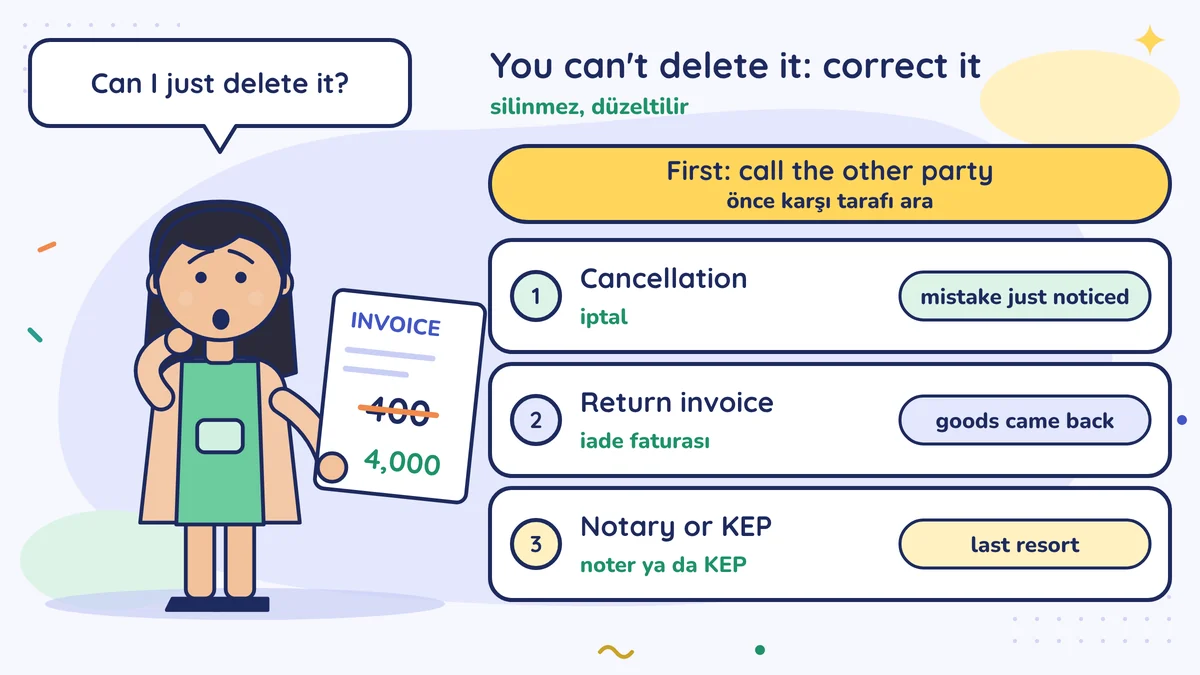
First rule: talk to the other party first
The moment you find a mistake, call the other party. If the invoice hasn't been recorded yet, the fastest solution is cancellation, because both parties' records are cleaned. The matter grows after days have passed: the buyer enters the invoice into their accounts and deducts its VAT (KDV), and then correcting it becomes a job for both parties.
Way 1: Cancellation (within a short time)
Cancellation is the way of treating the invoice as if it had never been issued. The period is short.
For an e-Archive invoice: You can cancel it through the portal or program you issued it from. The period is short and sources give different numbers of days. So do it on the day you see the mistake; don't try to push the limit.
For an e-Invoice (e-Fatura): Here it splits in two.
- Commercial invoice (ticari fatura): The buyer can reject the invoice through the system within 8 days (its basis is Turkish Commercial Code (Türk Ticaret Kanunu) 21/2: if no objection is made to an invoice within 8 days, its content is deemed accepted). If a rejection comes, the invoice is cancelled.
- Basic invoice (temel fatura): The buyer has no reject button in the system. To correct the mistake, cancellation through GİB's cancellation-objection portal (iptal-itiraz portalı) with the approval of both parties, or a return invoice, is needed.
For a paper invoice: Take the original of the wrong invoice back from the customer. Write "İPTAL" (cancelled) on the original and on the copy that stays with you, leave both in the invoice book, then issue the correct invoice. If the original stayed with the customer and you can't get it back, ask your mali müşavir.
Elif noticed the mistake the next day; because her invoice was e-Archive, she could cancel it straight away and issue the correct one. In short: if your own invoice is e-Archive, the cancel button is with you; if it is an e-Invoice, the work goes ahead together with the buyer.
Way 2: Return invoice (if the goods came back)
If the goods really came back and the cancellation period has passed, the invoice is not deleted; a return invoice (iade faturası) is issued against it. You can think of it as a document for the invoice amount in the opposite direction: the first invoice recorded the sale, the return invoice takes that sale back. Who issues which document varies with the situation. Generally the party sending the goods back issues the return invoice. If the buyer is not a taxpayer (a private person), the seller can use a different document, for example an expense voucher (gider pusulası). You can find the expense voucher in the glossary.
In Elif's example the goods went out, the company took the flowers; nothing came back. What was wrong was the amount and the number. If only a short time has passed, cancelling and issuing the correct one is cleanest. If the period has passed, things change: issuing a return invoice even though the goods didn't come back is debatable. If the amount was written too low, in practice an additional invoice (a price difference invoice, fiyat farkı faturası) is usually issued for the missing part. If the number is wrong, GİB's cancellation-objection route may be needed. Decide which document to issue together with your mali müşavir.
Way 3: Objection through a notary or KEP
If the party that received the invoice objects to its content and it can't be resolved through the system, the formal objection route remains. It is made through a notary, a registered letter with return receipt (iadeli taahhütlü mektup) or KEP (kayıtlı elektronik posta, registered electronic mail, that is, e-mail with official validity) (Turkish Commercial Code 18/3). This route is long and costly; think of it as a last resort. For most mistakes, calling the other party and issuing the right correction document is enough.
Decision table
| Situation | What is usually done |
|---|---|
| Paper invoice, mistake just noticed | Take the original back, write "İPTAL" on both copies, keep them, issue the correct one |
| e-Archive, mistake just noticed | Cancel from the portal or program, issue the correct invoice |
| e-Invoice (commercial), 8 days not over | The buyer sends a rejection, the invoice is cancelled, then a new one is issued |
| Period passed, goods did not come back | Choose the right document with your mali müşavir (price difference invoice or GİB's cancellation-objection route) |
| Goods came back | Return invoice |
| The other party doesn't accept | First talk, if needed a notary or KEP |
Keeping the mistake small
Elif later picked up this habit: before sending an invoice, she reads the screen out loud once. "Who am I invoicing? Is this the number? Is this the amount?" These ten seconds prevent half of the correction correspondence.
Also, if you invoice the same customer often, bring the number from saved details instead of typing it by hand. The chance of a mistake drops. You saw the general structure of an invoice in the previous lesson; for choosing the invoice type, see the lesson e-Invoice or e-Archive? On time limits, the article When is an invoice issued? also helps.
Why do you need to keep the wrong invoice?
Put the cancelled invoice, or the one corrected with a return, in your archive too. In a tax inspection the question "where is the invoice with this number?" may come up; the cancellation record is the answer. You can see how many years to keep it in the article Document retention period.
Do this this week
Take the last invoice you issued or are about to issue. Check three things one by one: the buyer's name, the number and the amount. If they are all correct, write "checked" on it. Also ask your mali müşavir, "If there is a wrong invoice, how many days is the cancellation period?" and write the answer down somewhere.
Common mistakes
- Seeing the mistake and waiting. The time is short; cancellation is easiest in the first days.
- Saying "I'll just delete it". An invoice that has entered the official system cannot be deleted; you need a cancellation or a correction document you choose with your mali müşavir.
- Throwing away the cancelled invoice. It must stay in the archive together with the cancellation record; it is asked about in an inspection.
Sources
- Allianz Trade, Disputed invoice: cancellation and objection guide (İhtilaflı fatura: iptal ve itiraz rehberi) (e-Invoice rejection 8 days, TTK 21/2)
- Alomaliye, reporting e-document cancellations, notices and warnings to GİB systems (TTK 18/3 and 21)
- Sovos, mistakes made in e-Invoice and e-Archive invoices and how to correct them
- Turkish Commercial Code (Türk Ticaret Kanunu), Law No. 6102, art. 18 and 21 (mevzuat.gov.tr)
- Tax Procedure Law (Vergi Usul Kanunu), Law No. 213, articles 229-232, the invoice (mevzuat.gov.tr)
- GİB e-Document portal (e-Belge portalı)
Translated from the Turkish lesson. Last checked against Turkish rules: 7 October 2026. Not yet reviewed by a licensed accountant.
This is general information about Turkish rules, not financial, tax or legal advice. Rules change; check the date and the sources, and ask a licensed accountant (mali müşavir) about your own situation. Disclaimer