How do you record the money coming in and going out every day?
There is money missing from the cash box, but nobody knows where it went. Starting from a day in the life of Burak Bey the coffee-house owner, we set up a simple table that records cash, bank and card sales in five minutes; we look at the end-of-day count, the document column and the bank rule for large payments.
Every day, write the money coming in and going out of the cash box, the bank and the card into a table with the date, description, place, amount and document; in the evening count the cash and compare it with the figure in the table, and look at the bank once a week. This table is not the official book, it is your compass; your mali müşavir (accountant) keeps the official books. In 2026, business-related collections and payments of more than 30,000 TL (whether the other party is another business, a company shareholder or a customer) must be made through a bank, a payment institution or PTT.
The missing 2,000 lira of Burak Bey the coffee-house owner
Burak Bey runs a small coffee house in the market. On Friday evening he counted the cash box: 2,000 lira missing. He thought about what had happened during the week. Milk came, coffee beans came, one day he paid the child's school bus fee from the cash box, another day an advance to the apprentice. He doesn't remember which one was how much.
The money hadn't disappeared. It hadn't been written down. In this lesson we see how to write down the money coming in and going out every day, in five minutes.

Why every day?
You remember today's spending today. A week later you remember half of it, a month later none of it. Sitting down to write once a week means trusting your memory. Writing every day is a five-minute habit.
What you write is not the official book. Your mali müşavir (accountant) keeps the official books (the operating account book, the books on a balance sheet basis, or, under simplified taxation, the Defter Beyan Sistemi (Book and Declaration System) record). Your table is your own compass: what came in, what went out, where the money is. At the end of the month your mali müşavir can also look at this table and find a missing document more easily.
Money comes in and goes out in three places
Cash box. Cash received and paid by hand. This is where money gets lost most, because it leaves no trace.
Bank. Transfers, EFT, automatic payment orders. The bank already records every movement; your job is to write next to each line the answer to the question "what is this?"
Card (POS). The customer pays by card today; the money reaches your account a few days later, with the bank commission deducted. So write a card sale on the day of the sale, and check separately the day it reaches the account.
We talked about why cash, bank and your own pocket are kept separate in the lesson Cash, bank and the money in your pocket. Here we turn that separation into each day's record.
A simple table is enough
Open a notebook or a table on your phone. Six columns are enough: date, description, from or to where (cash, bank, card), in, out, document.
Burak Bey's Tuesday (because all the lines have the same date, we left out the date column here):
| Description | Place | In | Out | Document |
|---|---|---|---|---|
| Cash at start of day | Cash | 500 | Previous day's count | |
| Cash sales | Cash | 3,000 | End-of-day report | |
| Card sales | Card | 5,000 | POS end-of-day | |
| Payment to the milkman | Cash | 1,500 | Invoice | |
| Napkins and cups | Bank | 400 | Invoice | |
| Money he took for himself | Cash | 1,000 | Note: personal |
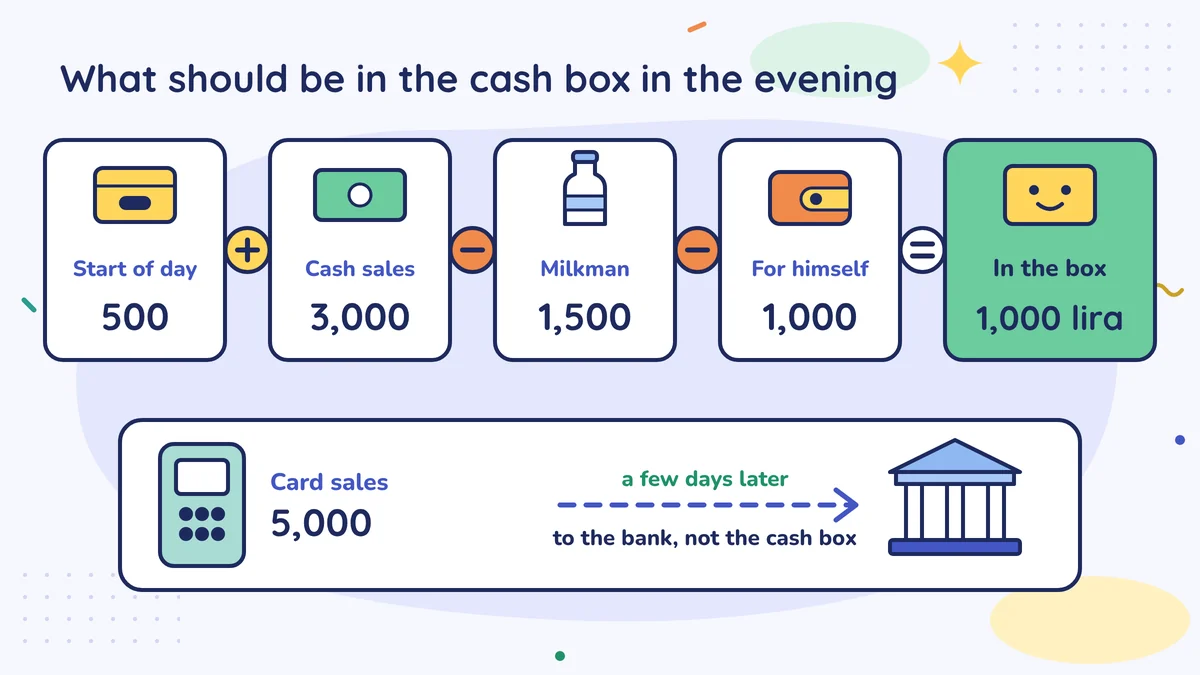
What should be in the cash box in the evening: 500 + 3,000 − 1,500 − 1,000 = 1,000 lira. Burak Bey counts the drawer; if there are 1,000 lira, the day is closed.
Note two lines. The card sales were written as 5,000 lira, but this money is not in the cash box; a few days later it will reach the bank with the commission deducted. Burak Bey's business is a sole proprietorship; the 1,000 lira he took for himself is not an expense. This is called "owner's drawings" (özel çekiş); you write it separately so that the cash balances and your mali müşavir doesn't take it for an expense. In a limited company the rule is different; both are in the third lesson of this module.
End of day: count, write, compare
- Count the cash in the drawer.
- Compare it with the "should be in the cash box in the evening" figure in the table.
- If there is a difference, look for it today: an unrecorded payment, change not given, a receipt left in the wallet.
If you can't find the difference, don't hide it. Write a line in the table called "count difference". A hidden difference grows by the end of the month; a recorded difference stays as a question and is usually found later.
For the bank and the card you don't need to look every day. Once a week, for example on Monday morning, open the bank's transaction list and compare it with your table. Check that day too whether the card sales have reached the bank.
Every line should have a document
The last column of the table, the document column, is half the job. Invoice, receipt, bank slip, end-of-day report. An expense without a document cannot be recorded; you saw this in the lesson Invoices, receipts and documents. Complete any line with an empty document column that same week: ask the seller for the invoice.
Where to put the documents and how long to keep them is in the second lesson of this module.
Large payments go through the bank
Business-related collections and payments of more than 30,000 TL must be made through intermediary institutions such as a bank, a payment institution or PTT, and proven with their documents. The other party may be another business, a shareholder of the company or a customer who is not a taxpayer; the rule applies to all of them. This limit has been 30,000 TL since 30 November 2024 and is still in force in 2026 (VUK General Communiqué No. 459, last amended by Communiqué No. 575).
Splitting the amount into parts doesn't change the rule. Transactions with the same person on the same day are added together. For payment in instalments, the total amount of the transaction is what counts; if the total is more than 30,000 TL, each instalment, even a small one, goes through the bank. If you don't comply, a special irregularity penalty of 10 percent of the transaction amount can be imposed on each of the two parties separately, and the penalty also has a minimum (VUK repeated art. 355). The bank slip proves the payment but doesn't replace the invoice; you still issue or receive the invoice. The limit may change in future; ask your mali müşavir before a large payment.
The easiest thing is to pay suppliers through the bank, whatever the amount. A bank transaction is a record and a proof in itself.
There is a separate rule for the money you pay your employee: since 1 July 2025, an employer with 3 or more employees must pay wages into the employee's bank account. If this applies to you, don't pay wages by hand from the cash box; it is also safest to send advances, like the one Burak Bey gave the apprentice, through the bank.
The total in the cash box is not profit
At the end of the table you may say "this week 20,000 came in, 12,000 went out, 8,000 is left". This shows you where the money went. But the 8,000 lira is not your profit. It may include VAT you collected from customers; rent whose invoice has arrived but which hasn't been paid may not be in it; a credit sale whose money hasn't come in may not appear at all. We explained in detail why cash and profit differ in the lesson Profit but no cash.
Burak Bey's second Friday
For a week Burak Bey set aside five minutes every evening. At the Friday count the cash box came out 300 lira over. He looked at the table: on Tuesday he had received a customer's debt in cash and forgotten to write it down. He added the line, and the cash balanced.
Last week's 2,000 lira turned up too: it had been paid to the milkman by hand, and the invoice had stayed in the wallet. That invoice is now in the document column as well.
Do this this week
This week, set aside five minutes every evening at closing time. Open the six-column table (date, description, cash/bank/card, in, out, document), write the day's movements and count the cash. On Friday evening mark the lines whose document column is empty; on Monday ask for those documents.
Common mistakes
- Not counting the cash every evening. Finding the reason for a week's difference is much harder than finding the reason for a day's.
- Not writing down the money you take for yourself, or writing it as an expense. In a sole proprietorship this is owner's drawings; it is written as a separate line and not counted as an expense.
- Recording a card sale on the day it reaches the bank. The sale happens on the day the customer pays; it reaches the bank a few days later with the commission deducted. Check the two separately.
Sources
- VUK General Communiqué No. 459, as amended by Communiqué No. 575: 30,000 TL limit for collections and payments (Cott summary, Official Gazette 30.11.2024)
- KPMG: VUK General Communiqué No. 575 (Official Gazette 30.11.2024, 32738), documentation limit raised from 7,000 TL to 30,000 TL
- VUK General Communiqué No. 459, current text: scope, same-day and partial payments (Alomaliye)
- Ekonomi Gazetesi: the obligation to make collections and payments through financial institutions, scope and penalty
- Tax Procedure Law No. 213, repeated art. 257 and repeated art. 355 (mevzuat.gov.tr)
- Payment of wages and similar payments through banks: employers with 3 or more employees, since 1 July 2025 (Official Gazette 04.06.2025; Cott summary)
- Income Tax Law No. 193, art. 41/1 (money withdrawn from the business is not recorded as an expense) (mevzuat.gov.tr)
Translated from the Turkish lesson. Last checked against Turkish rules: 12 October 2026. Not yet reviewed by a licensed accountant.
This is general information about Turkish rules, not financial, tax or legal advice. Rules change; check the date and the sources, and ask a licensed accountant (mali müşavir) about your own situation. Disclaimer