The VAT return month: your side
Your mali müşavir files the VAT return, but everything that goes into it passes through your hands. Collecting invoices all month, catching an invoice you forgot to issue before seven days are up, the month-end package, VAT carried forward, and seeing the VAT to pay in the middle of the month.
In most businesses the VAT return is filed by the mali müşavir (accountant); your job is to make sure all the invoices you issued and received during the month reach them in full. An invoice is issued within seven days at the latest from the delivery or service, and the VAT on work done at the end of the month belongs, as a rule, to the month you did the work. In the middle of the month you can estimate the amount to pay in advance by subtracting the VAT on the invoices you received from the VAT on the invoices you issued.
Kadir Usta the mechanic's forgotten invoice
On the evening of 30 September Kadir Usta finished the gearbox of a minibus. The customer transferred 24,000 lira. Kadir Usta was tired: "I'll issue the invoice tomorrow." Tomorrow came and went. On 6 October his mali müşavir (accountant) called: "I'm preparing the September VAT. 24,000 lira came into your bank account; where is its invoice?"
Kadir Usta was lucky; the seven days were not up yet. In this lesson we see why, even though the mali müşavir files the VAT return, the real work of the month is on your side.
We explained what VAT is, and output and deductible VAT, in the article What is VAT? (in Turkish). Here we turn that knowledge into the work within the month.
First a check: under simplified taxation you do not collect VAT on sales and you do not file a VAT return. The VAT part of this lesson is for VAT taxpayers. The habit of issuing and collecting invoices on time, however, applies to everyone.

The VAT month is like a laundry basket
At home the laundry basket fills up all month. A shirt that doesn't go into the basket doesn't go into the machine either. Every invoice you issue and receive during the month goes into that basket. At the end of the month the mali müşavir runs the machine: the VAT you paid on purchases is deducted from the VAT you collected on sales. An invoice that doesn't go into the basket doesn't go into the calculation either.
During the month: three boxes
- Invoices you issued. e-Invoices and e-Archive invoices stay in the system, and your mali müşavir sees most of them there. If you have paper invoices or cash register end-of-day reports, collect them separately.
- Invoices you received. Materials, rent, electricity, phone. For the VAT you paid on purchases to be deductible, the invoice must be issued in the business's name and must have reached your mali müşavir. Not every purchase's VAT can be deducted, and for a late invoice the right to deduct is limited by time; the details are in the article What is VAT? (in Turkish). Ask your mali müşavir about any purchase you are unsure of.
- Money that came into the bank but has no invoice. Like Kadir Usta's 24,000 lira. Look at your bank transactions once a week; catch any collection without an invoice that same week.
The full list of which documents go to the mali müşavir is in the lesson What to send your mali müşavir every month.
The invoice not issued: the seven-day rule
Under Tax Procedure Law art. 231/5, an invoice is issued within seven days at the latest from the day the goods were delivered or the service was performed. An invoice not issued within this period is considered never to have been issued, and is the subject of a separate penalty.
Watch out at the end of the month: even if you issue the invoice for work you finished on 30 September on 3 October, the VAT belongs, as a rule, to the month you did the work, that is, September (VAT Law art. 10). Tell your mali müşavir about work finished in the last days of the month together with the September documents. The easiest thing is to leave no work without an invoice on the last working day of the month. You saw how to issue an invoice in Issue your first invoice, and how to correct one issued by mistake in the lesson Invoice issued by mistake.
End of the month: the package that goes to the mali müşavir
In the first days of the month, send your mali müşavir these: the invoices you issued, including paper ones, the invoices you received, bank and card sales (POS) statements, and the reason for any returns and discounts. Add a short note: "September: 40 sales invoices, 25 purchase invoices, 2 returns. The invoice for the gearbox job on 30 September was issued on 6 October." This note shortens the time the mali müşavir would spend looking for something missing.
VAT carried forward, briefly
In some months the VAT you paid on purchases is more than you collected on sales; for example, the month you bought a big piece of equipment. That month you pay no VAT. The difference is carried forward to the next month and deducted from the VAT of the coming months; as a rule it is not paid back in cash. If you see a figure called "VAT carried forward to the next period" on the return, this is an amount to be deducted later. Ask your mali müşavir for this figure every month and write it down; it helps when you make next month's estimate.
Seeing the VAT to pay in advance
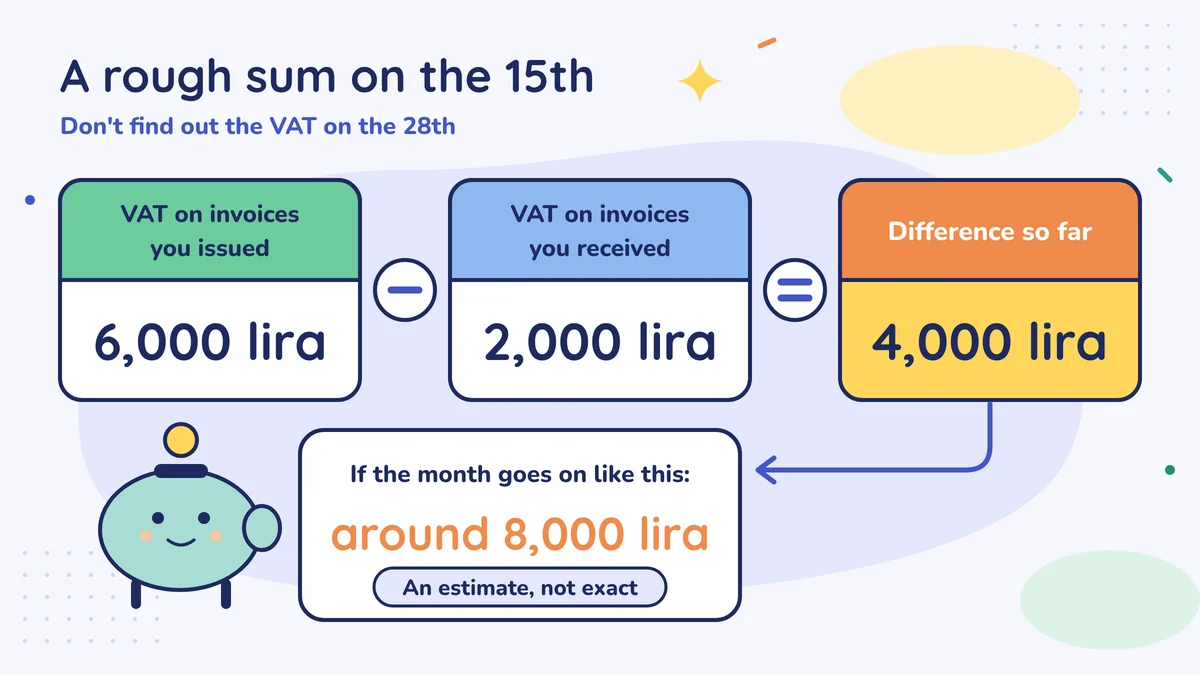
You don't have to find out the VAT on the 28th of the month. Do a rough calculation in the middle of the month:
| Up to the 15th of the month | Amount |
|---|---|
| VAT on invoices you issued | 6,000 lira |
| VAT on invoices you received | 2,000 lira |
| Difference so far | 4,000 lira |
| VAT carried forward from the previous month | 0 lira |
Half the month has gone and a 4,000 lira difference has built up. If the month goes on like this, it will come to around 8,000 lira at the end. This estimate is not exact, because the mali müşavir may not deduct the VAT on some purchases. But it means you won't be surprised on the 28th.
You built the habit of putting money aside in the lesson Setting money aside for tax. What you do now is compare the money in your savings box with this estimate in the middle of the month. If the box is short, make up the difference before the month ends. To calculate the VAT on an invoice quickly, the VAT calculator (in Turkish) is useful.
Kadir Usta issued the invoice for the gearbox job on 6 October, before the seventh day was up; the VAT went into the September return. The next month he pinned a sheet of paper to the board in the workshop: "Before the month ends: is there any job without an invoice?"
Do this this week
Add up separately the VAT on the invoices you issued and received up to the 15th of this month, find the difference and multiply it by two. Compare the estimated tax you get with the money in your tax savings box. Also look at your bank transactions: if there is a collection without an invoice, issue its invoice before seven days are up.
Common mistakes
- Holding back the invoice for end-of-month work, saying "I'll issue it later". If an invoice is not issued within seven days, it is considered never to have been issued. And since the VAT belongs, as a rule, to the month you did the work, your mali müşavir must know about this work in that month's return.
- Sending purchase invoices late. The VAT on a purchase invoice that has not reached the mali müşavir cannot be deducted that month; if it is very late, the right to deduct can be lost because of the time limit.
- Finding out the VAT on the 28th. Not making a rough estimate in the middle of the month means not having the money ready at the end of the month.
Sources
- Tax Procedure Law No. 213, art. 231/5 (issuing the invoice within seven days) (mevzuat.gov.tr)
- Value Added Tax Law No. 3065, art. 10 (taxable event), art. 17/4-a (simplified taxation exemption), art. 29 (deduction) (mevzuat.gov.tr)
- GİB circular VUK-149/2022-12: extension of the VAT return to the 28th of the month (Alomaliye copy)
- GİB, Return filing and payment periods (PDF)
- GİB Tax Calendar
Translated from the Turkish lesson. Last checked against Turkish rules: 12 October 2026. Not yet reviewed by a licensed accountant.
This is general information about Turkish rules, not financial, tax or legal advice. Rules change; check the date and the sources, and ask a licensed accountant (mali müşavir) about your own situation. Disclaimer