Mali müşavir fees and the contract
A mali müşavir's (accountant's) fee is not a random number: there is a minimum fee schedule, and the fee is tied to a written contract. In this lesson we see how the fee is set, what to look for in the contract and which jobs may fall outside the scope.
Every year a minimum fee schedule (asgari ücret tarifesi) for mali müşavirs (accountants), prepared by TÜRMOB and approved by the Ministry, is published in the Official Gazette (Resmî Gazete); a mali müşavir cannot work for a fee below this schedule. The fee is set by a written contract, and the contract clearly states which work it covers. A separate fee may be charged for work not in the contract; so read the scope carefully.
Like the price board at the barber's
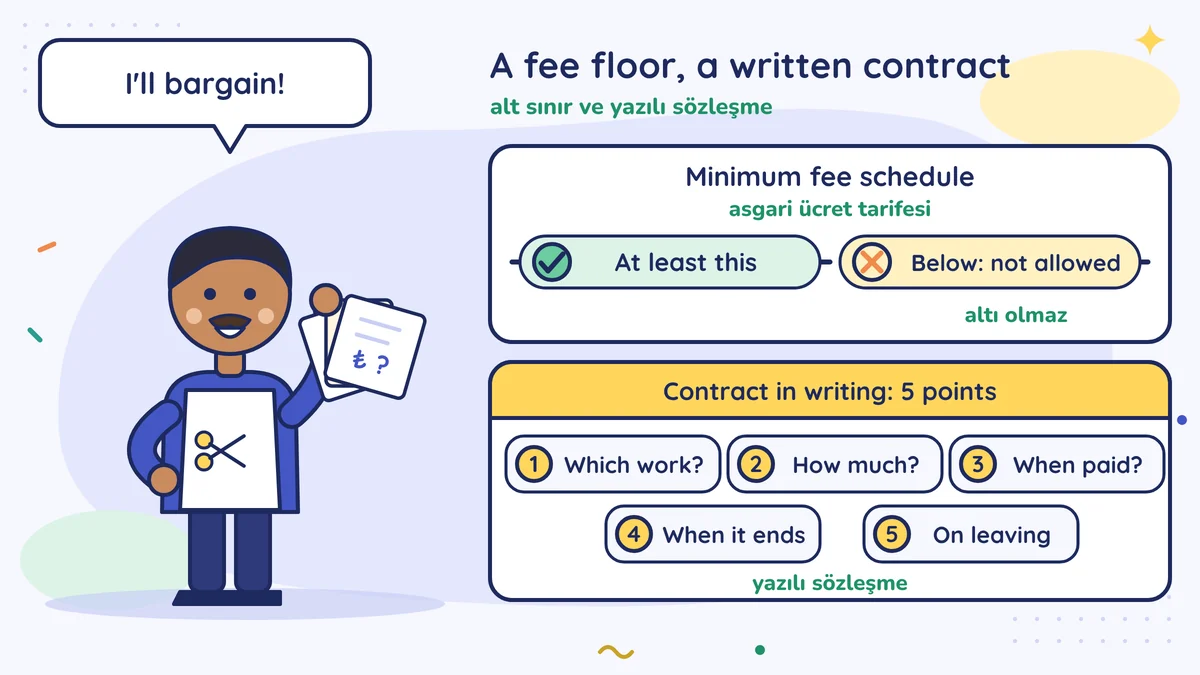
Hasan Abi opened a barber's shop. He talked to three mali müşavirs (accountants) about the monthly accounting work. All three named different prices. Hasan Abi thought, "I'll bargain." There is a detail here: at the barber's you set the price, but in accounting there is a lower limit. A mali müşavir cannot work for a fee below the lower limit in the official schedule.
What is the minimum fee schedule?
Every year a minimum fee schedule (asgari ücret tarifesi), that is, an "at least this much" list, comes out for mali müşavir services. The schedule is prepared by the professional chambers and their union, TÜRMOB; the Ministry of Treasury and Finance (Hazine ve Maliye Bakanlığı) approves it and it is published in the Official Gazette (Resmî Gazete). The 2026 schedule came out in the Official Gazette dated 17 December 2025 and has been in force since 1 January 2026. Its basis is article 46 of Law No. 3568 and the regulation that sets out the principles of mali müşavir fees.
The schedule has lower limits by type of work: keeping books, preparing tax returns, set-up procedures and so on. The figures change according to the type of business and the size of the work. We don't give figures in this lesson, because your mali müşavir should tell you which line applies to your business. Just know this: a mali müşavir who makes an offer below the schedule is not giving you an advantage, they are breaking the rule. Under the regulation, working below the schedule is forbidden and calls for a disciplinary penalty.
The schedule says "at least this much". You can agree on a higher fee. What you will pay is the figure written in the contract you sign.
A written contract is a must
The fee agreement is made in writing. The regulation requires the fee contract to be in writing and to contain a specific figure; so a verbal agreement is against the rules for the mali müşavir too. The contract should state:
- Which work? Every job one by one, such as keeping books, the monthly VAT (KDV) return and the yearly income tax return.
- How much? A monthly or yearly figure, and whether VAT is included or not.
- When is it paid? On which day of each month.
- When does it end? The length of the contract and how many days' notice you will give if you want to leave early. Have this written clearly: under the regulation, if you end the contract early when the mali müşavir is not at fault, the mali müşavir can claim the whole agreed fee. If the terms for leaving are written from the start, the chance of an argument later is lower.
- What happens when you leave? The handover of records and documents.
What does the fee cover, and what not?
The fee in the contract covers only the work written in it. Work that comes up later is subject to a separate fee. For example, if the contract says "monthly VAT return", the SGK (social security) procedures that come up when you hire an employee may not be included in that fee.
There is also this: under the regulation, costs related to the work, such as taxes, fees (harç) and the mali müşavir's travel costs, belong to the business owner. So the mali müşavir does not pay Hasan Abi's tax out of their own pocket; the fee is one thing, the tax is another.
Payment of the fee also has its rule: under the regulation, the fee is in principle paid in advance, but the contract can state that it will be paid in instalments as the work is done. Most mali müşavirs take a monthly fee.
For the fee they receive, the mali müşavir issues you a self-employment receipt (serbest meslek makbuzu) (today most are electronic). One more detail: if you are not under simplified taxation (basit usul), you need to deduct 20% income tax from the VAT-exclusive part of the fee you pay and pay it to the tax office (vergi dairesi) on the mali müşavir's behalf (Income Tax Law (Gelir Vergisi Kanunu) art. 94). This is called withholding tax (stopaj), that is, tax deducted while making a payment. If you are under simplified taxation, this deduction is not made. If your mali müşavir works as a company, they issue an invoice, not a receipt; then no deduction is made either. Your mali müşavir usually does the calculation; you just need to know why you don't pay the full amount on the receipt.
What will you watch out for in the contract?
| What it says | What the problem is |
|---|---|
| "All necessary work" | Vague; it isn't clear which work is included and which is left out |
| No fee figure | They can name whatever figure they want later |
| No terms for leaving | Your records can be held hostage when you leave |
| Terms such as a "partnership share" | Under the regulation, a mali müşavir cannot be given a partnership share in return for the fee; if there is such a clause, don't sign |
Work outside the scope
Examples of work that may fall outside the scope: a change of workplace, changing the company type, incentive applications, correction work for past years, and correspondence that requires going to and from public offices. If the contract says "charged separately" for these, that is normal. As long as it is in writing and the price is told in advance.
Signing day
The contract is made in two copies; one stays with you, one with the mali müşavir. The mali müşavir asks you for one more signature: the "e-return intermediary and responsibility contract" (e-beyanname aracılık ve sorumluluk sözleşmesi), so that they can file your tax returns online on your behalf. This is the rule, don't be surprised; the mali müşavir enters it into the tax office's system. Before signing, read it once from start to finish together with the mali müşavir. Ask about any word you don't understand; asking "what does this clause mean?" is nothing to be embarrassed about.
Also look at how the fee will change each year. Because the schedule is published again every year, fees are usually updated at the start of the year. If the contract doesn't say how this will be done, the question "what is our fee this year?" can turn into an argument in January. A single sentence such as "The new year's fee is notified in writing in January" ends this argument from the start.
Also keep a photo of the contract you signed on your phone. In a disagreement, that is the first place you will look.
What did Hasan Abi do?
He put the three offers into the same template: which work is included, what the fee is, and how the price is given if work outside the scope comes up. When he saw the answers side by side, he understood which offer was really cheap and which was just incomplete.
The offer with the lowest figure did not include payroll and the SGK work related to employees. Because Hasan Abi was thinking of taking on an apprentice in a few months, he would have to pay for this work separately. When he did the sums, that offer turned out to be the most expensive. Hasan Abi signed a contract with the mali müşavir who wrote the scope most clearly.
Do this this week
Ask your mali müşavir (or the mali müşavir who gave you an offer) for a draft contract. Find each of the 5 items in this lesson in the draft and put a mark next to it. Ask the mali müşavir about any missing item. Before signing the contract, also ask in writing for the fees for work outside the scope.
Common mistakes
- Starting with a verbal agreement. Later the argument "that job wasn't included in the fee" comes up, and you have no proof in your hand.
- Signing without reading the scope. The fee figure looks good, but if the scope is narrow, extra invoices come later.
- Thinking an offer below the schedule is a bargain. A fee below the schedule is against the rules; such an offer can put both you and your mali müşavir in a difficult position.
Sources
- 2026 Minimum Fee Schedule for SM, SMMM and YMM (2026 Yılı SM, SMMM ve YMM Asgari Ücret Tarifesi) (Official Gazette, 17.12.2025, issue 33110; summary on Alomaliye)
- Regulation on the Principles of Fees of Independent Accountants, SMMM and YMM (Serbest Muhasebeci, SMMM ve YMM Ücretlerinin Esasları Hakkında Yönetmelik), art. 11, 12, 13, 17, 20, 21 (TÜRMOB)
- Law No. 3568 (3568 sayılı Kanun) (mevzuat.gov.tr)
- Income Tax Law (Gelir Vergisi Kanunu), Law No. 193, art. 94 (tax withholding) (mevzuat.gov.tr)
- E-return intermediary and responsibility contract (e-beyanname aracılık ve sorumluluk sözleşmesi), VUK General Communiqué No. 340 (Alomaliye)
Translated from the Turkish lesson. Last checked against Turkish rules: 7 October 2026. Not yet reviewed by a licensed accountant.
This is general information about Turkish rules, not financial, tax or legal advice. Rules change; check the date and the sources, and ask a licensed accountant (mali müşavir) about your own situation. Disclaimer