What is provisional tax, and who pays it?
When news of "provisional tax is due" arrives before the year is over, the first question is: a tax on what? Provisional tax is an advance part of the annual tax, paid every three months. Who pays it, who does not, and the 2026 rates: 15% for a sole proprietorship, 25% for a company.
Provisional tax (geçici vergi) is the part of the income tax or corporate tax due at the end of the year that is paid in advance every three months during the year; at the end of the year it is deducted from the actual tax, so you do not pay the same money twice. Sole proprietorships under real taxation, self-employed professionals and companies pay it; tradespeople under simplified taxation do not. In 2026 the rate is 15% for sole proprietorships and self-employed professionals, and generally 25% for companies.
Hasan Abi the photographer's deposit
The rules described in this lesson are those of Turkish law.
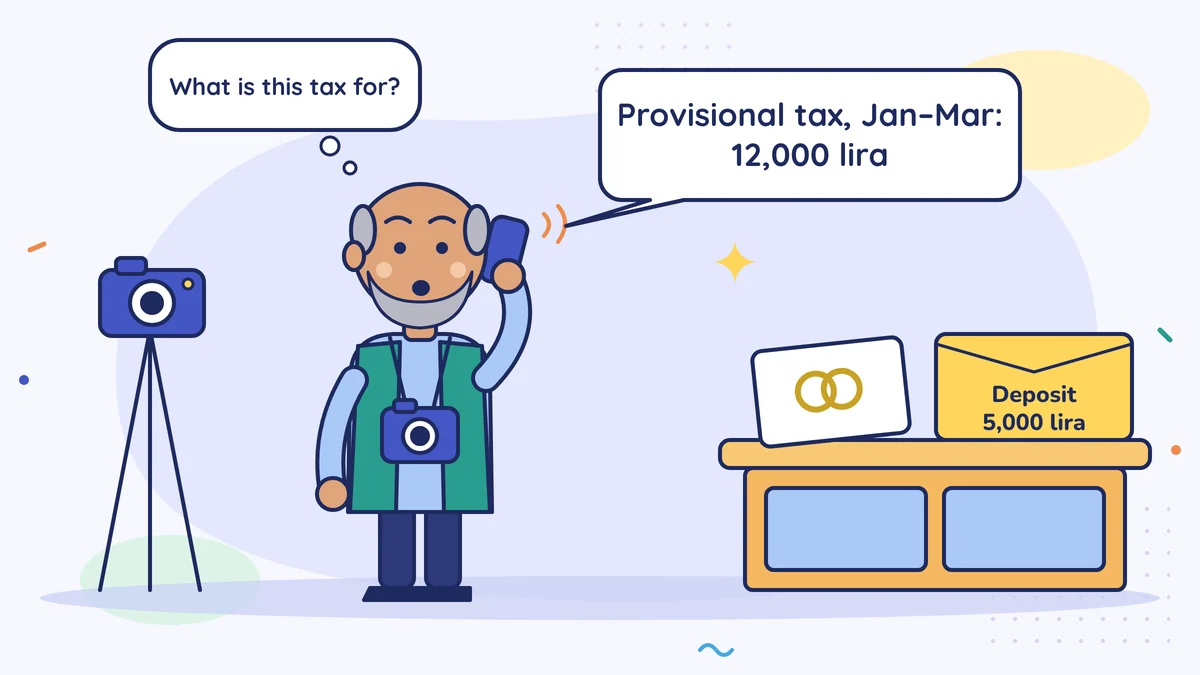
Hasan Abi has been a wedding photographer for twenty years. For a wedding shoot he asks 20,000 lira; on the day of the agreement he takes a 5,000 lira deposit (kapora). The wedding takes place, the album is delivered, the account is closed: the couple pays the remaining 15,000 lira, and the deposit is deducted. Nobody pays the same money twice.
Last year Hasan Abi expanded his studio, took on two assistants and moved to real taxation (gerçek usul). This year in May his mali müşavir (accountant) called: "Provisional tax for January–March has come out: 12,000 lira." Hasan Abi was surprised: "The year isn't over yet. What is this tax for?"
The answer is hidden in his own work. Provisional tax is the deposit the state takes for the annual tax.
What is provisional tax?
The actual tax you pay on your profit is annual: income tax (gelir vergisi) for a sole proprietorship, corporate tax (kurumlar vergisi) for a company. When the year closes, the whole year's profit is calculated and its tax is found.
Provisional tax (geçici vergi) is the part of this annual tax that is paid in advance every three months during the year. The law defines it as tax paid "to be offset against the income tax of the current tax period" (Income Tax Law, Gelir Vergisi Kanunu, repeated art. 120, mükerrer md. 120). Offsetting (mahsup) here means "being deducted": the provisional tax you pay during the year is deducted from the tax calculated at the end of the year.
The calculation is made every three months. Your profit from the start of the year to the end of that period is taken, the rate is applied, the provisional tax already calculated earlier in the same year is deducted, and the rest is paid. We will see a worked example with figures in the third lesson of this module.
Know two things from the start:
- Provisional tax is calculated on profit, not on turnover. If there is no profit, there is no provisional tax to pay; but the return is still filed, and your mali müşavir does that.
- It is not an extra tax. It is the part of the annual tax that is paid in advance.
Who pays, and who does not?
| Situation | Provisional tax |
|---|---|
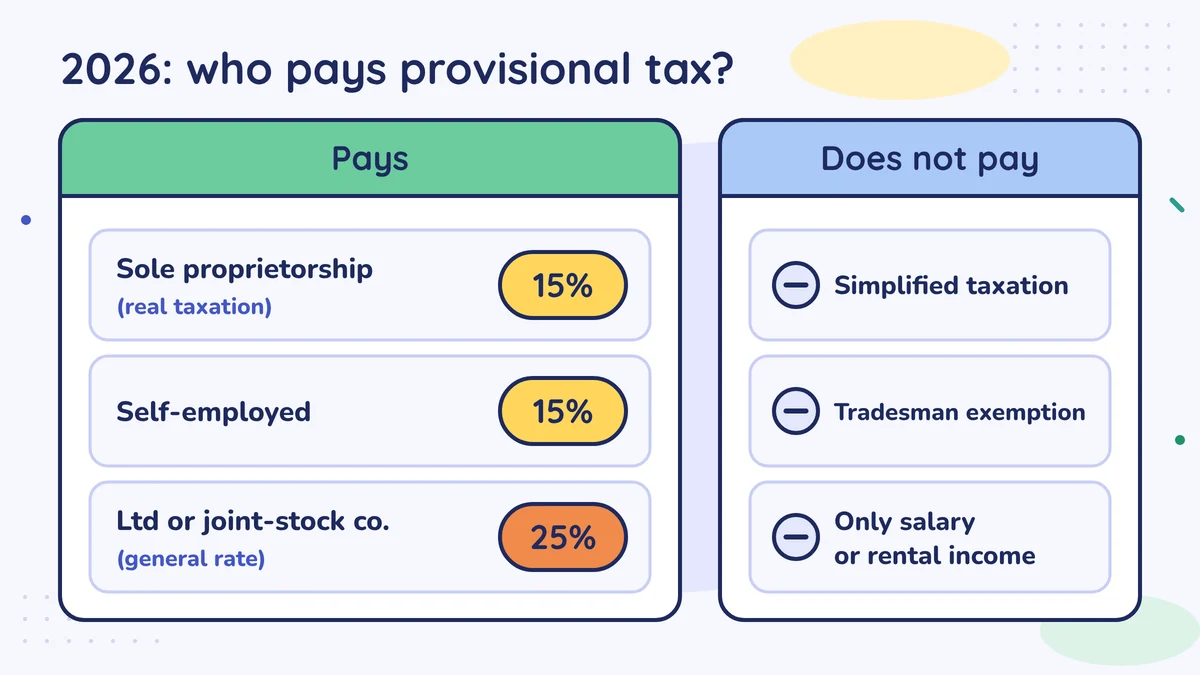
| Sole proprietorship under real taxation (keeping a business book or a balance sheet) | Pays |
| Self-employed professionals (such as lawyers, architects, doctors) | Pays |
| Limited and joint-stock companies | Pays (corporate provisional tax) |
| Tradespeople under simplified taxation | Does not pay |
| Those under the tradesman exemption (esnaf muafiyeti) | Does not pay |
| Those with only salary income or only rental income | Does not pay |
Simplified taxation (basit usul) is expressly left out in the text of the law: provisional tax is paid by "those with commercial earnings (excluding those taxed under the simplified method) and self-employed professionals" (GVK repeated art. 120). Under simplified taxation these earnings are already exempt from income tax; we explained the difference in the lesson Simplified taxation or real taxation?.
At the start of 2026 there was a big change in this table. In metropolitan municipalities, in districts with a population over 30,000, tradespeople in manufacturing, buying and selling, construction, car maintenance and repair, restaurants, entertainment venues and urban passenger transport were taken out of simplified taxation and moved to real taxation from 1 January 2026 (Presidential Decision No. 10380, Official Gazette 9 September 2025). The decision has exceptions; for example, those selling at markets and itinerant sellers, and, through Decision No. 10679, small towns and villages that have become neighbourhoods were left out. If you fall within its scope, 2026 may be the first year you pay provisional tax. Ask your mali müşavir which method you are under.
The annual tax on income such as salary and rent is calculated under other rules; no provisional tax is paid on this income. If you have both a business and rental income, provisional tax is calculated only on your business's profit.
The 2026 rates
Sole proprietorships and self-employed professionals: By law, the rate is the rate applied to the first bracket of the income tax tariff (GVK repeated art. 120). Because the first bracket in the 2026 tariff is 15%, the provisional tax rate in 2026 is 15% (Income Tax General Communiqué Serial No. 332, 332 Seri No'lu Gelir Vergisi Genel Tebliği).
There is a detail here: annual income tax is progressive; for 2026 it starts at 15% and goes up to 40%. Provisional tax, however, is a flat 15% whatever the profit. This difference may show up as an extra payment at the end of the year; we will see it with figures in the fourth lesson.
Companies: The rate is that year's corporate tax rate. For 2026 the general rate is 25%. For banks and financial companies, 30% applies. There are reduced rates on export earnings and on manufacturing earnings with an industrial registry certificate. Companies also have the domestic minimum corporate tax rule, and it applies in provisional tax periods too (Corporate Tax Law, Kurumlar Vergisi Kanunu, art. 32/C). Your mali müşavir works out whether your company is affected by these.
Hasan Abi's figure also comes from here: January–March profit 80,000 lira, 15% of it is 12,000 lira.
Why is it paid in advance?
The state collects tax as the earnings arise, without waiting for the end of the year. From your side, too, one big payment that would otherwise come all at once at the end of the year is split into four parts.
The 12,000 lira Hasan Abi paid in May is not lost. In March 2027, when the annual return for 2026 is filed, this amount will be deducted from the calculated tax, just as the deposit is deducted on the day the album is delivered.
Who files the return, and who makes the payment?
Your mali müşavir files the provisional tax return online, through the e-beyanname (electronic return) system. When the return is filed, a tax assessment slip (tahakkuk fişi) is created; that is, the paper showing the amount you will pay and the last day. Your mali müşavir sends you this slip. You make the payment: through your bank's online banking, through GİB's Digital Tax Office (Dijital Vergi Dairesi, dijital.gib.gov.tr) or at banks the tax office works with. If the return was filed on time but the payment was not made, the debt is not considered closed, and late payment interest (gecikme zammı, an addition that works like late interest) is added on top; so when you receive the slip, also write the payment day in your calendar.
Questions you can ask your mali müşavir
- "Am I one of those who pay provisional tax, and at what rate?"
- "Which documents do you use to calculate my profit for the period, and what should I send you by when?"
- "How many days in advance will you tell me each period's amount?"
You will find which months the periods cover and the 2026 deadlines in the next lesson, under the heading provisional tax periods.
Do this this week
Send your mali müşavir a single message: "Do I pay provisional tax? If I do, how much did I pay in the first two periods of this year?" Write the answer on the first page of your tax file.
Common mistakes
- Thinking provisional tax is a second tax on top of the annual tax. Provisional tax paid during the year is deducted from the tax calculated at the end of the year.
- Thinking it is calculated on turnover. Provisional tax is calculated on profit; if you have lots of sales but no profit, no provisional tax comes out.
- Thinking 15% is the annual tax rate. In 2026, 15% is only the provisional tax rate; annual income tax is progressive and goes up to 40% as profit grows.
Sources
- Income Tax Law No. 193 (193 sayılı Gelir Vergisi Kanunu), repeated art. 120 (provisional tax), mevzuat.gov.tr
- Text of GVK repeated art. 120 (secondary copy, fatiharas.com)
- TÜRMOB Circular Report 24.07.2015/136-2: the phrase "excluding those taxed under the simplified method" in repeated art. 120 (basit usulde vergilendirilenler hariç)
- Income Tax General Communiqué Serial No. 332 (332 Seri No'lu Gelir Vergisi Genel Tebliği), Official Gazette 31.12.2025 (2026 income tax tariff; Alomaliye text)
- Alomaliye, 05.10.2026: general corporate tax rate of 25% (2026) and the 2027 arrangement
- PwC: tax provisions of Law No. 7456 (7456 sayılı Kanun) (corporate tax 25%, financial sector 30%)
- TÜRMOB: Law No. 7524 (7524 sayılı Kanun), domestic minimum corporate tax (Corporate Tax Law, Kurumlar Vergisi Kanunu, art. 32/C)
- KPMG: Presidential Decision No. 10380 (10380 sayılı Cumhurbaşkanı Kararı), Official Gazette 09.09.2025 (some simplified taxation taxpayers in metropolitan municipalities moved to real taxation from 1.1.2026)
- KPMG: Presidential Decision No. 10679 (10679 sayılı Cumhurbaşkanı Kararı), Official Gazette 11.12.2025 (change to the scope of Decision No. 10380, 1.1.2026)
Translated from the Turkish lesson. Last checked against Turkish rules: 12 October 2026. Not yet reviewed by a licensed accountant.
This is general information about Turkish rules, not financial, tax or legal advice. Rules change; check the date and the sources, and ask a licensed accountant (mali müşavir) about your own situation. Disclaimer