Provisional tax periods and the 2026 deadlines
How many times a year is there provisional tax? Three between 2022 and 2024, four again since 2025. Which months the four periods cover, the 2026 deadlines (18 May, 17 August, 17 November and, by the rule, 17 February 2027), old articles saying "the fourth period was abolished", and what to do when a period ends.
Provisional tax (geçici vergi) divides the year into four three-month periods, and each period is declared and paid by the evening of the 17th of the second month after it. For 2026 the deadlines are 18 May, 17 August, 17 November 2026 and 17 February 2027; the last date was worked out from the rule and becomes final once GİB publishes the 2027 calendar. The fourth period did not exist between 2022 and 2024; with Law No. 7566 it came back from 2025 onwards.
Zeynep Hanım the hairdresser's seasons
The rules described in this lesson are those of Turkish law.
Zeynep Hanım's hair salon has its seasons: June is wedding season, December is New Year, February is quiet. Her appointment book tells her in advance which months will be busy. Last year her salon moved to real taxation; a new season was added to her book: provisional tax, which comes every three months.
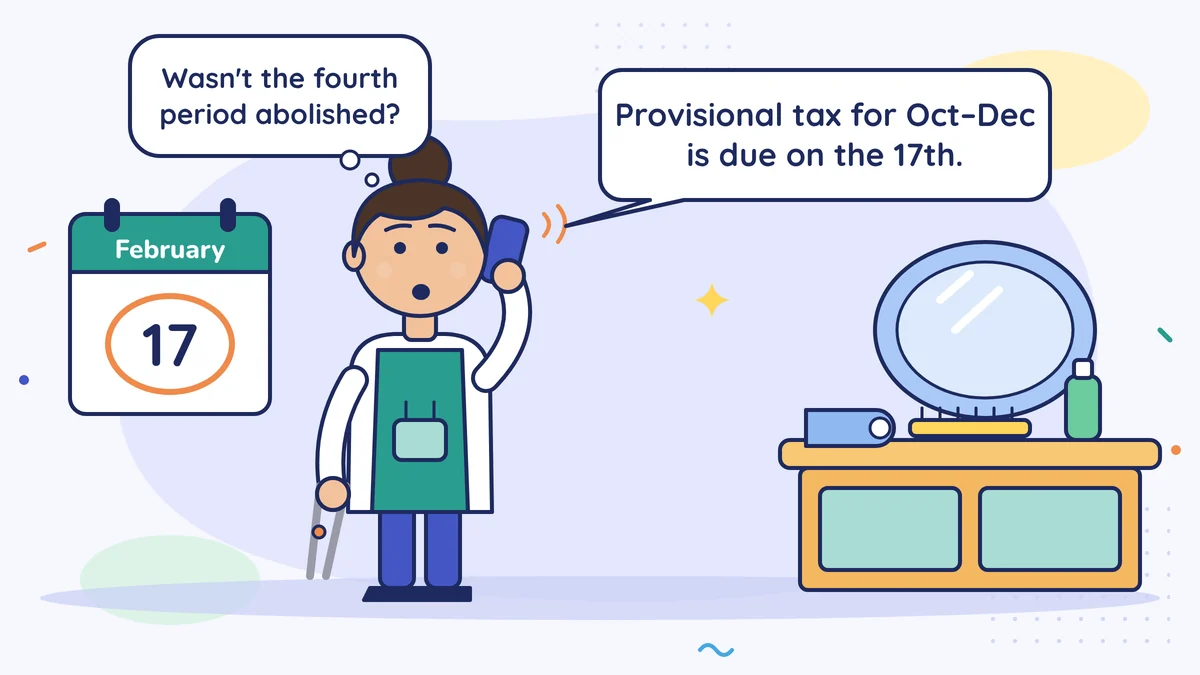
This year at the start of February her mali müşavir (accountant) reminded her: "On the 17th, provisional tax for October–December is due." Zeynep Hanım was surprised: "I read online that the fourth period was abolished." That was true once. Not any more.
We saw what provisional tax is in the lesson What is provisional tax, and who pays it?. Here we look at its calendar.
Four periods a year
The calendar year is divided into four quarters. At the end of each quarter comes one return and one payment.
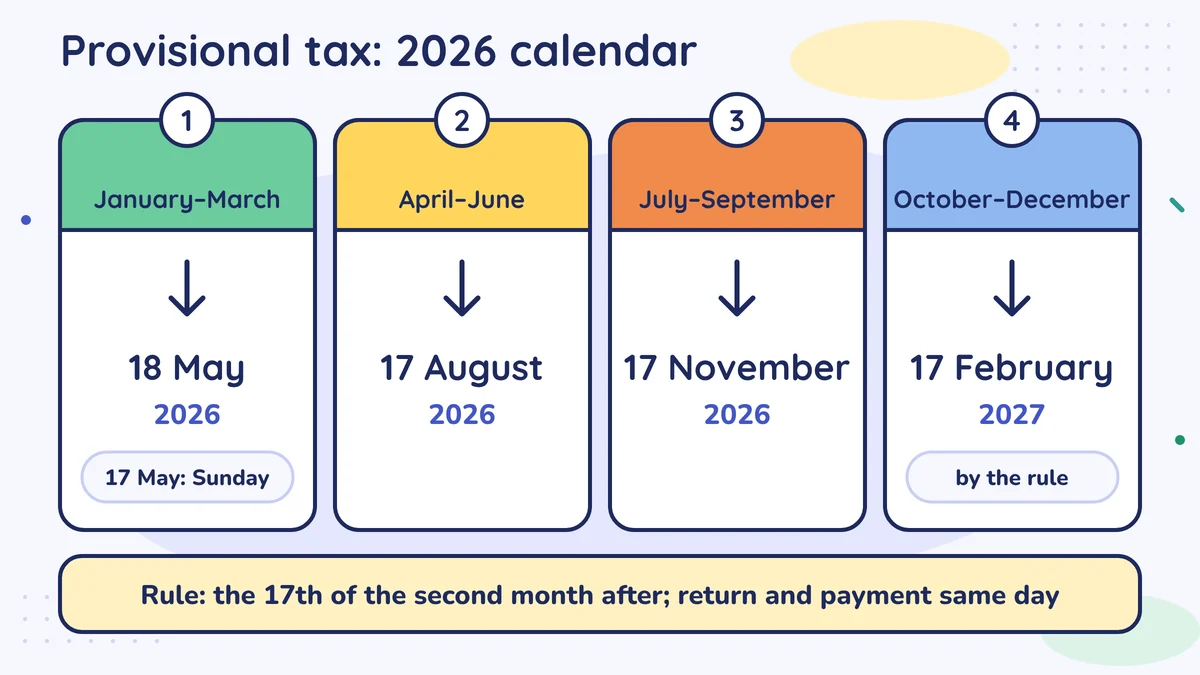
| Period | Months covered | 2026 deadline (return and payment) |
|---|---|---|
| 1st period | January–March | Monday 18 May 2026 (17 May fell on a Sunday) |
| 2nd period | April–June | Monday 17 August 2026 |
| 3rd period | July–September | Tuesday 17 November 2026 |
| 4th period | October–December | Wednesday 17 February 2027 (by the rule; becomes final once GİB publishes its calendar) |
The rule: by the evening of the 17th of the second month after the period. The return and the payment have the same deadline. Even if there was no profit in that period, or even a loss, the return is still filed. This day has applied since GİB's 2019 arrangement (VUK Circular No. 115, 115 Sıra No'lu VUK Sirküleri); if the days ever change again, it will show in the GİB calendar.
If the last day falls on a weekend or a public holiday, the deadline ends on the first working day after it (Tax Procedure Law, Vergi Usul Kanunu, art. 18). This happened in the first period of 2026: because 17 May was a Sunday, the deadline was 18 May. If you want to see it together with the month's other tax days, look at the lesson A month's calendar.
The date 17 February 2027 was worked out from the rule; once GİB publishes the 2027 calendar, confirm it there too.
The fourth period: abolished, then back
- 2022–2024: With Law No. 7338, provisional tax for the last period had been abolished. There were three returns a year; October–December profit was calculated directly in the annual return.
- From 2025 onwards: Law No. 7566 (Official Gazette 19 December 2025) removed the "first nine months" limit in GVK repeated art. 120. The change applies to periods starting from 1 January 2025. That is why the October–December period of 2025 was also declared; according to the GİB announcement, the normal deadline was 17 February 2026. For taxpayers in the earthquake region whose force majeure status ended on 30 November 2025, the deadline was extended to 9 March 2026.
- 2026: Once again there are four periods.
You will still come across articles online saying "there is no fourth period"; most of them describe the 2022–2024 rule. Before trusting an article, check the date of the law it relies on.
The calendar is the same for companies. Only for companies whose accounting period differs from the calendar year (a special accounting period) do the days shift; if you have such a company, your mali müşavir will know.
February and March, back to back
The return of the fourth period has a consequence on the cash side. In February comes provisional tax for October–December, in March the annual return and its first instalment (for a company, the corporate tax return is in April). The amount in March is what is left after deducting the provisional tax you paid in February; in other words, the two are parts of the same tax. Still, because the two payments come about six weeks apart, the money to set aside needs to be planned from December.
The fourth period also has one convenience. Its tax base (matrah), that is, the profit the tax is calculated on, is the profit from the start of the year to the end of December; the same year the annual return covers. When your mali müşavir closes the books in January, they prepare both jobs from the same documents. Sending December's documents in the first week of January makes both February's provisional tax and March's annual return easier.
What happens when a period ends?
Think of October 2026: the July–September period has closed, and its calculation is being done now. The flow usually goes like this:
| When | What happens |
|---|---|
| The first days of October | September's documents go to the mali müşavir |
| During October | The mali müşavir enters the books; September's VAT and muhtasar (withholding tax) returns are filed |
| The first week of November | The mali müşavir calculates the January–September profit and the provisional tax amount |
| Before 17 November | The return is filed and the amount is paid |
The period's profit is calculated from documents. A purchase invoice that has not arrived after the period ends makes expenses look too low; a forgotten sales invoice makes profit look too low. Sending the documents as soon as the period closes is the easiest way to get the figure right.
Zeynep Hanım added four lines to her calendar: 18 May, 17 August, 17 November, 17 February. One week before each, she also put a note: "ask the mali müşavir for the amount". February was not quiet this year, but there were no surprises either.
If you are under simplified taxation, none of the lines in this calendar concern you; there is no provisional tax.
Do this this week
Add the deadlines 17 November 2026 (July–September period) and 17 February 2027 (October–December period; confirm once the GİB 2027 calendar is out) to your phone's calendar; one week before each, set a reminder: "ask the mali müşavir for the amount". If your September documents are still with you, send them to your mali müşavir this week.
Common mistakes
- Leaving February empty because "there is no fourth period". That rule was for 2022–2024; with Law No. 7566 there are again four periods a year from 2025 onwards.
- Leaving the return to the mali müşavir and forgetting the payment. For provisional tax, the return and the payment have the same deadline: the 17th.
- Sending the period's documents late. Profit calculated from missing documents comes out wrong; correcting it later means extra work.
Sources
- Income Tax Law No. 193 (193 sayılı Gelir Vergisi Kanunu), repeated art. 120 (provisional tax), mevzuat.gov.tr
- Text of GVK repeated art. 120 (secondary copy, fatiharas.com)
- KPMG: Law No. 7566 (7566 sayılı Kanun), Official Gazette 19.12.2025/33112, art. 2: removal of the phrase "set for the first nine months", periods starting from 1.1.2025
- TÜRMOB: GİB announcement, 2025 4th period provisional tax (normal deadline 17 February 2026)
- Grant Thornton: 2022 tax changes (abolition of last-period provisional tax by Law No. 7338, 7338 sayılı Kanun)
- GİB Tax Calendar
- Muhasebetr: 2026 tax calendar (provisional tax deadlines)
- Grant Thornton: VUK Circular No. VUK-115/2019-5 (VUK-115/2019-5 Sıra No'lu Sirküler), 29.03.2019 (provisional tax return and payment on the 17th, from 1.4.2019)
- VUK Circular No. 115 (115 Sıra No'lu VUK Sirküleri, 2019): rearrangement of filing deadlines, the 17th for provisional tax (Muhasebetr summary)
- Tax Procedure Law No. 213 (213 sayılı Vergi Usul Kanunu), art. 18 (last day falling on a holiday), mevzuat.gov.tr
Translated from the Turkish lesson. Last checked against Turkish rules: 12 October 2026. Not yet reviewed by a licensed accountant.
This is general information about Turkish rules, not financial, tax or legal advice. Rules change; check the date and the sources, and ask a licensed accountant (mali müşavir) about your own situation. Disclaimer