Paying wages and the timesheet (puantaj): from month end to the tax return
Payday is not just about sending money. How many days were worked, who was on sick leave, who was on leave: it all shows on the payroll. How do you choose the payday, what is a pay slip, and which dates should you know when the month ends?
Under the Labour Law (İş Kanunu), the wage is paid at least once a month. With every payment, the employer gives the employee a pay slip (ücret hesap pusulası). Over the month, write the days worked, on leave, on sick report and not come in on a timesheet (puantaj), and send it to your mali müşavir (accountant) when the month ends. With this, your mali müşavir gives the withholding and premium service return (muhtasar ve prim hizmet beyannamesi) by the 26th of the following month; SGK premiums are paid by the end of the following month.
Ayten Hanım the stationer's month end
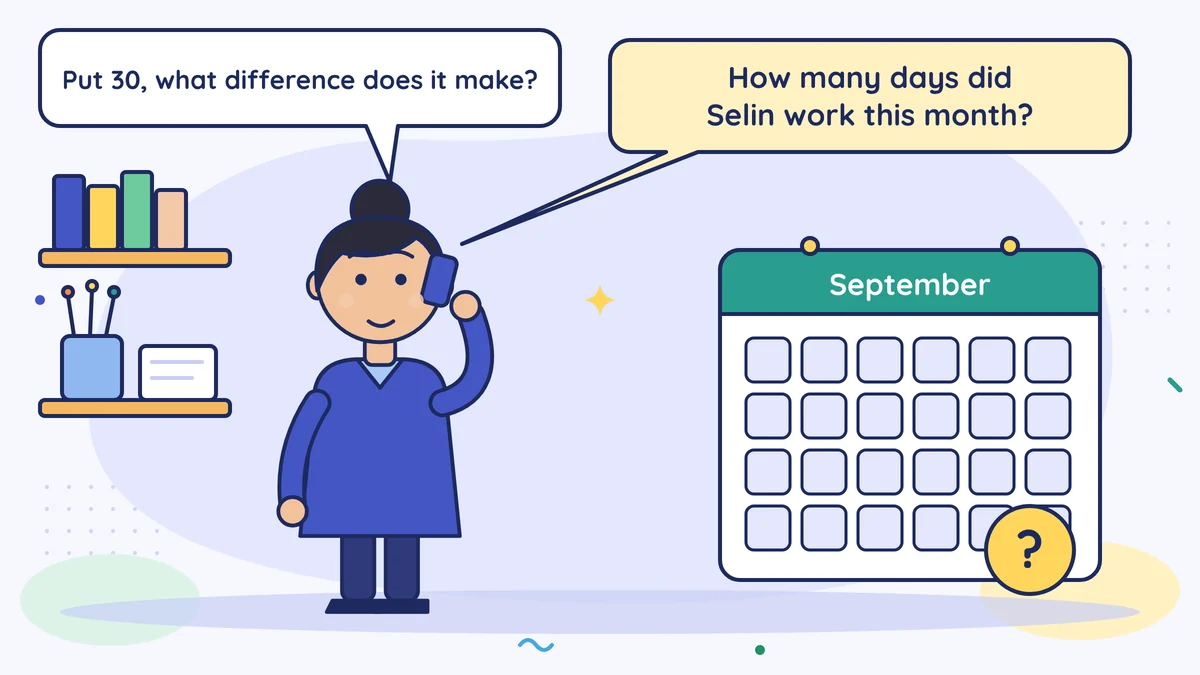
September is the busiest month for Ayten Hanım's stationery shop: the schools are opening. Her employee Selin was on sick report for two days in the middle of the month. She also asked for one day of unpaid leave for a family matter. When the month ended, her mali müşavir (accountant) asked: "How many days did Selin work this month?" Ayten Hanım said, "Put 30, what difference does it make?"
It does make a difference. Sick-report days and unpaid leave days go to different lines on the payroll, and to different codes in the notification to SGK (Social Security Institution). A day written wrongly shows both Selin's insurance and your premium debt wrongly.
Payday: choose it once, put it in writing
Under Labour Law (İş Kanunu) art. 32, the wage is paid at least once a month. By contract, the payment period can be shortened to as little as one week. You choose which day you pay yourself. What matters is that this day is written in the contract and that the wage is paid on the same day every month.
The law sets one more limit: if the wage is not paid within 20 days from the payday without a force majeure reason, the employee may refrain from working (art. 34). That is why you should choose the payday according to the days money comes into your till. For example, if your customers pay on the 5th of the month, making the 1st of the month payday will squeeze you every month.
Pay the wage through the bank, into an account opened in the employee's own name. If you have three or more employees, this is compulsory anyway; the details are in the lesson What an employee really costs you. Even with a single employee, the bank record is the easiest way to prove who you paid what. In the description field, write the period, such as "September 2026 wage".
The pay slip
The payroll is the list of all the employees. The pay slip (ücret hesap pusulası), on the other hand, is the paper given to a single employee. Under Labour Law art. 37, with every payment made at the workplace or through the bank, the employer gives the employee a slip showing the wage calculation, signed or bearing the workplace's special mark. The gross, the deductions and the net appear on this slip.
The slip is usually prepared by your mali müşavir's payroll program. You sign it and give it to the employee. Having the employee also sign that they received it helps you later in an argument over "no slip was given".
The timesheet: the month's tab book
The neighbourhood grocer writes a line in his tab book (veresiye defteri) every day. At the end of the month, the account comes out of that book. The timesheet (puantaj), that is, the chart showing the employee's days, does the same job. A box is opened for every day of the month, and that day's status is written in it:
| Status of the day | Effect on the payroll |
|---|---|
| Worked | Normal day |
| Paid annual leave | The wage is paid, the day counts in full |
| Weekly day off (for example Sunday) | It is paid, the day counts in full; "didn't come" is not written |
| Sick report | Sick-report days for which you pay no wage are notified to SGK as missing days, with the reason "rest" (istirahat). In illness, SGK pays the temporary incapacity allowance (geçici iş göremezlik ödeneği) from the 3rd day of the report; for this, at least 90 days of short-term insurance premium must have been notified for the employee in the last year |
| Unpaid leave or a day they didn't come | No wage is paid; it is notified to SGK as a missing day, with the code of its reason |
| Overtime | Written hour by hour; paid at a higher rate |
There are two details about sick reports. First: after the report ends, the employer notifies SGK electronically that the employee did not work at the workplace on the sick-report days. SGK pays the allowance based on this notification. Second: SGK makes no payment for the first two days. Whether you pay the wage for these days depends on your contract and your practice. If you pay, those days may not count as missing days; ask your mali müşavir how to notify them. The rules are different for work accidents and occupational diseases; report such a sick report to your mali müşavir separately too.
Keep the documents showing the reason for missing days, such as the sick report or the leave request. If the employee didn't come without notice, write a short report (tutanak) dated that day. Your mali müşavir works out the overtime premium and its calculation. You only need to give them the correct hours.
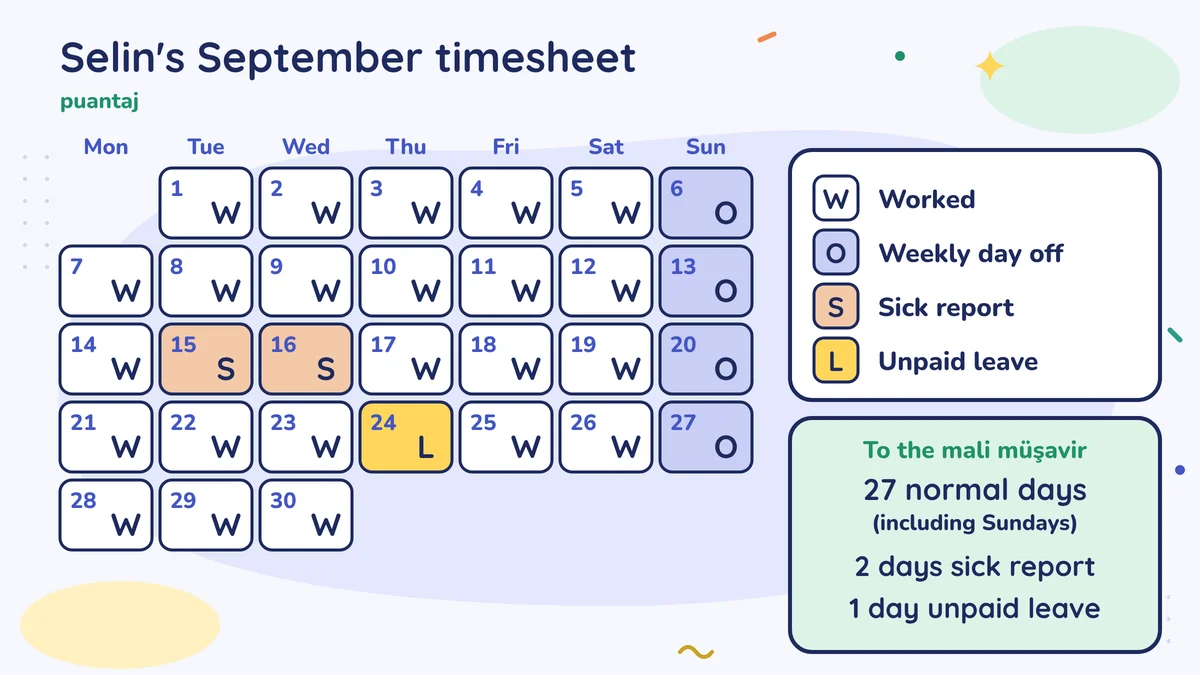
In Ayten Hanım's timesheet, September should have looked like this: 2 days on sick report, 1 day of unpaid leave, the remaining 27 days normal days, including Sundays. The mali müşavir prepared the payroll accordingly and notified the days with no wage paid, with their reasons.
The calendar when the month ends
Your mali müşavir does most of these jobs. But you should know the dates too, because the money leaves your account:
| When | What is done | Who |
|---|---|---|
| The last day of the month or the first working day of the following month | The timesheet is sent to the mali müşavir | You |
| The payday in the contract | The net wage is paid through the bank, and the slip is given | You |
| The 26th of the following month, until 23:59 | The withholding and premium service return is given | Mali müşavir |
| By the 26th of the following month | The income tax and stamp duty withheld are paid | You (the mali müşavir tells you the amount) |
| By the end of the following month | SGK premiums are paid | You (the mali müşavir tells you the amount) |
| When the sick report ends | It is notified that no work was done on the sick-report days | Mali müşavir or you |
The withholding and premium service return (muhtasar ve prim hizmet beyannamesi) reports the employee's days, earnings and the tax withheld to both the tax office and SGK in a single notification. Private-sector employers give it electronically; it is not given on paper. If you are a tradesman taxed under simplified taxation (basit usul), the return is still given, but no income tax is withheld from the wage; the tax payment line in the table may not concern you, so ask your mali müşavir. If the last day for the SGK premium falls on an official holiday, the payment can be made until the first working day after the holiday. During periods such as religious holidays (bayram), filing deadlines may also be extended; ask your mali müşavir for that month's date. To see the dates for the whole year, look at the article Tax calendar (in Turkish); for what goes to the mali müşavir every month, look at the lesson What to send your mali müşavir every month.
If you missed it
If you sent the timesheet late or incomplete: If you notice before the return is given, have your mali müşavir correct it. If you notice after it is given, an additional notification is needed for the correction; this sometimes brings an extra cost such as interest or a fine. The earlier you say it, the less trouble there is.
If you can't pay the wage on payday: Tell the employee in advance and give the new day in writing. Letting the delay pass in silence is the way that wears down trust the most.
The next month, Ayten Hanım put up a wall calendar next to her desk. She writes a letter in the box for each of Selin's days: W (worked), O (weekly day off), L (leave), S (sick report). At the end of the month she takes a photo of it and sends it to her mali müşavir.
Do this this week
Open a simple timesheet for this month: one box for each day, and in it write W (worked), O (weekly day off), L (leave), S (sick report) or A (absent). Don't write A for days off such as Sunday. At the end of the month, send it to your mali müşavir (accountant). If the payday is not written in the contract, choose a day and put it in writing together with the employee.
Common mistakes
- Having every month written as 30 days. Sick-report days, unpaid leave days and days the employee didn't come are notified separately. A wrong number of days shows both the employee's insurance and your premium debt wrongly.
- Paying part of the wage by hand, outside the payroll. The net on the payroll and the amount sent from the bank must be the same. The difference paid by hand stays unregistered; it causes you problems both in a dispute with the employee and in an SGK inspection.
- Not giving the slip or not getting a signature for receipt. The Labour Law requires a pay slip with every payment. A signature for receipt prevents arguments later.
Sources
- Labour Law (İş Kanunu), Law No. 4857, art. 32, 34, 37 (Ministry of Labour and Social Security PDF)
- SGK: The employer's obligations (withholding and premium service return, premium payment deadline, rest notification) (İşverenin Yükümlülükleri)
- Law No. 5510, art. 18 (temporary incapacity allowance), 86 and 88
- SGK: Illness (allowance from the 3rd day, the 90-day condition) (Hastalık Hâli)
- EY: The threshold for paying wages through a bank dropped to 3 employees (Official Gazette 04.06.2025, No. 32920)
Translated from the Turkish lesson. Last checked against Turkish rules: 9 October 2026. Not yet reviewed by a licensed accountant.
This is general information about Turkish rules, not financial, tax or legal advice. Rules change; check the date and the sources, and ask a licensed accountant (mali müşavir) about your own situation. Disclaimer