How is provisional tax calculated? The cumulative calculation, with figures
Each period, provisional tax is calculated on total profit from the start of the year to date; the tax of earlier periods is deducted, and the difference is paid. Mehmet Usta's 2026 with the figures for all four periods: quarters with profit, with a loss, and with a recovery. What happens if there is withholding tax, and what changes for a company.
In each period, the total profit from the start of the year to the end of that period is found and multiplied by the rate; in 2026, 15% for a sole proprietorship. The provisional tax (geçici vergi) calculated in earlier periods of the same year is deducted from this amount, and the rest is paid. If the result comes out below zero, no payment is made for that period; the overpaid part is not given back during the year, it is taken into account in the annual return.
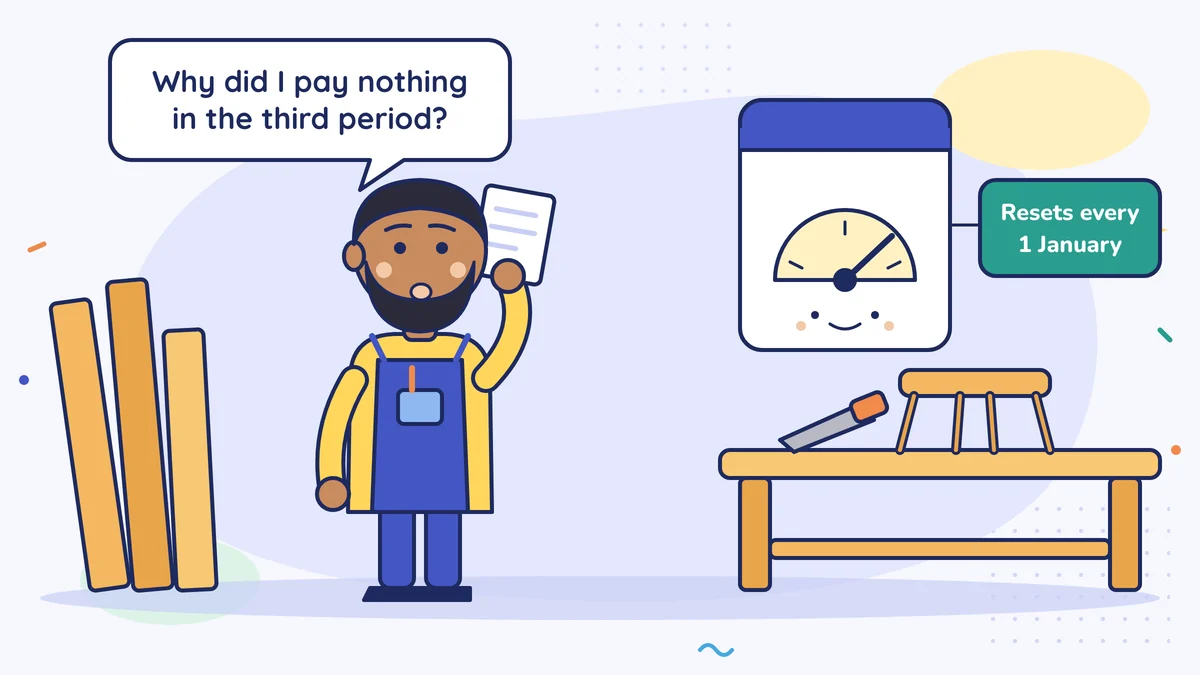
Mehmet Usta's electricity meter
The rules described in this lesson are those of Turkish law.
Mehmet Usta's furniture workshop has an electricity meter. Every month the electricity company reads the meter, subtracts last month's figure, and issues a bill for what is in between. The meter keeps adding up from the start; the bill asks only for the difference.
Provisional tax is calculated the same way, with one difference: this meter is reset to zero at the start of every year.
Mehmet Usta is a sole proprietorship, keeps a business book (işletme defteri) and is under real taxation. In 2026 his work went up and down: spring was good, summer was bad, autumn was very good. Looking at the amounts his mali müşavir (accountant) sent him each period, one day he asked: "Why did I pay nothing in the third period, and why did it suddenly go up in the fourth?" The answer lies in the logic of the meter.
What does cumulative mean?
Cumulative means adding up over time. In provisional tax, each period's tax base (matrah), that is, the amount the tax is calculated on, is the total profit from the start of the year to the end of that period:
- 1st period: January–March profit
- 2nd period: January–June profit
- 3rd period: January–September profit
- 4th period: January–December profit
For 2026 this total profit is multiplied by 15% (sole proprietorships and self-employed professionals). From the result, the provisional tax calculated in earlier periods of the same year is deducted; what is left is that period's payment.
The profit here is not the money in the cash box but the earnings in the books: sales minus business-related expenses. The mali müşavir adds back spending that does not count as an expense and deducts any losses from previous years. We talked about this difference in the lesson Profit but no cash.
If you keep books on the balance-sheet basis (bilanço esası; companies are always on the balance-sheet basis), a note: in the 2025, 2026 and 2027 accounting periods, including provisional tax periods, no inflation adjustment is made (Tax Procedure Law, Vergi Usul Kanunu, provisional art. 37; Law No. 7571, Official Gazette 25 December 2025). Profit is calculated from the figures in the books, without adjustment. Only those dealing in the buying, selling and making of worked gold and silver are outside this rule; if you are a jeweller, ask your mali müşavir. The business book has no inflation adjustment anyway.
Mehmet Usta's four periods
| Period | Profit for those three months | Total profit since the start of the year | 15% of the total | Calculated in earlier periods | Payable this period |
|---|---|---|---|---|---|
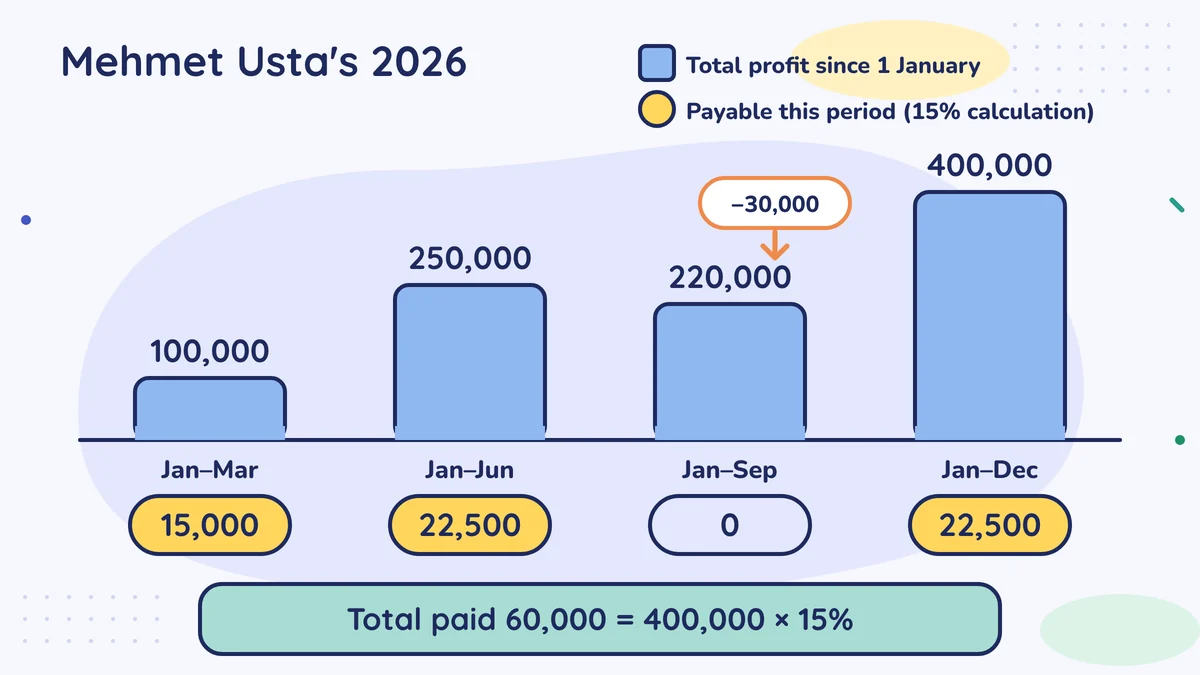
| 1. January–March | 100,000 | 100,000 | 15,000 | 0 | 15,000 |
| 2. April–June | 150,000 | 250,000 | 37,500 | 15,000 | 22,500 |
| 3. July–September | −30,000 (loss) | 220,000 | 33,000 | 37,500 | 0 |
| 4. October–December | 180,000 | 400,000 | 60,000 | 37,500 | 22,500 |
Let's go through it line by line.
1st period: 100,000 lira of profit in the first three months of the year. 15% of it is 15,000 lira. Nothing was paid before, so 15,000 lira is paid.
2nd period: In April–June he earned another 150,000 lira; the total since the start of the year is 250,000. 15% of that is 37,500 lira. The 15,000 calculated in the first period is deducted, and 22,500 lira is paid.
3rd period: Summer went badly: a loss of 30,000 lira in three months. Total profit fell to 220,000; 15% of it is 33,000 lira. But the total calculated earlier is 37,500. The difference comes out at minus 4,500. No payment this period. The overpaid 4,500 lira, however, is not given back during the year; at the end of the year it is taken into account in the annual return.
4th period: Autumn went very well: 180,000 lira in three months. Total profit 400,000; 15% of it is 60,000. The total calculated in earlier periods is 37,500 (15,000 + 22,500 + 0). The remaining 22,500 lira is paid by 17 February 2027 (by the rule; becomes final once GİB publishes its calendar).
Check: the total paid over four periods is 15,000 + 22,500 + 0 + 22,500 = 60,000 lira. That is exactly 15% of the annual profit (400,000). The cumulative calculation evens out the ups and downs during the year by itself.
Why is it calculated this way?
Think of seasonal businesses: an ice cream seller earns in summer and makes a loss in winter; someone selling heating fuel is the opposite. If each quarter were calculated separately, the tax paid in a good quarter would never be taken into account in a bad quarter, and all year tax would be paid above the real profit. In the cumulative calculation, each period looks at the whole year's picture up to that day; a bad quarter pulls total profit down, so it also reduces the next payment.
One detail: in the next period's calculation, the amount calculated in earlier periods is deducted. In the annual return, however, only provisional tax that was actually paid is deducted. If a period was not paid, it does not count at the end of the year.
If your customer withholds tax
In self-employment and some other work, your customer withholds tax on your behalf when making a payment and pays it to the tax office; this is called withholding tax (stopaj). Income tax withheld from you in the same period is deducted from that period's provisional tax (GVK repeated art. 120).
Example: Selin Hanım, a freelance architect, has a provisional tax of 15,000 lira for the period. In the same period, her customers that are companies withheld 9,000 lira on her behalf. This period Selin Hanım pays 6,000 lira. Ask your customers or your mali müşavir for a breakdown of the amounts withheld; for them to be deducted, the withholding must actually have been made. We explained how withholding tax works in the lesson Withholding tax and the muhtasar return.
The same calculation in a company, a different rate
In a limited or joint-stock company the method is the same; the rate for 2026 is generally 25%. If Mehmet Usta's workshop were a limited company, by the end of the year total provisional tax would be 400,000 × 25% = 100,000 lira. In companies the minimum corporate tax and reduced rates may also come into the calculation; your mali müşavir handles that part.
How do you read your mali müşavir's calculation?
Keep a copy of the provisional tax return. Looking at two lines is enough:
- Tax base for the period (dönem matrahı): Is it your total profit from the start of the year to this period? Does it roughly match your own estimate?
- Provisional tax calculated in earlier periods: Is it the total of the amounts on the earlier returns? This line does not look at whether you paid or not; check your payments separately against your payment receipts.
Mehmet Usta started comparing these two lines each period with the figures in his own books. He now knows why the third period was zero: his total profit since the start of the year had gone down, and the meter had gone backwards.
Do this this week
Ask your mali müşavir for copies of the provisional tax returns filed this year. On each, find the lines "tax base" (matrah, total profit since the start of the year) and "provisional tax calculated in earlier periods". Put the amounts payable side by side with your own payment receipts; if a payment is missing, ask your mali müşavir.
Common mistakes
- Calculating each period on its own three months. Provisional tax is calculated on total profit since the start of the year; the tax of earlier periods is deducted, and the difference is paid.
- Expecting money back in a period with a loss. If the calculation comes out negative, no payment is made for that period, but provisional tax already paid is not refunded during the year; it is taken into account in the annual return.
- Showing the period's profit too low. If, thinking "it will be corrected at the end of the year anyway", provisional tax is under-declared by more than 10% and this comes out in a tax audit, the tax on the missing part is demanded afterwards; a penalty and late interest may come on top (GVK repeated art. 120).
Sources
- Income Tax Law No. 193 (193 sayılı Gelir Vergisi Kanunu), repeated art. 120 (provisional tax), mevzuat.gov.tr
- Text of GVK repeated art. 120 (secondary copy, fatiharas.com)
- Alomaliye: Taxes to be offset on the annual return and refunds (the condition of having been paid)
- Income Tax General Communiqué Serial No. 332 (332 Seri No'lu Gelir Vergisi Genel Tebliği), Official Gazette 31.12.2025 (2026 income tax tariff; Alomaliye text)
- Alomaliye, 05.10.2026: general corporate tax rate of 25% (2026) and the 2027 arrangement
- PwC: tax provisions of Law No. 7456 (7456 sayılı Kanun) (corporate tax 25%, financial sector 30%)
- KPMG: Law No. 7571 (7571 sayılı Kanun), Official Gazette 25.12.2025/33118, Tax Procedure Law (Vergi Usul Kanunu) provisional art. 37 (no inflation adjustment in 2025–2027, including provisional tax periods)
- PwC (R. Bıyık): The 10% margin of error in provisional tax
Translated from the Turkish lesson. Last checked against Turkish rules: 12 October 2026. Not yet reviewed by a licensed accountant.
This is general information about Turkish rules, not financial, tax or legal advice. Rules change; check the date and the sources, and ask a licensed accountant (mali müşavir) about your own situation. Disclaimer