Opening a business account and a POS terminal
A bank account that separates your business from your personal money, and a POS (card payment) terminal for selling by card. In this lesson you see how to think about the two, why the cash register (ÖKC) and the POS are linked to each other, and what to ask the bank.
A business account separates the business's money from your personal money and makes your mali müşavir's (accountant's) work easier. A POS is a merchant agreement you make with the bank. Businesses that must use a cash register (ÖKC) have to take card payments with a POS that works linked to the cash register. Find out from the tax office or your mali müşavir whether the ÖKC requirement applies to you.
Mehmet Usta the mechanic's cash box
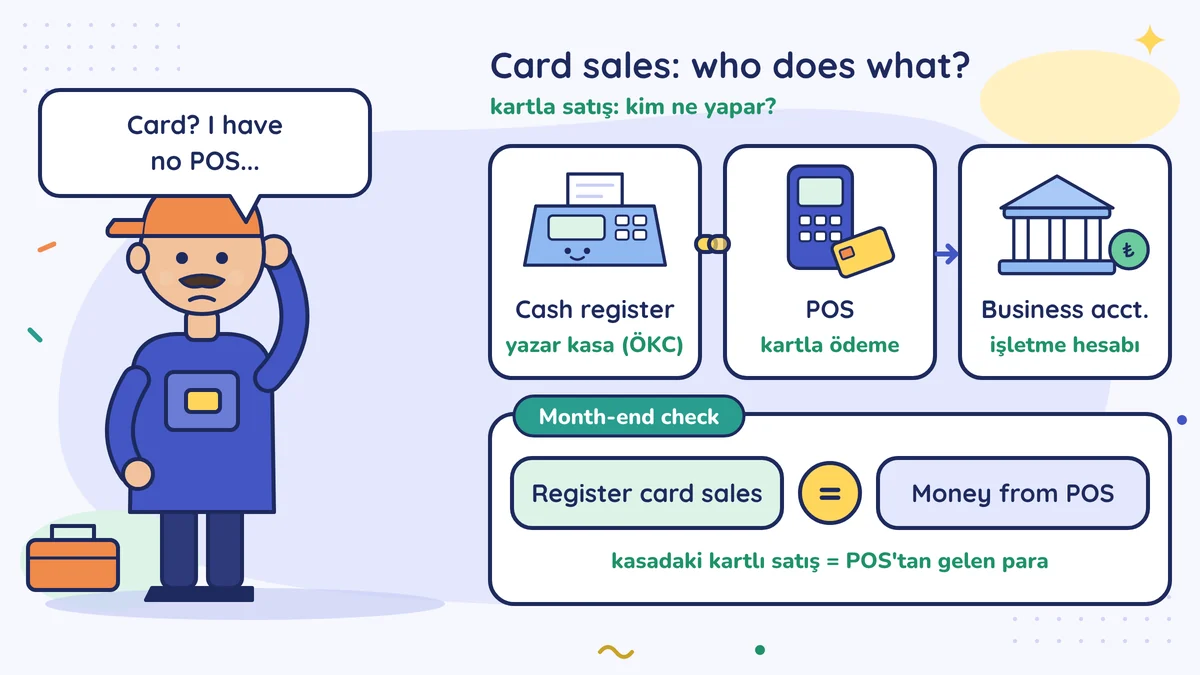
Mehmet Usta opened a small car repair workshop. In the first month, half of his customers wanted to pay by card. He had no POS. He turned two people away and told one "make a bank transfer". At the end of the month, his money was scattered between his personal account, the drawer under the counter and his pocket. He couldn't tell which money was the business's and which was his own.
In this lesson we sort out two things: a separate account for the business, and a POS for card sales.
1. Why a separate account for the business?
In the lesson Cash, bank and the money in your pocket you saw the idea of "three separate pockets". The business account is the bank side of that.
In a sole proprietorship (şahıs işletmesi), you and the business are legally the same person. Even so, opening a separate account has big benefits:
- You separate the business's money from your personal shopping.
- Sending the statement to your mali müşavir (accountant) at the end of the month becomes easier.
- You can see which money is profit, which is rent and which is the share for tax.
Opening a separate account is usually not compulsory; still, it is strongly recommended. For this account, banks may ask you for your tax certificate (vergi levhası) or your start-of-business documents; ask your bank which one it wants. Also know this: collections and payments you make with other businesses above a certain amount must go through a bank or PTT (the Turkish postal service) (VUK General Communiqué No. 320). This rule also covers tradesmen under simplified taxation (basit usul). If you pay large amounts in cash by hand, a penalty may arise; ask your mali müşavir for the current amount limit. Later on, if you have 3 or more employees, you also have to pay their wages through the bank (since 1 July 2025). A business account makes these jobs easier too.
If your start-of-business notification and certificate are ready, it is easy: first Start of business, then Tax certificate.
2. What is a POS?
A POS is the device or system that lets you take payments by card. The customer taps or inserts their card; the money goes to the bank, and from there to your account. Banks charge you a commission. The commission, and how many days it takes for the money to reach your account, vary by bank; get offers from a few banks.
A POS is a merchant (üye işyeri) agreement made with the bank. The bank registers you as "this business really exists". Banks usually ask for a document about the business's tax registration; ask your bank which one it wants. That is why sorting out your start-of-business notification and your certificate first makes things easier.
3. Are the cash register (ÖKC) and the POS the same?
There are two devices that get mixed up:
- ÖKC (payment recording device, ödeme kaydedici cihaz, that is, the cash register, yazar kasa): the device that records the sale and gives a receipt or an invoice-like document. It is a device tracked by the Revenue Administration (GİB).
- POS: the device that takes card payments.
You may think of the two separately, but the state sees them as linked. With the 2017 rule (VUK General Communiqué No. 483), businesses that must use a cash register have to take card payments with a POS that is linked to, or built into, a new-generation cash register (YN ÖKC, yeni nesil ÖKC). The new-generation device is computer-based, communicates securely over the internet and sends sales information electronically. Some new-generation devices already work as both a cash register and a POS.
The logic is this: the amount that goes through as card payment and the sales amount entered into the cash register must match. This makes it harder to keep sales off the record. For someone working on the record, this is not a burden; it means order.
Do I have to use an ÖKC?
This mainly depends on the type of work you do. The ÖKC requirement is regulated by Law No. 3100 and the related communiqués. Most businesses that sell retail are covered; some service businesses and professions are outside the scope or subject to different rules. If you are buying a cash register today, you buy a new-generation device; the era of old-type devices ended in 2018. With a rule that came into force on 8 May 2026 (VUK General Communiqué No. 593), some e-documents can also be issued from new-generation cash registers. GİB announces which documents can be issued from which devices; ask about this when you buy your device.
Whether you are covered, which device is suitable, and how soon after starting work you must put the device into use vary with your business, so we don't give a number of days here. Find out from the tax office or your mali müşavir. Otherwise you may face a penalty or device costs later. For which documents you will issue (receipt, e-Archive invoice (e-arşiv fatura)), the article The difference between e-invoice and e-Archive (in Turkish) also helps.
4. Ask when you talk to the bank
Mehmet Usta asked the bank these questions; you can ask them too:
- Which documents do you want for a business account?
- How much is the POS commission rate, and how many days does it take for the money to reach my account?
- Is there a rental or purchase fee for the device?
- Do you have a device that works together with a new-generation ÖKC, and is it needed for my business?
- How do I get the monthly statement?
Ask for the answers in writing. Every bank works differently; don't just pick "the cheapest" off the top of your head.
5. When does the money from a card sale count as yours?
On the day you make a card sale, the money may not be in your account yet. But the sale counts as made that day, and it is your income. That is why at the end of the month, the money coming from the POS and the card sales you entered into the cash register must match. If they don't, there is a commission deduction or a missing record.
The commission is an expense for you. The net amount you see on the statement is smaller than the sales amount; the difference is the commission. Check this together with your mali müşavir. For which expenses can be recorded, see the article Which spending can be recorded as an expense? (in Turkish).
Mehmet Usta's new system
Mehmet Usta now works like this:
- The business account is separate, his personal account is separate.
- The money from the POS goes into the business account.
- At the end of the month he sends the statement and his cash book to his mali müşavir.
- He found out about the ÖKC and the POS from the tax office and did what was needed.
The muddle of the first month was over by the second month.
Summary
- Business account: separates the business from the personal, and makes your mali müşavir's work easier.
- POS: for taking card payments; it is a merchant agreement with the bank.
- The ÖKC and the POS work linked together; confirm the scope and the time limit with the tax office or your mali müşavir.
Do this this week
Ask two banks: which documents are needed for a business account, how much is the POS commission, and how many days does it take for the money to reach the account? Note the answers in writing. Then ask your mali müşavir: "Is a cash register (ÖKC) compulsory for my business, and which device is suitable?"
Common mistakes
- Keeping the business's money in your personal account. At the end of the month you can't tell which money is the business's and which is yours.
- Assuming "I got a POS, so I don't need a cash register", or the other way round. The requirement varies with your type of business; don't decide off the top of your head, ask.
- Forgetting the commission. The net money on the statement is smaller than the sales amount; the difference is an expense and must be recorded.
Sources
- VUK General Communiqué No. 483: new-generation ÖKC and POS (TÜRMOB e-library)
- VUK General Communiqué No. 483, Official Gazette 30.09.2017 (Alomaliye)
- Cash register POS and new-generation ÖKC (İş Bankası, summarising the GİB rule)
- VUK General Communiqué No. 593: e-documents with new-generation ÖKC (Alomaliye, May 2026)
- VUK General Communiqué No. 320: documenting collections and payments through a bank/PTT (Alomaliye)
- Threshold of 3 employees for paying wages through a bank, Official Gazette 04.06.2025 (Cott)
Translated from the Turkish lesson. Last checked against Turkish rules: 7 October 2026. Not yet reviewed by a licensed accountant.
This is general information about Turkish rules, not financial, tax or legal advice. Rules change; check the date and the sources, and ask a licensed accountant (mali müşavir) about your own situation. Disclaimer