Before your first employee: opening a workplace file with SGK
To insure an employee, your workplace first needs a file with SGK (Social Security Institution), that is, a registration number. When do you give the workplace notification, why does the employment start notification go one day before, and what changes every month with your first employee?
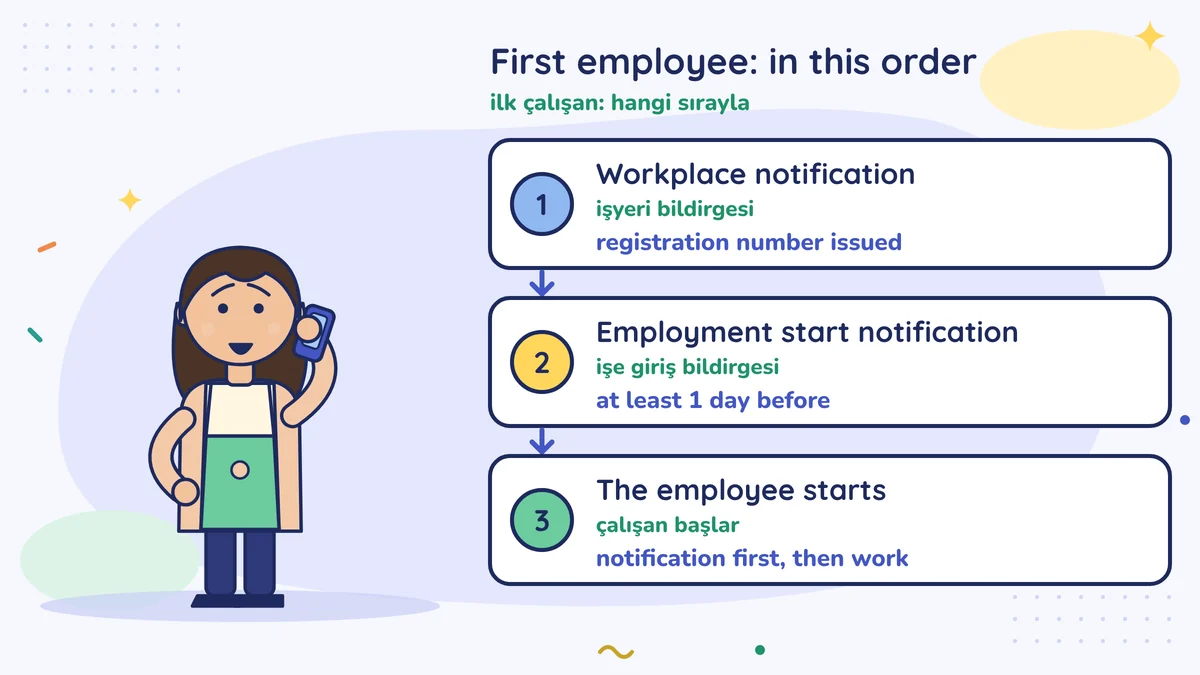
Before your first employee starts, you introduce your workplace to SGK (Social Security Institution) with a workplace notification (işyeri bildirgesi); the last day in the law is the day the first insured employee starts work, but because you will need the registration number, it is easier to give it a few days earlier. As a rule, the employee's employment start notification (işe giriş bildirgesi) is given through e-Sigorta at least one day before they start work; workplaces giving SGK a workplace notification for the first time get extra time for the first month, but the simplest way is still to give it in advance. Most of the time your mali müşavir (accountant) does these jobs; your task is to tell them the date early.
Zeynep Hanım the florist's Valentine's Day rush
Zeynep Hanım's florist's shop has been a one-person business for two years. As February approached, she couldn't keep up with the orders; she decided to start Derya, her neighbour's daughter, on Monday. On Friday evening she called her mali müşavir (accountant): "Someone starts on Monday, we'll do her insurance, won't we?" The mali müşavir first asked a question: "Does the shop have a workplace file with SGK (Social Security Institution)?" It didn't. Because until now she had never employed an insured worker.
Zeynep Hanım was registered with the tax office, and she herself was covered by Bağ-Kur (social security for the self-employed). But these do not mean the workplace is registered with SGK as an employer. Taking on an employee means opening a new door in SGK's eyes.
The workplace file: the shop's door number at SGK
In a block of flats, every flat has a door number; the post comes to that number. At SGK, too, every workplace has a workplace registration number (işyeri sicil numarası). All the notifications about the employees are made to this number. Without the number, you cannot register the employee's insurance start.
The form you give to get this number is called the workplace notification (işyeri bildirgesi). According to SGK's own page:
- The workplace notification is given on the date you start employing insured workers at the latest (Law No. 5510 art. 11).
- You apply on e-Devlet (e-Government) on the screen "Workplace Notification (for Those Employing 4-a Insured Persons)" (İşyeri Bildirgesi (4-a'lı Sigortalı Çalıştırılanlar Yönünden)); you attach the documents showing the workplace as PDF or JPEG.
- The social security centre or provincial directorate you are attached to approves the notification; after approval, the workplace registration number is issued.
The last day the law gives you is the first employee's first day. But because you cannot give the employment start notification before the registration number arrives, don't leave this to the last day. Giving it a few days in advance is easiest.
Once the registration number is issued, you get a password specific to the workplace so you can log in to SGK's electronic screens for employers (such as e-Sigorta and e-Bildirge). In most businesses the mali müşavir handles these jobs.
The employee's start: one day before
After the file is opened, it is the employee's turn. The insured employment start notification (sigortalı işe giriş bildirgesi) says "this person started at this workplace on this date". SGK's general rule is this: the notification is given through e-Sigorta at least 1 day before the employee starts work. In some work, such as construction, agriculture and fishing, there are different time limits; in ordinary work such as a florist, a coffee shop or a hairdresser, the rule is "notification first, then work".
If Derya starts on Monday, under the general rule her notification must be given by Sunday at the latest.
One SGK exception directly concerns people hiring for the first time, like Zeynep Hanım: in workplaces giving SGK a workplace notification for the first time, for people hired within one month after the date the workplace started employing insured workers, the start notification counts as on time if it is given within one month from the date the workplace started employing insured workers. Your mali müşavir will tell you whether this exception fits your workplace and how the days are counted. The simplest and least risky way is still "notification first, then work".
Zeynep Hanım's mali müşavir wanted to keep this order too: first the workplace file, then Derya's start notification, then the work. That is why the mali müşavir suggested moving Derya's start a few days later. Two days may look like a loss, but it is much cheaper than the trouble of correcting things afterwards.
What changes every month with your first employee?
When the employee arrives, new jobs are added to the shop's monthly routine:
| What | When | Who usually does it |
|---|---|---|
| Paying the salary | On the day written in the contract | You |
| Payroll (bordro), that is, the monthly list where the salary, deductions and premiums are calculated | Every month | Mali müşavir |
| Withholding and premium service return (muhtasar ve prim hizmet beyannamesi) (the employee's days, earnings, tax withheld) | By the 26th of the following month | Mali müşavir |
| Paying the SGK premium | By the end of the following month | You (the mali müşavir tells you the amount) |
| Paying the tax withheld from the employee's salary | By the 26th of the following month (together with the return) | You |
| Employment termination notification (işten ayrılış bildirgesi) | Within 10 days after the employee leaves | Mali müşavir |
For private-sector employers, the return in the table is a single notification that goes both to SGK and to the tax office. If you are a tradesman taxed under simplified taxation (basit usul), the tax withholding side may work differently, but the employee's days and earnings are still notified every month; ask your mali müşavir how this applies to you. Your own Bağ-Kur premium runs separately; taking on an employee does not change it (you can look at the lesson SGK and Bağ-Kur registration).
On top of these, being an employer has other consequences too: basic duties for the employee's health and safety, a personnel file for each employee, an employment contract. We explain these one by one in the other lessons of this module. To see on which day the money goes out, the article Tax calendar (in Turkish) is also useful.
What do you do if you missed it?
Did you start the employee but the notifications were not given? Hiding it doesn't fix the situation. Call your mali müşavir the day you notice; have them give the missing notifications straight away. SGK imposes an administrative fine (idari para cezası) for a notification given late (Law No. 5510 art. 102); your mali müşavir will tell you how much it is and how to keep it as low as possible. A delay corrected early usually ends much more lightly than a long period of unregistered work.
Three frequently asked questions
I have a limited company; is the process different? A little. The notification made to the trade registry directorate when the company is set up counts as made to SGK (Law No. 5510 art. 11); that is why in companies the workplace file is usually opened automatically together with the company's set-up. But you may need to hand in documents separately for the e-Sigorta password; and if no insured worker has been employed for a long time after the set-up, the file may have been taken out of scope. In a sole proprietorship, the workplace notification is given separately. In both cases, the first job is to ask your mali müşavir whether the file is open.
They will work half days; do I need to notify for them too? Yes. Someone working half days or a few days a week is also insured, and the employment start notification is subject to the same rule. The number of days of the month that are notified may differ from a full-time employee; make this clear with your mali müşavir.
What if I open a second shop? Opening a separate workplace at a separate address may require a separate file at SGK. Ask your mali müşavir before you open it.
Three pieces of information to take to your mali müşavir
- The day the employee will start and the working hours (full day or half day).
- The employee's identity details, the gross wage agreed, and whether they are retired or a foreign national (the type of notification changes with this).
- The workplace address and documents showing the workplace, such as the lease.
Zeynep Hanım sent these on Saturday. The workplace notification was given on Monday; when the registration number arrived, Derya's start notification was made, and Derya was behind the counter on Wednesday morning. There were still two weeks to Valentine's Day.
Do this this week
Send your mali müşavir (accountant) a short message: "I'm thinking of starting my first employee on this date. What do you need from me for the workplace notification, and how many days in advance should I let you know?" Write the answer down. Set the employee's start date according to this answer, not the other way round.
Common mistakes
- Thinking your tax registration or Bağ-Kur is the workplace file. Being registered with the tax office and covered by Bağ-Kur does not mean the workplace is registered with SGK as an employer; with the first employee, the workplace notification is given separately.
- Starting the employee with "let's try for a week, then we'll insure them". The employee is insured during the trial period too; as a rule, the employment start notification is given at least one day before they start work.
- Telling your mali müşavir the start date on the last day. The registration number and password steps can take time; telling them the date a week in advance makes the job easier.
Sources
- SGK: Workplace, employer and notification of the workplace (İşyeri, İşveren ve İşyerinin Bildirimi)
- SGK: The employer's obligations (employment start, termination, withholding and premium service return, premium payment) (İşverenin Yükümlülükleri)
- SGK Circular 2018/11, automatic workplace registration (when a company is set up) (Lexpera)
- Social Insurance and General Health Insurance Law (Sosyal Sigortalar ve Genel Sağlık Sigortası Kanunu), Law No. 5510, art. 8, 11 and 102
Translated from the Turkish lesson. Last checked against Turkish rules: 9 October 2026. Not yet reviewed by a licensed accountant.
This is general information about Turkish rules, not financial, tax or legal advice. Rules change; check the date and the sources, and ask a licensed accountant (mali müşavir) about your own situation. Disclaimer