The employment contract: types, probation period and why in writing
Shaking hands with an employee is also an employment contract; but when a dispute arises, nobody can show the handshake. How does the Labour Law (İş Kanunu) regulate open-ended and fixed-term contracts, part-time contracts and the probation period, and what do you gain by putting it in writing?
As a rule, an employment contract is not tied to a special form, but contracts of one year or longer are made in writing; and if you agreed verbally, you must give the working conditions in writing within two months. In most small businesses, the right choice is an open-ended contract (belirsiz süreli sözleşme). The probation period (deneme süresi) is at most two months (it can be extended to four months only by a collective agreement) and is written into the contract.
Elif Hanım the hairdresser's assistant
Elif Hanım took on Burcu as an assistant hairdresser at her salon. They talked, agreed and shook hands. Three months later, Burcu didn't want to work on Sundays: "We never talked about Sundays." Elif Hanım said "We did." They could both have been right; but there was nothing on paper.
Nobody rents a shop with a handshake; you write the rent, the increase and the conditions for leaving into the lease. The employment contract is the lease between you and your employee: who will do what, for how much pay, on which days, at which hours.
Is it compulsory to put it in writing?
Under Labour Law (İş Kanunu) art. 8, unless the law says otherwise, an employment contract is not tied to a special form. But there are two rules:
- Contracts lasting one year or longer are made in writing.
- If no written contract was made, the employer gives the employee, within two months at the latest, a written document showing the general and specific working conditions, the daily or weekly working time, the basic wage and its supplements, the wage payment period, the duration if it is fixed-term, and the termination provisions. This document is not needed for fixed-term work that does not last more than one month.
Under the law, these contracts are exempt from stamp duty and fees; putting it in writing doesn't cost you extra tax.
An open-ended contract has no end date; that is why making it in writing too is the safest way. In short: write it down in every case. Even a two-page text is enough.
Get to know the four types
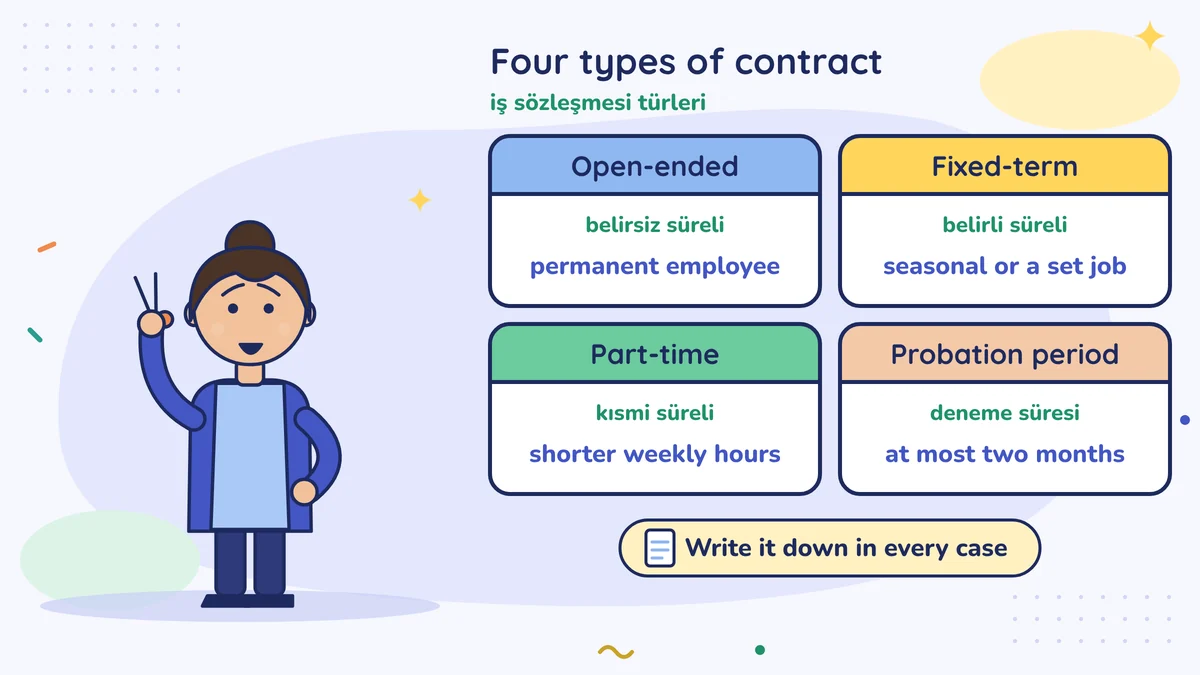
| Type | What it means | When it fits |
|---|---|---|
| Open-ended (belirsiz süreli) | No end date; it lasts until one of the parties ends it | A permanent employee (most cases) |
| Fixed-term (belirli süreli) | Tied to a set period or to a particular job being finished | Seasonal work, a particular project, covering for someone on leave |
| Part-time (kısmi süreli) | Weekly hours considerably shorter than a full-time employee's | Only in the afternoons, or a few days a week |
| With a probation period (deneme süreli) | A trial period added to the start of any contract | Getting to know each other in the first two months |
Open-ended (art. 11): Every working relationship not tied to a period is open-ended. Permanent jobs, like Elif Hanım's assistant, fall here.
Fixed-term (art. 11): In fixed-term work, it is made in writing based on an objective reason, such as a particular job being completed or a particular event happening. Without a material reason, it cannot be renewed back to back (in a chain); if it is, the contract counts as open-ended from the start. That is why the idea "we'll renew it every six months and won't be tied down" doesn't work.
Part-time (art. 13): If the weekly working time is considerably shorter than that of an employee doing the same job full time, the contract is part-time. A part-time employee cannot be treated differently just because they work half days, without a justified reason; the wage and divisible rights are paid in proportion to the time they work. The number of days notified to SGK (Social Security Institution) may differ from a full-time employee; ask your mali müşavir (accountant) how it will be notified.
The probation period (art. 15)
If the parties put a probation period into the contract, this period can be at most two months. If there is a collective agreement (toplu iş sözleşmesi), that is, an agreement made with a trade union, it can be extended up to four months; this is rare in small businesses.
During the probation period, both parties can end the contract without waiting for a notice period and without paying compensation. But the wage for the days the employee has worked up to that day, and their other rights, are paid. The probation period does not mean "a trial without insurance" either; the employee is insured from the first day (Before your first employee: opening a workplace file with SGK).
For the probation period to work, it must be written into the contract. A probation period that isn't in writing is hard to prove later.
What should be in the contract?
- The names and identity details of the parties, the workplace address
- The work to be done, briefly and clearly
- The start date and, if there is one, the probation period
- The gross wage (stating clearly whether it is net or gross), the payday and the payment method
- The weekly working days and hours, the weekly day off
- If overtime may be needed, the employee's written consent on this (the law requires the employee's consent for overtime)
- If it is fixed-term, its duration and reason
- The signatures of both parties and the date
You can find a ready-made example and adapt it to your business. If your work has a special side (confidentiality, a non-compete clause, a bonus scheme), don't sign it before showing it to an employment lawyer or your mali müşavir.
When writing the wage, the tables in the lesson What an employee really costs you help with the difference between gross and net. If you want to see the whole first-employee process in a single article, look at the article When hiring your first employee (in Turkish).
If you want to change something later
While the work goes on, conditions can change: hours shift, the role widens, the working days change. Under Labour Law art. 22, the employer can make a material change to working conditions by notifying the employee in writing. If the employee does not accept this change in writing within six working days, the change does not bind them. The parties can always change the conditions by agreement, but the change does not apply retroactively.
In practice this means: saying "From tomorrow you're coming in on Sundays too" is not enough. Write the change down, give it to the employee, get their signed acceptance. If the employee doesn't accept, the employer can end the contract by explaining the valid reason for the change in writing and respecting the notice period; and the employee can take legal action against this. Before it gets to that point, consult an employment lawyer.
If you missed it
Has your employee already started and there's no paper? Sit down today, put what you agreed in writing, and have both parties sign. A text in which you honestly write what was agreed is always better than nothing at all.
That is what Elif Hanım did too. She sat down with Burcu and they wrote the working days together; Sunday went into the contract as twice a month, with one weekday off in return.
Do this this week
Write everything you discussed with your employee (or the person you will hire) on a single page: the work, the gross wage, the payday, the working days and hours, the probation period. Show this page to your mali müşavir (accountant), then sign two copies; give one to the employee.
Common mistakes
- Not giving any written document at all. Even if you agreed verbally, you must give the working conditions in writing within two months; in a dispute, this paper is the only thing you can rely on.
- Thinking the probation period means working without insurance. The employee is insured during the probation period too; as a rule, the employment start notification is given before the first day.
- Not writing the probation period into the contract. A probation period that isn't in writing is hard to prove in a dispute; it can be at most two months and it must be on paper.
Sources
Translated from the Turkish lesson. Last checked against Turkish rules: 9 October 2026. Not yet reviewed by a licensed accountant.
This is general information about Turkish rules, not financial, tax or legal advice. Rules change; check the date and the sources, and ask a licensed accountant (mali müşavir) about your own situation. Disclaimer