How do you register the start of business? Step by step
Before you open your own business, or as soon as you open it, you need to give the tax office (vergi dairesi) a start-of-business notification (işe başlama bildirimi). In this lesson you see, step by step, the time limit, who can make the notification, what goes on the form and what is checked during the inspection (yoklama).
The owner of a sole proprietorship (şahıs işletmesi) must give the tax office a start-of-business notification within 10 days of the date they start work. You can do it yourself on the Internet Tax Office (İnternet Vergi Dairesi), or have your mali müşavir (accountant) do it. After that, the tax office carries out an inspection at your workplace.
Elif the hairdresser's key at the door
Elif worked as a hairdresser for ten years. Now she is opening her own salon: the lease is signed, the mirrors are in place, and the sign goes up tomorrow. One thing is missing: in the eyes of the state, Elif is not yet "someone doing business". Before she opens the door, she needs to tell the state.
This notification is called the start-of-business notification (işe başlama bildirimi). It means telling the tax office (vergi dairesi), that is, the state office that handles your tax matters, "I have started doing this work at this address". With this notification your tax liability (mükellefiyet) begins: from now on you are a registered business owner with a duty to pay tax.
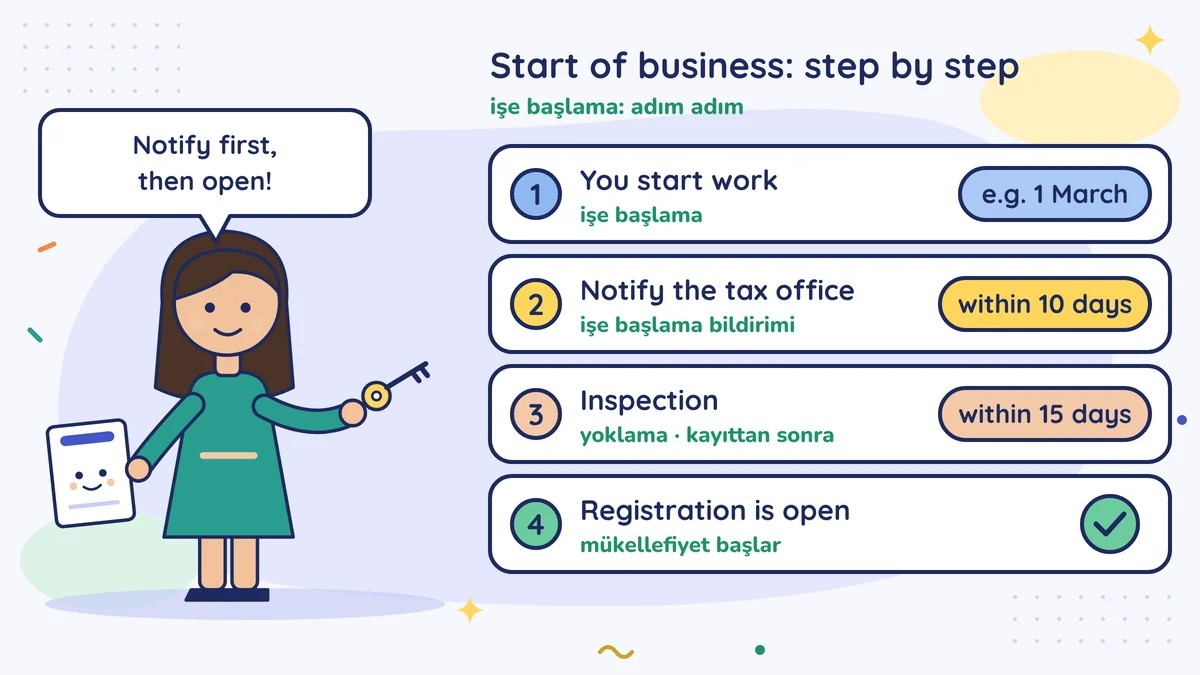
Time limit: 10 days from the day you start work
Under the Tax Procedure Law (Vergi Usul Kanunu, VUK) (art. 153 says who must notify, art. 168 gives the time limit), you need to notify the start of business within 10 days of the start date. The Revenue Administration's (GİB) own explanatory file gives the same time limit.
Note: the "start of business" date is not the day you write on paper, it is the day you actually start work. The law (VUK art. 154) counts opening a workplace as starting business; you don't need to wait for your first sale. If Elif's salon opens its door and takes customers on 1 March, the 10-day counter starts on 1 March. That is why it is easiest to prepare the documents before you open.
If you don't notify on time, the tax office may impose an irregularity penalty (usulsüzlük cezası). If you start work without notifying at all, the situation is more serious: a record can be opened going back to the date the business actually started. Penalty amounts change every year; ask your mali müşavir (accountant) for the current ones.
Who notifies, and how?
As a real person (sole proprietorship), you can choose one of these ways:
- Yourself: on GİB's Internet Tax Office (İnternet Vergi Dairesi) (ivd.gib.gov.tr). You log in with your e-Devlet (e-Government) password, fill in the "Start/Cessation of Business Notification" (İşe Başlama/Bırakma Bildirimi) form and send it. There is also a mobile app. Or you go to the tax office you will be attached to with the form.
- Your mali müşavir or your lawyer: according to GİB's explanation, authorised professionals (mali müşavir, independent accountant; Law No. 3568) and lawyers (Law No. 1136) can make the notification on your behalf.
Because it is her first business, Elif chose to have her mali müşavir do it. Not a bad choice: the risk of a mistake is low, and they check the address and the type of business together. For details, see the lesson What a mali müşavir does and does not do.
If you are setting up a company (limited, joint-stock), it is different: the trade registry (ticaret sicili) passes the notification to the tax office. This lesson is for sole proprietorships.
What will you write on the form?
According to GİB's explanation, the notification includes the following information:
- Your name and surname and your identity details
- The type of work you will do (for example, hairdressing)
- The workplace address
- The start date
Take with you the document showing that the workplace is yours or that you rent it (such as the lease), and your ID. Which documents are asked for can vary by tax office and by business; your mali müşavir or the office itself will give you a clear list. Chamber registration and the municipal licence are handled by separate bodies. If you are a tradesman (esnaf), you register with the chamber of tradesmen and craftsmen (esnaf ve sanatkârlar odası); if you are a merchant (tacir), with the chamber of commerce (ticaret odası). Which one you join depends on the type and size of your business. Ask your mali müşavir which step to take in which order; they know the order for your type of business.
What happens next? The inspection
After the notification, the tax office checks whether your workplace is really there. This is called an inspection (yoklama). Usually an inspection officer from the tax office comes to the workplace and enters what they see into the electronic inspection system. Think of it as someone coming to a grocery shop to check "is this really a shop?"
So that the inspection goes smoothly:
- Make sure the address you notified is the real address.
- Have your sign up, and your lease and ID to hand. (Your municipal licence may not be issued yet; don't hold back the notification for it.)
- On the inspection day, make sure you or someone who knows you is at the workplace.
- Keep an eye on your phone and e-mail, so the tax office can reach you.
According to GİB's explanation, the start-of-business inspection is carried out within 15 days at the latest from the date the registration is opened. You can find out the details by calling your tax office or your mali müşavir.
What do you have when the notification is done?
Your tax liability is established; in other words, your registration is opened. You now exist in the tax office's records, together with your type of business. In a sole proprietorship, your T.C. identity number (T.C. kimlik numarası) is also used as your tax number. You can issue invoices and get your tax certificate (vergi levhası). We explain the certificate in the next lesson (What is a tax certificate and where do you get it?). The same registration also makes you covered by Bağ-Kur (social security for the self-employed); you will see that in the Bağ-Kur lesson.
Whether you will pay tax under simplified taxation (basit usul) or real taxation (gerçek usul) is also decided at this stage; we covered that in the lesson Simplified taxation or real taxation?. If you haven't yet decided between a sole proprietorship and a limited company, go back to the lesson Decide in 4 questions first.
What should you watch out for while the notification is pending?
Most people opening their first business leave the notification with "I'll sort it out at the last minute". Then with the sign, the licence and the rent, before you know it the 10 days are over. Elif knew this, so she wrote two notes in her calendar: the opening day and the tenth day after opening. She prepared her documents the week before opening, and her mali müşavir gave the notification on the opening day; that way she didn't race the counter.
And don't forget this: if the information you gave in the notification changes later (address, type of business), you also need to notify the tax office of that. The change notification is made in the same place.
Elif's checklist
- I have fixed the date I will open the business.
- My lease and my ID are ready.
- I have decided who will make the notification (me or my mali müşavir).
- I gave the notification within 10 days of the day I started work.
- My address, sign and phone are ready for the inspection.
Having completed these five items, Elif opened the salon with peace of mind.
Do this this week
Write the address, the type of work and the start date of the business you are thinking of opening on a single sheet of paper. Add your lease and your ID to it. Decide whether you or your mali müşavir will make the notification; if you have a mali müşavir, send them the sheet and ask: "With this information, when shall we give the start-of-business notification?"
Common mistakes
- Saying "I'll open first and notify later". The time limit counts from the day you actually start work; the day you open the shop counts too, it doesn't wait for the first sale. If you are late, an irregularity penalty may follow.
- Notifying an address that is not real, or an old one. If the workplace cannot be found during the inspection, the registration runs into problems.
- Thinking everything is done because you gave the notification. The tax certificate, Bağ-Kur, the licence and the tradesmen's chamber are separate steps.
Sources
Translated from the Turkish lesson. Last checked against Turkish rules: 7 October 2026. Not yet reviewed by a licensed accountant.
This is general information about Turkish rules, not financial, tax or legal advice. Rules change; check the date and the sources, and ask a licensed accountant (mali müşavir) about your own situation. Disclaimer