Young entrepreneur exemption and start-up support
If you are setting up a business for the first time before turning 29, you can benefit from an income tax exemption for three years. In this lesson you see the logic of the conditions, how the amount is set, and how to look at start-up support such as KOSGEB.
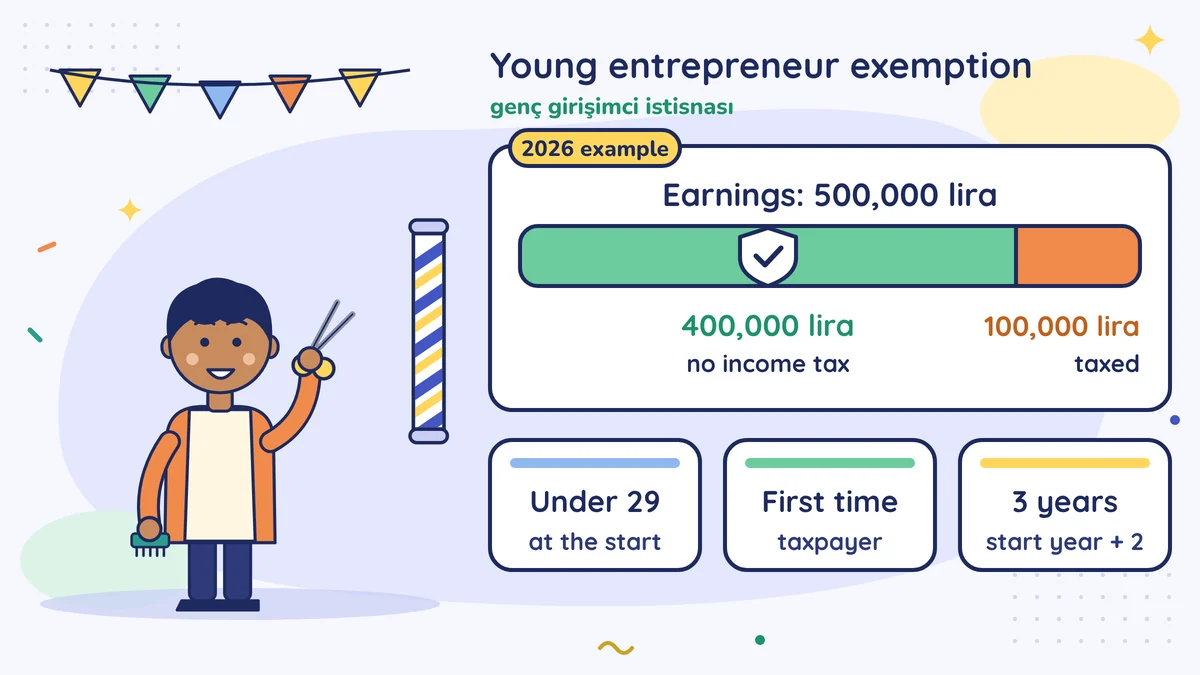
The young entrepreneur exemption (genç girişimci istisnası) keeps a certain part of the earnings of people who become income taxpayers for the first time, and who have not turned 29 on the date their tax liability starts, exempt from tax for three years. The exemption amount is the second bracket amount in that year's income tax tariff; for 2026 it is 400,000 lira. Support from bodies such as KOSGEB is a separate topic.
Emre the barber's first shop
Emre is 24. He worked as a journeyman (kalfa) for two years, and now he is opening his own barber's shop. He has never been a taxpayer. He has heard that there is a "tax exemption for young entrepreneurs". Is it true, who benefits, and what does he need to do?
What is the young entrepreneur exemption?
It is an income tax exemption in repeated article 20 of the Income Tax Law (Gelir Vergisi Kanunu). So it is not a cash grant: a certain part of your earnings is not taxed. The logic on paper is this: when a young person sets up their first business, the tax burden should be light.
The exemption is only for income tax (gelir vergisi). Other obligations such as VAT (KDV) and stamp duty (damga vergisi), and the Bağ-Kur (social security for the self-employed) premium, are separate from it.
The logic of the conditions
The conditions are detailed in the law and the communiqué. The general framework:
- Age: You must not have turned 29 on the date your tax liability starts.
- Taxpayer for the first time: You must not have been an income taxpayer before because of commercial, agricultural or professional earnings. Working for a wage, as a journeyman for example, does not make you a taxpayer.
- Notification on time: You must have notified the tax office that you started work within the legal period, that is, within 10 days. If you are late, you may lose the exemption. How to do it is in the lesson How do you register the start of business? (in Turkish).
- Working yourself: You will work in your business yourself or run it yourself.
- Type of business: It applies to a sole proprietorship (şahıs işletmesi). In an ordinary partnership (adi ortaklık), all partners must meet the conditions. If you later become a partner in an existing business, you cannot benefit. If you are a partner in a limited or joint-stock company, this exemption does not apply.
- Transfer from a relative: The exemption does not apply to a business you take over from your spouse or from a relative up to the third degree (such as your mother, father, sibling, or paternal or maternal uncle).
The exemption lasts three years: the year you start work and the following two years.
How much is it?
The exemption amount is tied to a rule in the law: the upper limit of the second bracket in that year's income tax tariff (this has been the case since 2023; before that it was a fixed 75,000 lira). For 2026 this amount is 400,000 lira. Because the tariff is updated every year, the amount also changes every year; in later years, look at the current tariff.
The logic is simple: you pay no income tax on earnings below the exemption amount, and the part above it is taxed normally. Example: if you earn 500,000 lira in 2026, 400,000 lira of it is exempt, and tax is calculated on the remaining 100,000 lira.
A note: if you are under simplified taxation (basit usul), your earnings are already exempt from tax under a separate exemption (GVK art. 20/A); the young entrepreneur exemption is mainly useful for those under real taxation (gerçek usul). This matters for Emre: barbering is not on the list of businesses that moved to real taxation in 2026; if his district and figures fit, he can use simplified taxation. Ask your mali müşavir (accountant) which one applies, and whether you can use this exemption if you move to real taxation later.
Application and notification
How this exemption is reported (which screen, which line on the return) is detailed in practice and can change over time. Your mali müşavir takes this exemption into account when preparing your start-of-business notification and your return; tell them your date of birth and whether you have ever been a taxpayer before (if you are not sure, ask the tax office). If the conditions are broken or the declaration is wrong, tax, late payment interest and penalties may come up later; so asking before you start is easier than trying to fix it afterwards.
What path do you follow over the three years?
The exemption is a good opportunity, but it should not turn into "I have no tax" complacency. Over the three years, do the following:
- Record your income and expenses every month. You want to see in the middle of the year whether you are getting close to the exemption amount.
- Keep your documents; even with the exemption, expense documents, invoices and receipts are part of your record-keeping.
- Towards the end of the third year, work out with your accountant "what will my tax be when the exemption ends". Starting to pay tax in the fourth year should not be a surprise; set money aside for that year.
- If your business grows and you are thinking of moving to a company, ask in advance how the move affects the exemption. Being a company partner prevents you from using this exemption.
Where is start-up support?
Apart from the income tax exemption, there is other support for entrepreneurs. The best known is KOSGEB (Small and Medium Enterprises Development Organisation): it offers small businesses training, consulting and some grant and loan support. Which programmes are open, who can apply and how much support is given change over time; that is why we don't write amounts. For current programmes, look at KOSGEB's own website, and don't apply without reading the conditions.
Watch out: don't fall for middlemen and fake sites that say "we'll get you a grant, make an advance payment". Applications are made only through the body's official website or e-Devlet.
Emre's roadmap
- He confirmed with the tax office that he had not been a taxpayer before.
- Before opening the shop, he told the mali müşavir his age and his situation.
- He asked in writing whether he would be under simplified or real taxation, and whether the exemption would be useful for him.
- He looked at KOSGEB's current programmes; he will read their conditions and then decide.
When your preparation is short but done properly, you can plan your tax comfortably for three years.
Don't mix up the exemption and Bağ-Kur
Young entrepreneurs often confuse two topics. The income tax exemption is about tax. The Bağ-Kur premium is about social security and is a separate calculation. As the owner of a sole proprietorship you need to pay premiums; you will see the premium topic in the lesson SGK and Bağ-Kur registration (in Turkish). In the past, young entrepreneurs were given one year of Bağ-Kur premium support. According to the SGK (Social Security Institution) announcement, this support was ended as of 31 December 2025. So a young entrepreneur who starts work in 2026 pays the Bağ-Kur premium even if they benefit from the tax exemption.
Do this this week
You may be a young entrepreneur, or you may know one. Find out three things: Have you been a taxpayer before? How old will you be on the date you start work? Will you work in the business yourself? Write down the answers, take them to your mali müşavir and ask: "Does this exemption apply to me, and will I be under simplified or real taxation?"
Common mistakes
- Thinking the exemption is a cash grant. It is a tax exemption; no tax is calculated on part of your earnings.
- Saying "I've never done business before" and forgetting an earlier tax liability. If you were a taxpayer once before, the exemption may not apply.
- Notifying the start of business late. If the 10-day period is missed, the exemption may be lost. Also don't forget that partners in limited and joint-stock companies cannot benefit from this exemption at all.
Sources
- Income Tax Law (Gelir Vergisi Kanunu), Law No. 193, repeated art. 20 (earnings exemption for young entrepreneurs)
- GİB, Earnings Exemption for Young Entrepreneurs guide, 2019 (TÜRMOB copy; amount information outdated)
- SGK announcement: end of the young entrepreneur premium support on 31.12.2025 (İSMMMO, 22.12.2025)
- KOSGEB, current support programmes
- 2026 income tax tariff, Income Tax General Communiqué Serial No. 332 (Alomaliye)
Translated from the Turkish lesson. Last checked against Turkish rules: 7 October 2026. Not yet reviewed by a licensed accountant.
This is general information about Turkish rules, not financial, tax or legal advice. Rules change; check the date and the sources, and ask a licensed accountant (mali müşavir) about your own situation. Disclaimer