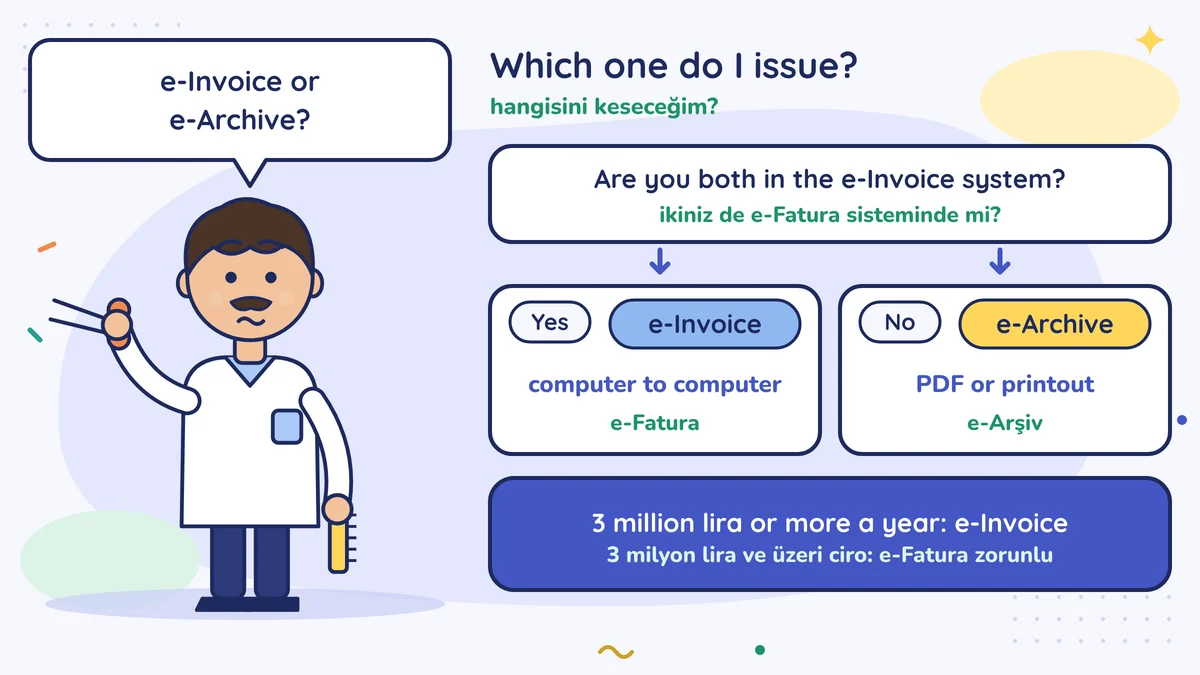
e-Invoice or e-Archive? Which one do I issue?
When you issue your first invoice, the first question is: e-Invoice (e-Fatura), e-Archive (e-Arşiv) or a receipt (fiş)? You decide in four steps: your turnover, the other party's status, the amount and your type of books. The figures are the ones that apply for 2026.
If the other party is registered in the e-Invoice (e-Fatura) system and you are registered too, you issue an e-Invoice; if not, you issue an e-Archive invoice (e-Arşiv fatura). If the buyer is a consumer and the amount does not exceed 12,000 lira for 2026, a receipt (fiş) is enough. If you are issuing an invoice, on the balance sheet basis (bilanço esası) you issue it electronically whatever the amount; under simplified taxation (basit usul) and the business account basis (işletme hesabı) you can issue a paper invoice up to 3,000 lira including taxes until 31 December 2026.
Murat the barber's first customer
Murat has just opened his shop. In the first month a friend came in for a haircut and said, "I want an invoice." Two words came to Murat's mind straight away: e-Fatura, e-Arşiv. Both are an "electronic invoice". Which one will he issue?
The answer doesn't depend on Murat's choice; it depends on the answers to a few questions. First, let's explain the two words.
- e-Invoice (e-Fatura): If both the buyer and the seller are registered in the e-Invoice system, the invoice goes from computer to computer. No paper.
- e-Archive invoice (e-Arşiv fatura): If the other party is not in the e-Invoice system (most of the time a private person or a small tradesman), you still issue the invoice electronically, but you give it to the customer as a PDF or a printout. The invoice details are reported to the Revenue Administration (Gelir İdaresi Başkanlığı, GİB).
For a longer explanation of the difference, you can look at the article The difference between e-Invoice and e-Archive. Here we focus on the decision steps.
Step 1: Do you have to join the e-Invoice system?
The obligation depends on turnover (ciro). Today's general framework is as follows (VUK General Communiqué No. 509, VUK 509 Sıra No'lu Tebliğ):
- If the previous year's gross sales revenue (brüt satış hasılatı, that is, your yearly sales) is 3 million lira or more, you need to switch to e-Invoice on 1 July of the following year. So for those whose 2025 revenue exceeded 3 million lira, the date is 1 July 2026.
- For some groups, such as those who sell online and those who buy, sell or rent real estate and motor vehicles, the limit is 500,000 lira. For some sectors, turnover is not looked at.
For a newly opened shop these limits are usually far away. But two notes: even if you are not obliged, you can switch voluntarily. And if your business is in one of these special groups, the limit is much lower or there is none at all. In these special groups, a newly opened business may be asked to switch within a short time, without waiting for the end of the year. Be sure to ask your mali müşavir (accountant) about your own situation when you start your business; the limits can change from year to year.
Step 2: Is the other party an e-Invoice taxpayer?
If you are an e-Invoice taxpayer and your customer is too, you issue the invoice as an e-Invoice. If the customer is not in the e-Invoice system, you issue an e-Archive invoice.
How do you find out whether the customer is in the system? You look up their tax identification number (vergi kimlik numarası, VKN) in GİB's list of registered e-Invoice users. Or you ask the customer; companies usually know. Asking is the easiest way.
If you are selling to a private person (a consumer), that person is not in the e-Invoice system anyway. There the answer is e-Archive or, if the amount is small, a receipt.
Step 3: Paper, electronic or a receipt?
There are four situations here. The receipt limit is based on VUK General Communiqué No. 588, and the paper invoice rule on Communiqué No. 509 and Communiqué No. 589, which amends it (588 and 589 were published in the Official Gazette (Resmî Gazete) dated 31 December 2025).
| Situation | What happens in 2026 |
|---|---|
| The buyer is a consumer, the amount does not exceed 12,000 lira | An invoice is not required; a retail sales receipt (perakende satış fişi) or a cash register receipt (yazarkasa fişi) is enough. If the customer asks, an invoice is still issued. Ask your mali müşavir whether VAT (KDV) is included in the limit. |
| The buyer is a taxpayer (a company or a tradesman) | An invoice is issued whatever the amount. |
| You keep books on the balance sheet basis (bilanço esası) | Since 1 January 2026, every invoice you issue is an e-Archive or e-Invoice, whatever the amount. |
| You keep books under simplified taxation (basit usul) or on the business account basis (işletme hesabı esası) | Until 31 December 2026 you can issue a paper invoice up to 3,000 lira including taxes. If the amount is above this, e-Archive. From 1 January 2027 the amount makes no difference: e-Archive. |
This table changes according to your type of books. Your mali müşavir knows which group you are in. Most sole proprietorships look at the last row; limited and joint-stock companies, on the other hand, are always on the balance sheet basis. We saw this distinction in the lesson Simplified taxation or real taxation?
Step 4: Where will you issue the invoice from?
There are three ways to issue an electronic invoice:
- GİB e-Archive Portal (e-Arşiv Portal): The state's free portal. You apply and log in with your Internet Tax Office (İnternet Vergi Dairesi) details; do the setup together with your mali müşavir. It is enough for small businesses.
- Private integrator (özel entegratör): Paid programs that issue and send invoices. If you issue a lot of invoices, they save time.
- Pre-accounting program (ön muhasebe programı): It brings customer and product details from your records; how the invoice is officially transmitted depends on the program, so ask during setup.
In addition, Communiqué No. 593, which came out in May 2026, opened the way for e-documents to be issued from new-generation cash registers too. This is not an obligation, and it is only possible on devices GİB has approved; ask the seller whether your cash register supports it.
Murat chose the portal. He issues fifteen invoices a month; the free route is enough for him.
Murat's decision sheet
Murat wrote three lines on a sheet of paper:
- Turnover far below 3 million lira: no e-Invoice obligation for now.
- My customer is a private person: e-Archive or a receipt.
- My books are under simplified taxation (I asked my mali müşavir). Until the end of 2026, paper is possible for under 3,000 lira; still, to be ready for 2027, I will issue from the portal from the start.
Pay attention to the third line: the rule changes from 2027. Rather than starting with paper and changing your habit a year later, starting electronic from the beginning is less tiring.
When will you look at this again?
As your turnover grows, you may get close to the e-Invoice limit. At the start of every year, ask your mali müşavir, "Do I need to switch to e-Invoice this year?" Get the answer in writing.
Do this this week
Write these three things on a sheet of paper: your approximate sales amount last year, your type of books (ask your mali müşavir) and who your first three customers are (private persons or companies). Then ask your mali müşavir, "Which applies to me: e-Archive, e-Invoice or a receipt?" and get the answer in writing.
Common mistakes
- Issuing an e-Archive invoice to a company in the e-Invoice system. If both you and the buyer are in the e-Invoice system, the invoice must go as an e-Invoice; an invoice issued as the wrong type may be treated as invalid. Look up the buyer's tax number before you issue it.
- Looking for the rule without knowing your type of books. In the same year, 2026, the rules for simplified taxation and the balance sheet basis are different.
- Forgetting the next year's rule. For those under simplified taxation and on the business account basis, the paper invoice allowance ends on 31 December 2026.
Sources
- Alomaliye, VUK General Communiqué No. 589 (VUK Genel Tebliği Sıra No: 589) (e-Archive dates for simplified taxation and the business account basis postponed by one year; Official Gazette 31.12.2025, issue 33124)
- Alomaliye, VUK General Communiqué No. 588 (VUK Genel Tebliği Sıra No: 588) (2026 limits and amounts, invoice issuing limit 12,000 lira)
- PwC Türkiye, invoice issuing limit table (fatura düzenleme sınırı)
- Andersen, changes concerning e-documents (Communiqués No. 509 and 573; e-Invoice 3 million / 500,000 lira, e-Archive 3,000 lira)
- Alomaliye, VUK General Communiqué No. 593 (VUK Genel Tebliği Sıra No: 593) (e-documents from new-generation cash registers; Official Gazette 08.05.2026, issue 33247)
- GİB e-Document portal (e-Belge portalı)
Translated from the Turkish lesson. Last checked against Turkish rules: 7 October 2026. Not yet reviewed by a licensed accountant.
This is general information about Turkish rules, not financial, tax or legal advice. Rules change; check the date and the sources, and ask a licensed accountant (mali müşavir) about your own situation. Disclaimer