When do you need a dispatch note (irsaliye)?
Once goods are on the road, an invoice may not be enough. With Selim Usta the carpenter's wardrobe, you see what a dispatch note (irsaliye) is, when it is needed, how an invoice-cum-dispatch note (irsaliyeli fatura) makes things easier and who e-Dispatch (e-İrsaliye) covers.
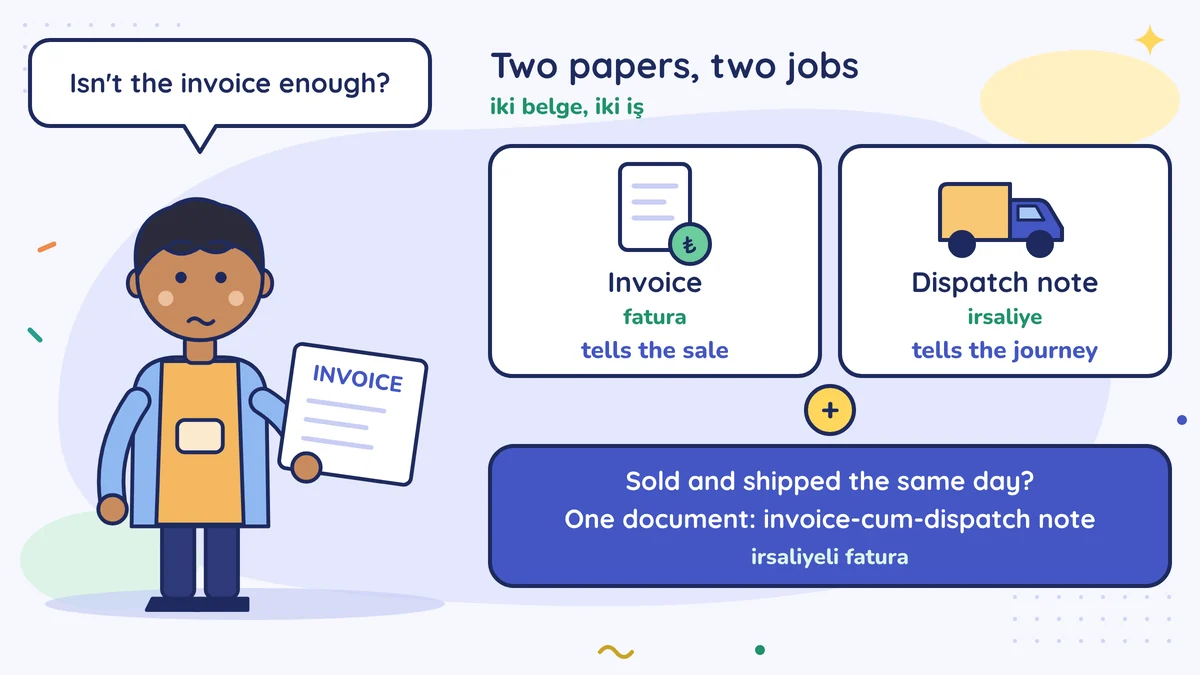
If goods are being moved from one place to another, a dispatch note (sevk irsaliyesi) is needed; the invoice describes the sale, the dispatch note describes the journey. If the final consumer carries goods they bought at retail themselves, an invoice or a receipt (fiş) is enough. If the sale and the shipment happen at the same time, an invoice-cum-dispatch note (irsaliyeli fatura) can be used as a single document; e-Dispatch (e-İrsaliye), on the other hand, is an obligation that depends on turnover and sector.
Selim Usta the carpenter's wardrobe is on the road
Selim Usta makes wardrobes. This week he will take a wardrobe to a customer in his own van. He issued the invoice. But a neighbouring tradesman said: "If the police stop you on the road, you need a dispatch note (irsaliye)." Selim Usta was surprised: "Isn't the invoice enough?"
The two documents answer different questions.
- Invoice (fatura): "These goods were sold, and the price is this much." It describes the sale.
- Dispatch note (sevk irsaliyesi): "These goods are right now being moved from here to there." It describes the journey.
The invoice is the paper of the sale; the dispatch note is the paper in the pocket of the person carrying the goods on the road. In traffic or in a warehouse, the dispatch note answers the question "whose goods are these, and where are they going?" We saw the invoice itself in the earlier lessons.
When is a dispatch note needed?
As a rule, a dispatch note is issued if goods are being moved from one place to another. If the seller carries the goods or has them carried by courier, the seller issues the dispatch note; if the buyer carries the goods, the buyer issues the dispatch note (if both parties agree, the seller can also issue it). Examples:
- Selim Usta takes the wardrobe to the customer in his own van.
- A florist moves flowers bought wholesale from the warehouse to the shop.
- A tailor sends fabric from the workshop to another workshop for sewing.
There is one exception: if the final consumer carries goods they bought at retail themselves, an invoice or a receipt is enough. No dispatch note is written for the bread you buy from the neighbourhood grocer. But if goods ordered online go to the customer by courier, the person is not carrying the goods themselves; in that case a dispatch note or an invoice-cum-dispatch note is needed. A 2013 ruling (özelge) by GİB (an official answer given to a taxpayer's question) also says this; if you sell online, be sure to ask your mali müşavir (accountant).
Invoice-cum-dispatch note: one document instead of two
For Selim Usta, the most practical way is an invoice-cum-dispatch note (irsaliyeli fatura). The invoice and the dispatch note can be issued as two separate documents; but if the invoice is issued while the goods are being shipped, at the same time and with the shipping details, a single document may be enough. This document describes both the sale and the journey. In this case, no separate dispatch note is issued.
This is also possible if you issue the invoice as an e-Archive (e-Arşiv) or e-Invoice (e-Fatura): issue the invoice as the goods set off, make sure the hour and minute show on it, write "İrsaliye yerine geçer" (replaces the dispatch note) on the printout, sign it and take it along with the goods. For those who use e-Dispatch (e-İrsaliye), the rule is different.
When is it useful? If the sale and the shipment happen on the same day. The goods go today, the invoice is issued today. If you will issue the invoice later, the dispatch note is issued first and the invoice comes afterwards. But the invoice is still issued within 7 days at the latest after the delivery of the goods. Saying "I'll issue them all in one invoice at the end of the month" can go over this period; if you are thinking of a collective invoice, ask your mali müşavir. There are details in the article When is an invoice issued?
Paper dispatch note or e-Dispatch?
e-Dispatch (e-İrsaliye) is the electronic form of the dispatch note. The obligation applies to e-Invoice taxpayers who exceed a certain turnover. The current rule (VUK General Communiqué No. 509, VUK 509 Sıra No'lu Tebliğ):
- e-Invoice taxpayers whose gross sales revenue for a year is 10 million lira or more use e-Dispatch from 1 July of the following year. For example, for those whose 2025 turnover exceeded this limit, the date was 1 July 2026.
- Some sectors, such as mining, sugar, iron and steel, fertiliser and licensed fuel businesses, come under the scope regardless of turnover.
These limits and the sector list are updated as the legislation changes. Ask your mali müşavir about your own situation every year.
It is rare for a small business that is just starting to have turnover close to 10 million lira. So most businesses use a paper dispatch note or an invoice-cum-dispatch note for now. But if you become an e-Invoice taxpayer and your turnover grows, one day a "we are switching to e-Dispatch" letter may arrive. Asking your mali müşavir at the start of every year prevents this surprise. The article The difference between e-Invoice and e-Archive explains the general logic of these e-documents.
What is written on a dispatch note?
A small checklist:
| Field | Example |
|---|---|
| Sender | Selim Usta Mobilya, tax no. 1234567890 (example) |
| Recipient | Hasan Bey, address |
| Type and quantity of goods | 1 wardrobe |
| Date of issue | The shipping day |
| Where it is going | The customer's address |
Note: a dispatch note usually has no price on it. The price is on the invoice. The dispatch note is information about the goods, the quantity and the route.
Selim Usta's journey
Selim Usta asked his mali müşavir and decided, "I'll issue an invoice-cum-dispatch note." Because the wardrobe is over 3,000 lira, its invoice is e-Archive. While loading the wardrobe he issued the invoice, printed it out, wrote "İrsaliye yerine geçer" on it, signed it and got into the van. Nobody stopped him on the road, but if they had, that document was in his pocket.
The buyer, Hasan Bey, will also keep the same document; when the goods arrive he will check them off as "received". The dispatch note is the document that answers both parties' question "did the goods arrive complete?" You can find the retention period in the article Document retention period.
In short
- If goods are being moved, a dispatch note is needed; if a person carries them themselves, there is the retail exception.
- If the sale and the shipment happen at the same time, an invoice-cum-dispatch note makes things easier.
- e-Dispatch depends on a turnover limit; for a new business it is mostly far off.
- If you are not sure, ask your mali müşavir before the shipment; finding out on the road costs more.
Do this this week
Do you have a shipment in the coming month where you will send or carry goods by road? If so, ask your mali müşavir, "Should I issue a dispatch note or an invoice-cum-dispatch note for this shipment?" Even if not, write down the question "Am I within the scope of e-Dispatch?" and ask it.
Common mistakes
- Saying "I issued an invoice, a dispatch note is unnecessary". If the goods are on the road, the transport document is a separate matter; if the invoice does not carry shipping details, a dispatch note is needed.
- Confusing the dispatch note with the invoice. A dispatch note usually has no price on it; the official document of the sale is the invoice.
- Never asking about the e-Dispatch limit. As your turnover grows, an obligation to switch may arise; asking once a year is enough.
Sources
- Alomaliye, legal rules on the invoice, the dispatch note and the invoice-cum-dispatch note (Fatura, sevk irsaliyesi ve irsaliyeli fatura hakkındaki yasal düzenlemeler) (VUK 230/5)
- Lexpera, ruling (özelge) on the dispatch note in online sales (18.03.2013)
- GİB, information note on VUK General Communiqué No. 535 (e-Dispatch 10 million lira)
- TÜRMOB e-Transformation (e-Dönüşüm), frequently asked questions (an e-Invoice or e-Archive printout replacing the dispatch note)
- Uyumsoft, e-Dispatch switch obligation 2026 (e-İrsaliye geçiş zorunluluğu 2026)
Translated from the Turkish lesson. Last checked against Turkish rules: 7 October 2026. Not yet reviewed by a licensed accountant.
This is general information about Turkish rules, not financial, tax or legal advice. Rules change; check the date and the sources, and ask a licensed accountant (mali müşavir) about your own situation. Disclaimer