How to choose a mali müşavir (accountant): 7 questions
Choosing a mali müşavir (accountant) is like choosing a tailor in your neighbourhood: the good work comes not from the cheapest one, but from the one who understands you and gets back to you on time. Step by step, we look at the 7 questions to ask at the first meeting and what each answer tells you.
When you choose a mali müşavir (accountant), don't look at the price; look at 7 things: their authorisation, how quickly they will get back to you, what the fee covers, how you will hand over documents, how close they are to your kind of business, how they will remind you of tax dates, and how they will hand over your records if you leave. Getting the answers in writing is the safest.
Like choosing a tailor
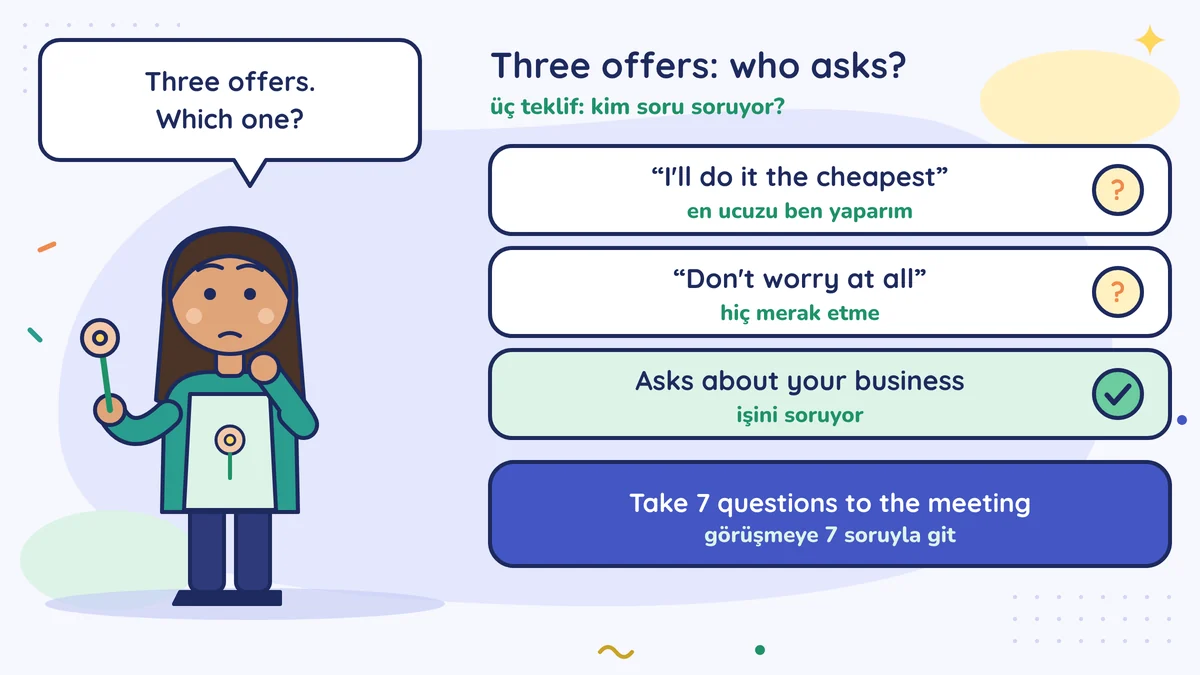
Zehra Hanım is opening a florist's shop. She is looking for a mali müşavir (accountant) and has three offers in her hand. One says "I'll do it the cheapest", one says "don't worry at all", and one asks questions. What will Zehra Hanım do?
Think of a tailor. A good tailor takes your measurements, asks about the fabric and tells you when the fitting will be. A bad tailor says "sure, no problem", and the jacket sleeve comes out short. A mali müşavir is the same: if they ask about your business at the first meeting, that is a good sign.
We explained exactly what a mali müşavir does in the lesson What a mali müşavir does and does not do. Here we look at the choosing stage. Go to the meeting with these 7 questions.
1. What is your authorisation, and which chamber are you registered with?
This work requires a professional licence (meslek ruhsatı). The person who will keep your books is a certified public accountant (serbest muhasebeci mali müşavir, SMMM for short) and is registered with the SMMM chamber (SMMM odası) in their province. Independent accountants (serbest muhasebeci) who got their licence in the past can also do this work. A sworn mali müşavir (yeminli mali müşavir, YMM), on the other hand, cannot keep books under the law; they do other work, such as certifying (tasdik) some returns and documents. So if you are looking for someone to keep your books every month, what you are looking for is an SMMM. Ask for their licence and the name of their chamber. You can confirm the chamber registration on the chamber's website or by calling the chamber. Giving the work to an unlicensed person as an "accountant" puts you in a difficult position later.
2. How do I reach you, and how quickly do you get back to me?
A mali müşavir who doesn't answer the phone as the tax return (beyanname) period approaches is the biggest headache. Phone, message or e-mail? Within how many working days do they get back to your question? Write the answer down. A clear answer like "messages the same day, I check the phone in the evening" is worth more than "we'll get right back to you".
3. What does the fee cover?
Saying "so many lira a month" is not enough. What is included? Is the monthly VAT (KDV) return included? Is payroll (bordro) included once you have an employee? Is the yearly income tax return included? Are the set-up procedures included? How much will be charged when work outside the scope comes up? The fee also varies a lot by the type of business: the books of a small tradesman under simplified taxation (basit usul) and the books of a limited company are not the same job. Make sure you ask for an offer based on your situation. You will see the details of the fee in the lesson Mali müşavir fees and the contract.
4. How will I hand over the documents?
Bringing the receipts in a bag, taking photos and sending them, or sharing them from a program? Choose whichever is easiest for you. By which day of the month do they expect the handover? We will give this as a list in the lesson What to send your mali müşavir every month.
5. Have you worked with a business like mine?
A mali müşavir who has worked with a florist, a carrier or a hairdresser knows your business. They have seen which expense causes problems and which invoice often gets mixed up. A mali müşavir from another sector can also be good; but because you are a new employer, you will want more explanation. Don't hesitate to ask about what you don't understand.
6. How will you remind me of tax dates?
Return and payment dates chase each other during the month. You saw the general framework in the tax calendar article. Will your mali müşavir tell you by message or by e-mail? How many days in advance will they tell you the amount to pay? Setting aside your money until the payment day is your job; you need to hear the news early.
7. What happens if I want to leave?
Nobody works with the same mali müşavir forever. Ask from the start how your records, books and documents will be handed over to you when you leave. Don't forget: keeping the books and documents is your responsibility under the law (for tax purposes at least five years, Tax Procedure Law (Vergi Usul Kanunu) art. 253), even if they sit in the mali müşavir's cupboard. A good mali müşavir answers this question comfortably. You will also want to see the answer in the contract.
What will you take to the meeting?
The mali müşavir also wants to get to know you. Take these with you: whether you will set up a sole proprietorship (şahıs şirketi) or a limited company (if you are undecided, ask about this too; the article Sole proprietorship or limited company? helps), your workplace address, your lease if you have one, two sentences describing what you will sell, roughly how many sales you will make a month, whether you will work with card or cash, and whether you will hire employees. Looking at these, the mali müşavir can tell you the size of the work and the fee more accurately. If you give incomplete information, the offer will be incomplete too.
How will you read the answers?
| What you hear | What it means |
|---|---|
| "We handle everything, you stay out of it" | They may not keep you informed; don't forget it is your business |
| "We'll talk about the price later" | The scope is unclear; surprises will come later |
| "Just bring your documents somehow" | There is no system |
| "This is how we do this job, you bring this" | The process is well established |
Have three meetings and put the answers side by side. You don't have to choose the cheapest. Choose the one who understands you best.
What did Zehra Hanım do?
Zehra Hanım talked to three mali müşavirs. The one who said "I'll do it the cheapest" couldn't say what the fee covered. The one who said "don't worry at all" answered the question of how the records would be handed over on leaving with "we'll see then". The mali müşavir who asked questions first asked how many invoices the florist would issue a month and whether she would sell by card or cash. They asked for the documents by photo in the first week of every month and said they would remind her of tax dates by message. Their fee was a little higher than the others, but what it included was clear. Zehra Hanım chose them. She also kept the sheet on which she wrote the answers; she will take it with her on the day of the contract.
Do this this week
If you already have a mali müşavir, ask them these 7 questions and ask for the missing answers in writing. If not, arrange a short meeting with three mali müşavirs (a phone call is fine too). Write the 7 questions in this lesson on a sheet of paper and note each answer next to it. On Friday, put the three sheets side by side and decide which one you want to work with. Don't sign a contract yet; you will sign it after reading the fee lesson.
Common mistakes
- Looking only at the price. The fee may be low and the scope narrow; later, every extra job turns into a separate fee.
- Not asking about their licence and chamber registration. Keeping books requires a licence; giving the work to an unlicensed person shifts the risk onto you.
- Not asking about the terms for leaving. If you don't know how your books and documents will be handed over to you when you part ways, you will be in a difficult position.
Sources
- TÜRMOB, Union of Chambers of Certified Public Accountants and Sworn-in Certified Public Accountants of Turkey (Türkiye Serbest Muhasebeci Mali Müşavirler ve Yeminli Mali Müşavirler Odaları Birliği)
- Law No. 3568 on Certified Public Accountancy and Sworn-in Certified Public Accountancy (Serbest Muhasebeci Mali Müşavirlik ve Yeminli Mali Müşavirlik Kanunu), art. 2 (a YMM cannot keep books) (mevzuat.gov.tr)
- Tax Procedure Law (Vergi Usul Kanunu), Law No. 213, art. 253 (retention period for books and documents) (mevzuat.gov.tr)
Translated from the Turkish lesson. Last checked against Turkish rules: 7 October 2026. Not yet reviewed by a licensed accountant.
This is general information about Turkish rules, not financial, tax or legal advice. Rules change; check the date and the sources, and ask a licensed accountant (mali müşavir) about your own situation. Disclaimer