Tradesman exemption: who is not a taxpayer
Doesn't everyone who makes jam at home or produces handmade goods and sells them have to go to the tax office? The tradesman exemption (esnaf muafiyeti) keeps some small businesses exempt from income tax. In this lesson you see who qualifies, who doesn't, and what to watch out for.
The tradesman exemption means that for certain small businesses no income tax liability arises. For example, people who make things by hand at home and sell them, without opening a separate workplace, can benefit from it. Opening a shop, or buying from someone else and selling in a shop, is not covered. For online sales, the yearly sales limit is tied to the yearly amount of that year's gross minimum wage; ask your mali müşavir (accountant) for this year's exact amount and about your own situation.
Zeynep Hanım, who makes jam at home
Zeynep Hanım sells the jams she makes in her kitchen and the baby booties she knits by hand to neighbours and online. She makes one or two thousand lira of sales a month. The question: for such a small business, does she need to go to the tax office, keep books and issue invoices?
The answer: not always. The law has an exemption for small tradesmen. Being exempt means not being counted as an income tax payer: you don't keep books and you don't file a return. But this does not mean "nobody will bother you"; there are conditions.
The logic of the exemption
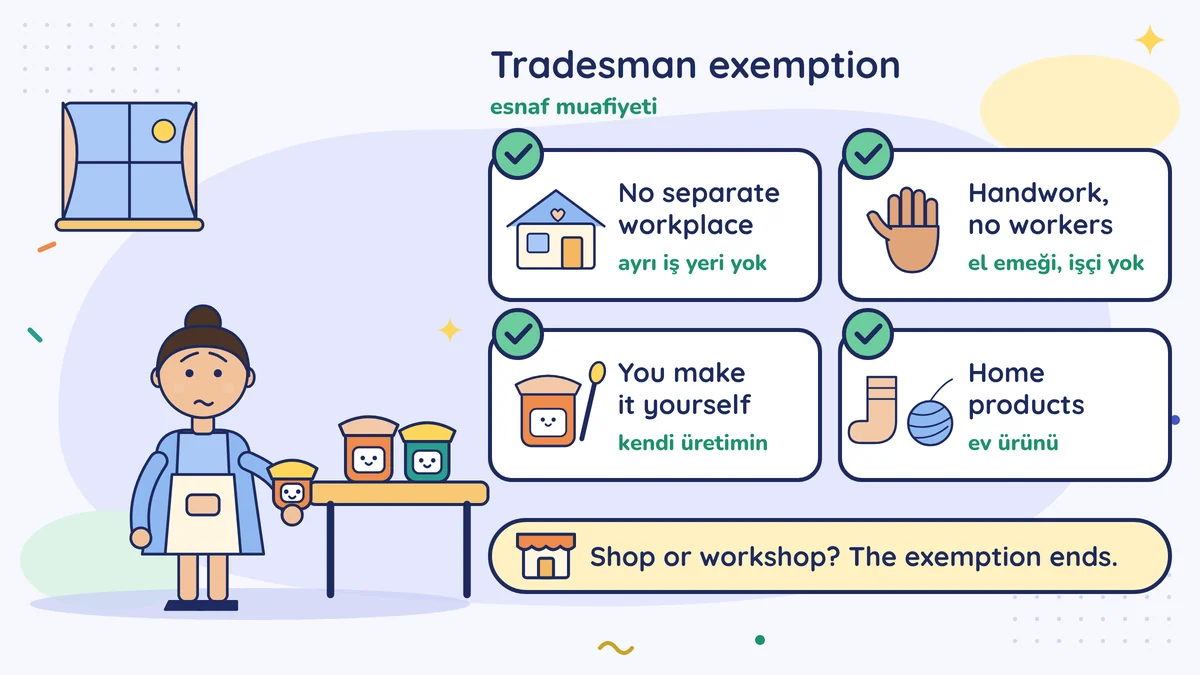
The law sets aside some tradesmen who work on a very small scale (Income Tax Law (Gelir Vergisi Kanunu) article 9). In this lesson we look at the most asked-about path: making things at home and selling them. The general framework:
- No separate workplace: You work at home, where you live. When you open a shop or workshop, the exemption goes.
- Handwork: You don't employ workers from outside and you don't use industrial or mass-production machines. You make things by hand, with small tools.
- What you make yourself: On this path, you make what you sell yourself. Buying from someone else and selling in a shop is trading.
- Home products: As examples, the law lists handicrafts such as towels, covers, socks, lace and embroidery, and home foods such as tarhana, erişte and mantı. The list is only examples; ask your mali müşavir or your tax office whether a similar product such as jam is covered.
If you sell online, your yearly sales must not exceed the yearly amount of that year's gross minimum wage. In 2026 the monthly gross minimum wage is 33,030 lira; the limit is calculated on its yearly total. But don't treat your own calculation as the exact limit: before planning your sales around it, have your mali müşavir or your tax office confirm the official amount.
For those who sell only online, there is also a second exemption path used by opening a "commercial account" (ticari hesap) at a bank (Income Tax Law art. 9/10). There, getting a certificate is compulsory, the certificate is renewed at the tax office every three years, and the bank deducts tax from the money coming in. Because its conditions are different, talk to your mali müşavir if you are thinking about this path.
The law also has other exempt groups. For example, people who sell small retail goods by going around the streets without using a motor vehicle, or without opening a shop, may also be exempt. Their conditions are separate; if you have such a business, ask your mali müşavir.
How do you get the certificate?
For the home production exemption, getting a tradesman tax exemption certificate (esnaf vergi muafiyeti belgesi) is optional according to the GİB (Revenue Administration) guide; but the certificate is the easiest way to show the customer and the tax office that you are exempt. The certificate is issued by the tax office where you live. You can apply with your e-Devlet password through the Digital Tax Office (Dijital Vergi Dairesi, GİB's online service site). If you have got the certificate, ask your tax office when you need to renew it and write the date in your calendar. If you want to sell on large online sales sites (marketplaces), this certificate is usually asked for.
Does an exempt tradesman issue invoices?
As a rule, an exempt tradesman does not issue invoices. So what if the customer asks for a document? If the customer is a business, when it buys the goods from you it issues the expense voucher (gider pusulası) itself. An expense voucher is the document the buyer prepares when buying from a person who does not issue invoices. The buying business usually holds back some income tax from the money it pays you (withholding, stopaj) and pays it to the state; according to the GİB guide, this rate is 2% for purchases of goods. So the money you receive may be a little less. You also saw this in the lesson Invoices, receipts and documents. You, too, keep the invoices for the materials you buy and the records of what you sell.
Does being exempt mean having no obligations at all?
No. Watch out for three things.
- If the limit is exceeded, the exemption ends. If the sales or activity conditions are broken, you become a taxpayer (if the online sales limit is exceeded, from the start of the following year). Whether you will be under simplified taxation (basit usul) or real taxation (gerçek usul) is decided separately. When you start selling regularly, tell your accountant.
- Being exempt from tax does not mean being exempt from everything. An exempt tradesman does not pay income tax and does not add VAT (KDV) to what they sell. But you cannot get back the VAT you pay when buying materials. If you hire a worker from outside, the condition of this exemption is broken anyway; other obligations may also arise.
- Insurance is a separate issue. Persons exempt from income tax who are registered in the tradesmen and craftsmen registry (esnaf ve sanatkâr sicili) may also be covered by Bağ-Kur (social security for the self-employed). Clarify your situation with SGK (Social Security Institution) or your mali müşavir.
When are you not exempt?
| Situation | Exempt? |
|---|---|
| I sell what I make by hand at home | Usually yes, if the conditions are met |
| I buy from a wholesaler and sell in my own shop | No, you are trading |
| I sell by going around the streets with a non-motorised cart | Possibly; it has separate conditions, ask |
| I rented a small shop | No, there is a separate workplace |
| I do mass production with machines | Usually no |
If you are borderline, don't interpret it on your own. Starting with "I may be exempt" and getting a penalty three years later is much more expensive than asking at the start.
Exemption or simplified taxation?
The two get mixed up. An exempt tradesman is not a taxpayer at all. A tradesman under simplified taxation, on the other hand, is a taxpayer; only the taxation method is simple. You saw the simplified taxation option for opening a sole proprietorship in the previous lesson: Simplified taxation or real taxation?
An example day: Zeynep Hanım's order book
Even if Zeynep Hanım is exempt, keeping records makes her work easier. For example, over one month she wrote: 10 jars of jam, 150 lira a jar, 1,500 lira in total. Shopping for ingredients 600 lira. The difference is 900 lira. Writing this calculation in a notebook or on her phone puts no legal burden on her; but when her business grows, the answer to "does my exemption still apply?" comes from these records. Only those who keep records know whether they are getting close to the sales limit.
When should you think about leaving the exemption?
- If your number of customers is growing fast and you are getting regular orders.
- If you want to employ someone or rent a workshop.
- If a large customer asks you for an invoice. An exempt tradesman cannot issue invoices; to work with a customer who wants an invoice, you may need to open a sole proprietorship (şahıs işletmesi).
- If you are buying machines and moving to mass production.
Each of these situations can affect the exemption. Before taking such a step, talk to your mali müşavir and answer the four questions in the lesson Sole proprietorship or limited company? again. Leaving the exemption is not a bad thing; it is a sign that your business is growing.
Do this this week
If you have, or are thinking of, a small home business, answer these three questions: Is there a separate workplace? Am I selling what I make myself? Is it handwork? If your answers are "yes", ask your mali müşavir or your tax office: "Do I qualify for the tradesman exemption?"
Common mistakes
- Saying "it's a small business, no need for tax". The exemption has conditions: not opening a workplace, not employing workers from outside, and not exceeding the yearly limit for online sales.
- Expecting the exemption while opening a shop and selling what you buy from a wholesaler. This is trading; it is not covered by the home production exemption.
- Forgetting to renew the exemption certificate. If you have a certificate, ask your tax office for the renewal date and write it in your calendar; also keep track of the sales limit.
Sources
- Income Tax Law (Gelir Vergisi Kanunu), Law No. 193, art. 9 (tradesman exemption; paragraphs 6 and 10)
- GİB, Guide to the Tradesman Exemption for the Sale of Home-Made Products, August 2025 (Alomaliye copy)
- Income Tax General Communiqué (Serial No: 314) (Lexpera)
- EY: Bağ-Kur insurance in all its aspects
- KPMG: change to GVK art. 9/6 by Law No. 7162 (online sales limit: yearly gross minimum wage)
- EY: 2026 minimum wage (gross 33,030 TL)
- VAT Law (KDV Kanunu), Law No. 3065, art. 17/4-b (supplies by exempt tradesmen)
Translated from the Turkish lesson. Last checked against Turkish rules: 7 October 2026. Not yet reviewed by a licensed accountant.
This is general information about Turkish rules, not financial, tax or legal advice. Rules change; check the date and the sources, and ask a licensed accountant (mali müşavir) about your own situation. Disclaimer