The first 30 words 5: Document types and e-Devlet
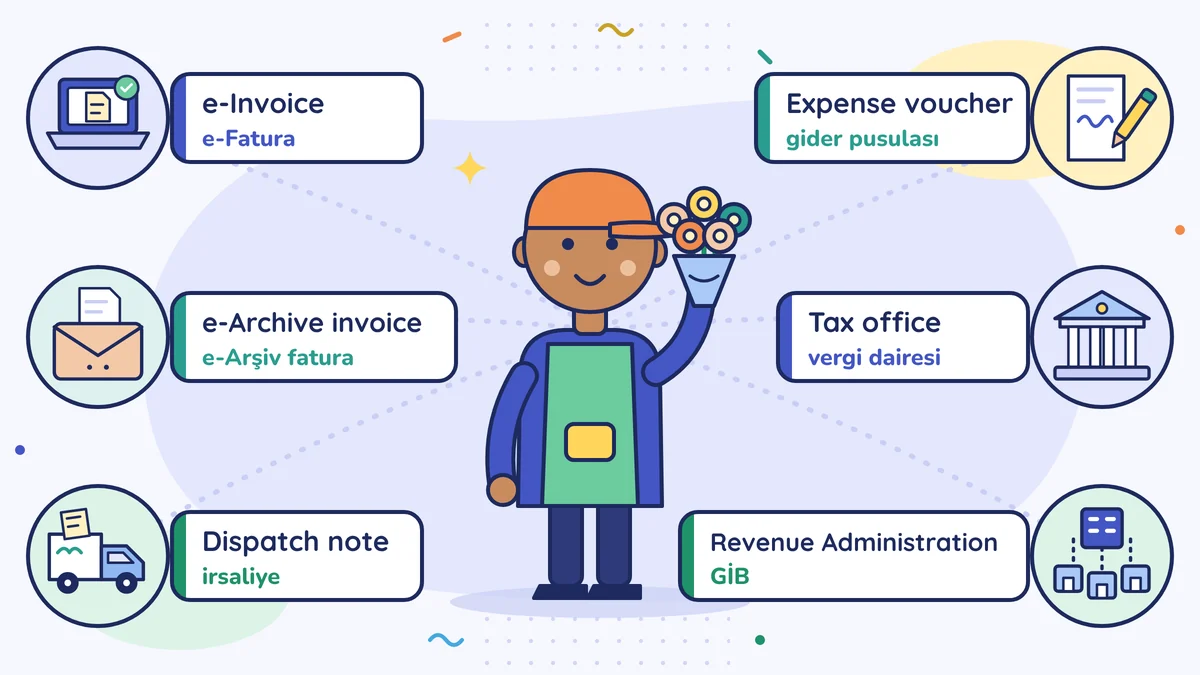
e-Fatura, e-Arşiv, irsaliye, gider pusulası, vergi dairesi, GİB (e-Invoice, e-Archive invoice, dispatch note, expense voucher, tax office, Revenue Administration). By watching a florist buy flowers from a wholesaler and sell them to customers, we learn which document and which institution is for which job.
An e-Invoice (e-Fatura) and an e-Archive invoice (e-Arşiv fatura) are invoices issued electronically instead of on paper; a dispatch note (irsaliye) is the travel document of goods, and an expense voucher (gider pusulası) is the document you issue yourself when you buy from someone who does not issue invoices. The tax office (vergi dairesi) is where your registration is kept; GİB (Gelir İdaresi Başkanlığı, the Revenue Administration) is the centre of the tax offices and of the electronic document system.
Ali Bey's flower shop
Ali Bey is a florist. Early in the morning he buys roses and tulips from a wholesaler, and in the shop he makes them into bouquets and sells them. Now and then he also buys products from a neighbour who prepares dried flowers at home. At every step he comes up against a different document and a different institution.
Last week the wholesaler said, "I'll issue you an e-Invoice." A customer said, "I want an e-Archive invoice." His mali müşavir (certified public accountant) said, "I checked with GİB." Ali Bey nodded at all of them, but inside he understood nothing. In this lesson we open up those words one by one.
e-Invoice (e-Fatura): not paper, an electronic invoice
An e-Invoice (e-Fatura) is an invoice issued electronically, without printing on paper, through the system of the Revenue Administration (Gelir İdaresi). Think of email instead of the post office; but official and on record. Both the one issuing the invoice and the one receiving it must be registered in this system; both sides need to be e-Invoice users.
Who is required to use e-Invoice depends on certain conditions and may change over time. Ask your mali müşavir whether it is compulsory for your business. Even if it is not compulsory for you, you can switch voluntarily.
Mini example: The wholesaler issued Ali Bey an e-Invoice. The invoice was not printed on paper; it landed in Ali Bey's account through the system, and Ali Bey saw it there and passed it on to his mali müşavir.
e-Archive invoice (e-Arşiv fatura): the electronic invoice issued to someone who is not an e-Invoice user
An e-Archive invoice (e-Arşiv fatura) is an electronic invoice issued to buyers who are not part of the e-Invoice system. It is e-Invoice's broader sibling. The buyer does not need to be registered in the system; the invoice reaches them by email or some other way.
In short: if you are an e-Invoice user and the buyer is also an e-Invoice user, you issue an e-Invoice; if not, you issue an e-Archive invoice. Paper invoices are coming to an end too: companies and those keeping books on the balance-sheet basis (bilanço esası) have issued every invoice electronically since 2026. Those keeping a business book (işletme defteri) and tradespeople under the simplified method (basit usul) can issue paper invoices only for small amounts until the end of 2026; from 1 January 2027 they will issue electronically too. Which one to use in which case is guided by the system that issues the invoice or by your mali müşavir; you don't have to choose on your own.
Mini example: A hotel bought wedding flowers from Ali Bey and asked for an invoice. If the hotel is an e-Invoice user, Ali Bey issues an e-Invoice. If an individual customer asks for an invoice, an e-Archive invoice is issued and goes to their email as a PDF.
Dispatch note (irsaliye): the travel document of goods
A dispatch note (irsaliye) is the document that goes along with goods while they travel from one place to another. If the police or an inspection asks on the road, it is the answer to "where are these goods going, who are they from, how much is there?" Think of it like the waybill-type slip stuck on a parcel.
A dispatch note does not replace an invoice; it does not ask for money, it only shows the shipment. The invoice is issued separately: within 7 days at the latest from the date the goods are delivered. An invoice that is not issued on time is treated as never having been issued, and a penalty arises. There are electronic dispatch notes too. When a dispatch note is compulsory depends on the business, so ask your mali müşavir.
Mini example: The wholesaler sent Ali Bey 200 roses in a van. The driver had a delivery note (sevk irsaliyesi) with him. The invoice came a few days later as an e-Invoice.
Expense voucher (gider pusulası): the purchase document from someone who does not issue invoices
An expense voucher (gider pusulası) is the document the buyer issues, in place of the seller, when buying goods or services from someone who is not required to issue invoices. You bought products from a tax-exempt tradesperson (vergiden muaf esnaf) who prepares dried flowers at home (someone who makes and sells on a small scale at home and has no tax registration); they do not issue invoices. So that you can "put my purchase on record", you prepare the document yourself. If you buy produce directly from a farmer, the document is different; it is called a producer receipt (müstahsil makbuzu).
This document is issued for a real purchase. Making up a document for a purchase that never happened has serious consequences. Talk to your mali müşavir about which purchases need an expense voucher and whether any other tax step is needed.
Mini example: Ali Bey bought 1,000 lira of products from Hatice Hanım, who prepares dried flowers at home. Hatice Hanım is a tax-exempt tradesperson and does not issue invoices. Ali Bey issued an expense voucher; that way the purchase had a document.
Tax office (vergi dairesi): where the business is registered
The tax office (vergi dairesi) is the official place where the business's tax registration is kept and its taxes are collected. One of the first things you do when opening a shop is register here: you notify them "I have started business" within 10 days of the start date, and your tax registration is opened. In a sole proprietorship your tax number is your Turkish ID number (T.C. kimlik numarası); a company is given a separate tax number. Today this notification is usually made online and through your mali müşavir. When you stop doing business, you notify them "I have closed" too.
What the civil registry office (nüfus müdürlüğü) does for people, the tax office does for businesses. Today most things can be handled online; even so, for opening, closing and some special procedures you may need to speak to the tax office.
Mini example: When Ali Bey opened his shop, he registered with the tax office, and his tax registration was opened. From now on, his tax returns are filed under this office.
GİB: the centre of the tax offices
GİB is the Gelir İdaresi Başkanlığı, the Revenue Administration: the central institution that the country's tax offices report to. Think of the tax office as a branch and GİB as head office. The e-Invoice, e-Archive and tax return systems run through GİB's websites and programs.
Alongside it there is also e-Devlet (e-Government, turkiye.gov.tr): a single gateway for many of the state's procedures. You can also do things like checking your tax debt there. GİB's website and e-Devlet are separate places; SGK (the Social Security Institution) is a separate institution too, and deals with insurance, not tax.
Mini example: Ali Bey wondered whether he had any unpaid tax debt. His mali müşavir showed him GİB's Internet Tax Office (İnternet Vergi Dairesi); they saw that they could do the same check through e-Devlet too.
Putting all six together
When goods came to Ali Bey from the wholesaler, there was a dispatch note (irsaliye) with them. Then the e-Invoice (e-Fatura) came. If his customer is not an e-Invoice user, he issues them an e-Archive invoice (e-Arşiv fatura). If he buys from a tradesperson who does not issue invoices, he issues an expense voucher (gider pusulası). His registration is at the tax office (vergi dairesi), and the systems work under the roof of GİB.
Do this this week
Look at three documents you received in the last month and say what each one is: e-Invoice, e-Archive invoice, dispatch note or something else? Write down on a sheet of paper which tax office you are registered with and your tax number. Ask your mali müşavir: "Is e-Invoice compulsory for me?"
Common mistakes
- Thinking a dispatch note is an invoice. A dispatch note is the travel document of the goods; for payment and for recording an expense, you need an invoice.
- Using an expense voucher for every purchase. It is only issued for real purchases from a seller who does not issue invoices; purchases from a farmer have a separate document.
- Mixing up GİB and SGK. GİB deals with tax, SGK with insurance; they are separate institutions.
Sources
- Revenue Administration (Gelir İdaresi Başkanlığı, GİB)
- Tax Procedure Law (Vergi Usul Kanunu), Law No. 213 (document rules)
- Notification of starting, stopping and changes in business (GİB Internet Tax Office)
- The 7-day period for issuing invoices, VUK art. 231/5 (Alomaliye)
- Expense voucher (gider pusulası), VUK art. 234 (Alomaliye)
- e-Government Gateway (e-Devlet Kapısı)
- TÜRMOB
Translated from the Turkish lesson. Last checked against Turkish rules: 7 October 2026. Not yet reviewed by a licensed accountant.
This is general information about Turkish rules, not financial, tax or legal advice. Rules change; check the date and the sources, and ask a licensed accountant (mali müşavir) about your own situation. Disclaimer