The first 30 words 3: Employee words
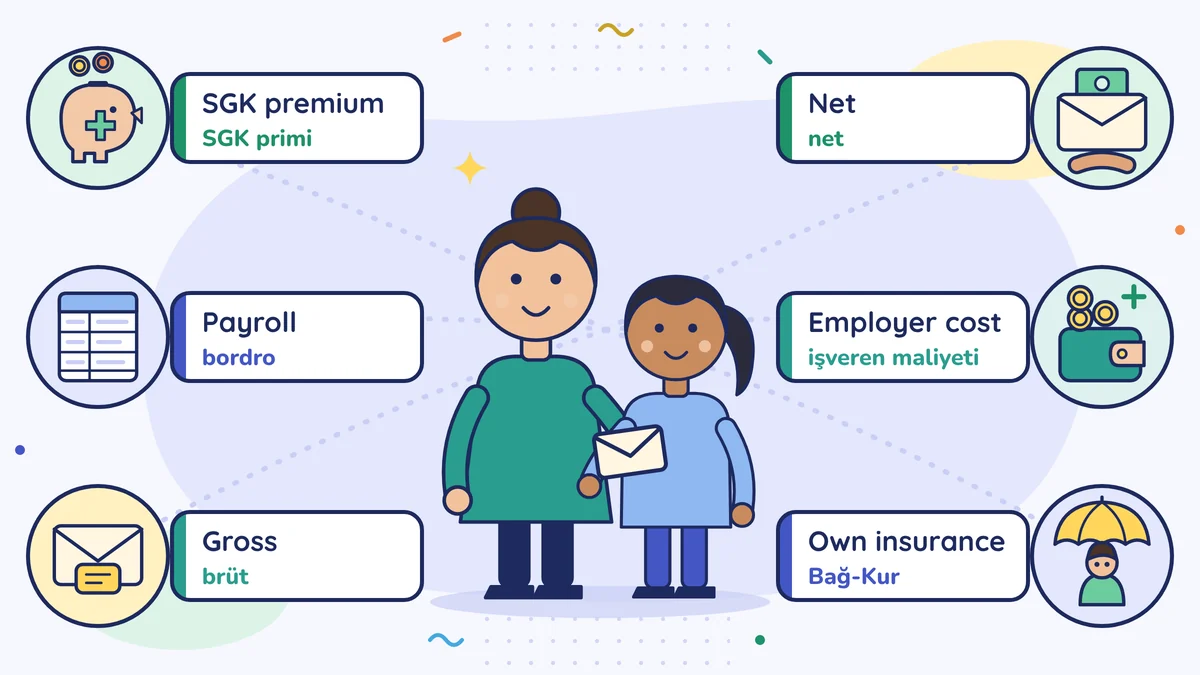
SGK primi, bordro, brüt, net, işveren maliyeti, Bağ-Kur (SGK premium, payroll, gross, net, employer cost, Bağ-Kur). By opening Elif's pay envelope at a hair salon, we learn the six words you need to know before taking on your first employee.
Gross (brüt) is the amount of the salary before deductions; net (net) is the money the employee actually receives. The employer cost (işveren maliyeti) is what you get when the employer's shares are added on top of the gross salary. The SGK premium (SGK primi) is paid for the employee's insurance, payroll (bordro) is the breakdown of this calculation, and Bağ-Kur is the insurance of people who work for themselves.
Zeynep Hanım's first employee
For years Zeynep Hanım ran her hair salon on her own. When the customers grew in number, she took Elif on. While they were agreeing terms, Elif asked: "Am I on a gross or a net salary?" Zeynep Hanım did not know what to say.
Taking on an employee is the biggest step in becoming an employer. Besides the salary, words like SGK and payroll come into your life. In this lesson we open up all six, one after another. Our comparison is a pay envelope: the amount written on the outside of the envelope is one thing, and what comes out of it is another. For a wider road map, also see the article When hiring your first employee (in Turkish).
SGK premium (SGK primi): a shared insurance piggy bank
The SGK premium (SGK primi) is the money paid every month to the Social Security Institution (Sosyal Güvenlik Kurumu, SGK) in return for the employee's health insurance, pension and similar rights. Both the employee and the employer put money into this piggy bank. The employee's share is deducted from their salary; the employer adds their own share and pays the two together.
So deducting and paying in the employee's share is also the employer's job. The SGK premium is not a tax, but like a tax it has a monthly calendar, and if it is late, a late payment penalty (gecikme cezası) and late payment interest (gecikme zammı) arise. One more rule: you must notify SGK of the employee before they start work. This notification is usually made by your mali müşavir (certified public accountant); you tell them the start date at least one day in advance. Rates and ceiling amounts may change; get the current ones from SGK's website or from your mali müşavir.
Mini example: Let's say Elif's gross salary is 40,000 lira. At 2026 rates, the total premium for that month comes to roughly 15,500 lira: about 6,000 lira of it is deducted from Elif's salary, and about 9,500 lira comes out of Zeynep Hanım's pocket (calculated without any discount, rounded). Zeynep Hanım pays the two together to SGK.
Payroll (bordro): the salary calculation sheet
Payroll (bordro) is the table showing how employees' salaries were calculated that month. What the gross salary is, which deductions were made, what was paid out: everything is written line by line. You can compare it to a supermarket receipt: what is in it, how much it came to, what the total is.
Payroll is prepared every month; in it there is a separate line for each employee. The technical side of the work is usually done by your mali müşavir or an accounting office; you give them that month's information (leave, overtime, people starting and leaving). You are also required to give the employee a slip showing how their salary was calculated, a pay slip (ücret hesap pusulası) (Labour Law, İş Kanunu, art. 37); this requirement still applies even if the salary is paid through the bank. If you have three or more employees, since 1 July 2025 you have been required to pay salaries through the bank.
Mini example: At the end of the month Zeynep Hanım told her mali müşavir how many days Elif had worked. The mali müşavir prepared the payroll: the gross amount, the deductions and the net salary were written line by line.
Gross (brüt): the figure on the outside of the envelope
Gross (brüt) is the amount of the salary before deductions. If "40,000 lira" was said during salary talks and "gross" is written next to it, those 40,000 lira will not reach Elif's hands. Think of a bag of fruit: on the scales, the total weight with the crate is gross; what is left after you sort out the peel and the rotten ones is net.
Always write gross or net in the employment contract and in the job advertisement. There is also a lower limit: in 2026 the lowest salary that can be paid to a full-time employee, that is, the minimum wage (asgari ücret), is 33,030 lira gross per month (28,075.50 lira net). Misunderstanding these two words is one of the most common causes of salary disputes.
Mini example: Zeynep Hanım and Elif agreed on 40,000 lira gross. This figure appears on the first line of the payroll; the amount paid out is lower than this.
Net (net): the money inside the envelope
Net (net) is the salary the employee actually receives after deductions. From the gross salary, deductions such as the employee's SGK share, unemployment insurance share (işsizlik sigortası), income tax and stamp tax (damga vergisi) come off; what is left is the net salary. For the employee, net is the figure that really matters; when they ask "how much is my salary", this is usually what they mean.
The exact net amount is calculated according to the tariff and deduction rates, which may change every year. Don't try to calculate it on your own: ask the person who prepares the payroll.
Mini example: Once the deductions come off a gross salary of 40,000 lira, in January 2026 about 33,060 lira reaches Elif's hands. As the tax bracket goes up during the year, it may drop a little in later months. This calculation is for an employer who keeps books: no income tax is deducted from the salary of someone working for a tradesperson under the simplified method (basit usul), so the net comes out different. The payroll shows the exact figure.
Employer cost (işveren maliyeti): the total that comes out of your pocket
Employer cost (işveren maliyeti) is what an employee really costs you each month. On top of the gross salary, the SGK shares paid by the employer and similar charges are added. If you agreed a gross salary of 40,000 lira with Elif, the money Zeynep Hanım pays out that month is more than 40,000 lira. Think of it like the tax added to a price tag.
When hiring, it is dangerous to look only at the salary and say "I can afford it". Use the employer cost when you work out your profit. In some cases the state may provide incentives or discounts; these vary from case to case, so ask your mali müşavir.
Mini example: At 2026 rates, once the employer's shares are added, Elif, with a gross salary of 40,000 lira, costs Zeynep Hanım about 49,500 lira in total (calculated without any discount; for an employer who meets the conditions, it is a little lower with the Treasury discount, Hazine indirimi). It is this figure, not 40,000, that goes into the shop's expense table.
Bağ-Kur: you take care of your own insurance
Bağ-Kur is the insurance of people who work for themselves. Elif works for someone else, and Zeynep Hanım pays her insurance. Zeynep Hanım, however, is the owner of her own shop; she pays her own insurance herself. There is no separate person opposite her paying an "employer's share"; the whole premium comes out of her own pocket.
Its official name is "4/b insurance" (4/b sigortalılığı). Owners of sole proprietorships are usually covered by it. Partners in a limited company are, as a rule, also covered by it; in a joint-stock company, the partners who are members of the board of directors. For which one you fall under and how you will pay your premium, ask SGK or your mali müşavir.
Mini example: Zeynep Hanım pays her own Bağ-Kur premium herself every month. Elif's SGK premium, on the other hand, is paid by Zeynep Hanım in her role as employer, through the payroll. Two separate items.
Putting all six together
You and Elif agreed on a gross (brüt) figure. After deductions, the net (net) amount reaches her hands. This calculation is written line by line on the payroll (bordro). Part of the deductions is paid in as the SGK premium (SGK primi). The total it costs you as the employer is the employer cost (işveren maliyeti). And your own insurance is Bağ-Kur.
Do this this week
For someone you are thinking of hiring (or someone who already works for you), write three lines on a sheet of paper: the gross salary agreed, the estimated net salary, the estimated employer cost. Don't make up the figures yourself; ask your mali müşavir or the person who prepares the payroll. Check whether the contract says gross or net.
Common mistakes
- Agreeing a salary without saying gross or net. This is where most disputes break out later; make it clear in writing.
- Letting an employee start work without notifying SGK. Employing someone without insurance because "let them try it for a week first" is subject to a penalty; the notification is made before the person starts work.
- Forgetting your own Bağ-Kur premium. As the employer you pay the employee's insurance; your own insurance is a separate matter.
Sources
- Social Security Institution (Sosyal Güvenlik Kurumu, SGK)
- Law No. 5510 on Social Insurance and General Health Insurance (5510 sayılı Sosyal Sigortalar ve Genel Sağlık Sigortası Kanunu)
- 2026 minimum wage and employer cost (EY)
- SGK premiums guide 2026 (Alomaliye)
- Bağ-Kur (4/b) insurance, company partners (EY)
- Pay slip (ücret hesap pusulası), Labour Law art. 37 (Alomaliye)
- TÜRMOB
Translated from the Turkish lesson. Last checked against Turkish rules: 7 October 2026. Not yet reviewed by a licensed accountant.
This is general information about Turkish rules, not financial, tax or legal advice. Rules change; check the date and the sources, and ask a licensed accountant (mali müşavir) about your own situation. Disclaimer