The first 30 words 2: Tax words
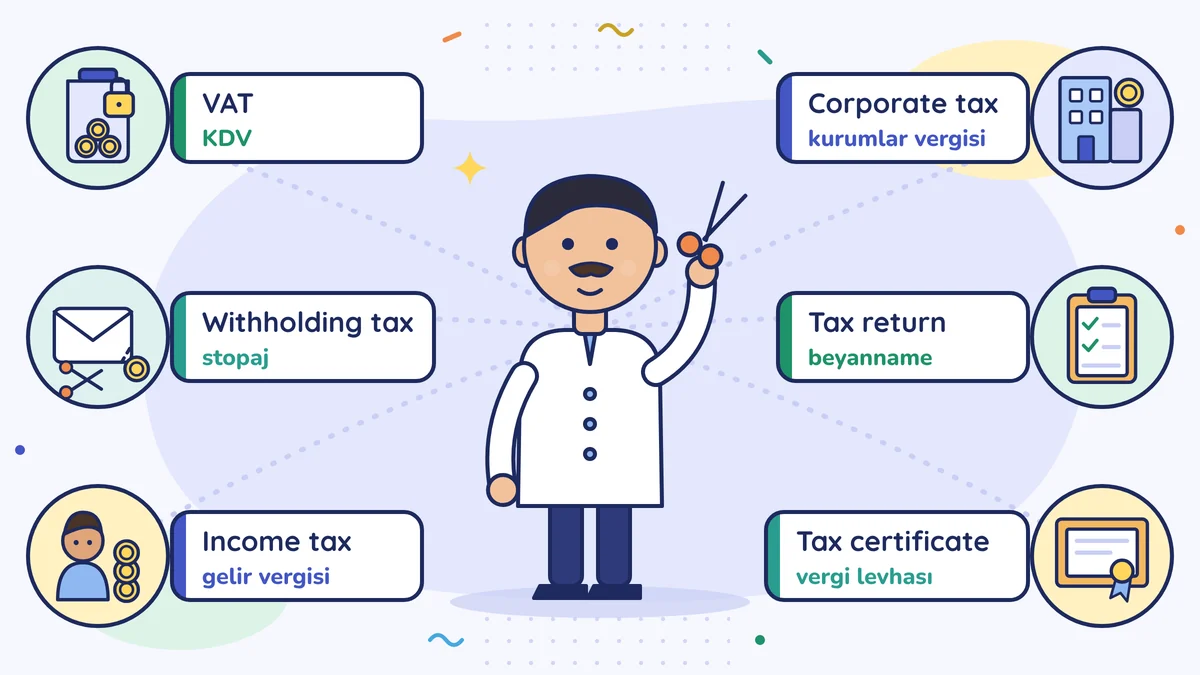
KDV, stopaj, gelir vergisi, kurumlar vergisi, beyanname, vergi levhası (VAT, withholding tax, income tax, corporate tax, tax return, tax certificate). By following a barber's shop on tax day, we learn in plain language what these six words are, whose money each one is, and why they are asked of you.
VAT (KDV) is money you collect from customers and hold in trust for the state. Withholding tax (stopaj) is someone else's tax that you deduct when making a payment and pay to the state. Income tax (gelir vergisi) is taken from the earnings of natural persons (such as the owner of a sole proprietorship or an employee), and corporate tax (kurumlar vergisi) from the earnings of capital companies such as limited and joint-stock companies; the tax return (beyanname) is the form you use to declare them, and the tax certificate (vergi levhası) is the document of your tax registration.
Mehmet Usta's tax day
Mehmet Usta has been a barber for thirty years. He has just made his shop bigger and taken on an assistant (kalfa). His mali müşavir (certified public accountant) said on the phone: "I've prepared your VAT, check the withholding tax, we'll file the returns this week. And download this year's tax certificate." Mehmet Usta can cut hair, but he cannot cut through these sentences.
First let's draw the big picture: tax is the state's share of your business. But not every tax comes from the same place. Some tax comes from your earnings, some from the customer's pocket, and some from the employee's salary. Sometimes you are the person who pays the tax, and sometimes only the person who collects it and pays it in. This difference explains everything.
VAT (KDV): money from the customer, held in trust
VAT (KDV) stands for katma değer vergisi, value added tax. It is added to the price of what you sell; the customer pays it, you collect it, and you pay it to the state. So that money is not your earnings; it is money you hold in your pocket in trust for the state. Think of it like money a neighbour leaves with you, saying "keep this for me, I'll pick it up tomorrow".
There is also the other side: when you buy goods, you pay VAT too. At the end of the month, the VAT you paid on purchases is subtracted from the VAT you collected from customers, and the difference goes to the state. This is called the VAT deduction (KDV indirimi). If the VAT you paid is more than the VAT you collected, the difference carries over to the next month. To be able to deduct the VAT you paid on a purchase, as a rule you need an invoice with the VAT shown separately, and that invoice must be entered in the books. For details, see the article What is VAT? (in Turkish). The VAT rate depends on the type of goods or service; ask your mali müşavir for the current rate.
Not every business collects VAT: no VAT is added to the sales of small tradespeople taxed under the simplified method (basit usul), and they do not file a VAT return; they cannot deduct the VAT they paid on purchases either. When Mehmet Usta made his shop bigger, he left the simplified method and now collects VAT; but a small barber in the neighbourhood may be under the simplified method. Ask your mali müşavir about your own situation.
Mini example: This month Mehmet Usta collected a total of 2,000 lira of VAT from customers and paid 800 lira of VAT when buying supplies. He will pay 1,200 lira to the state. (The amounts are rounded to show the logic.)
Withholding tax (stopaj): tax deducted at the source
Withholding tax (stopaj) means deducting the tax at the moment you make a payment and paying it to the state. It is also called "deduction at source" (kaynağında kesinti). The tax you deduct is not yours; it is the other person's tax. You are only the go-between: like a watchman standing at the gate, counting who passes and reporting it to the state.
The best-known example is an employee's salary: income tax is deducted from the salary, and the employer pays it in. If you rented your shop from a person rather than a company, withholding tax is usually deducted from the rent payment too; it also comes up in payments to self-employed people such as lawyers and accountants. Tradespeople under the simplified method, on the other hand, do not withhold tax. Knowing which payments need a deduction is your mali müşavir's job; ask before you pay. Know one exception: since 2022, no income tax or stamp tax (damga vergisi) has been taken on the part of a salary equal to the minimum wage (asgari ücret). That is why no income tax is deducted from the salary of an employee on the minimum wage.
Mini example: The gross salary of Mehmet Usta's assistant is 40,000 lira. In January 2026 about 900 lira of income tax was deducted from this salary; the amount is small because the part equal to the minimum wage is tax-free. This money is the tax the assistant pays. Mehmet Usta does not put it in his pocket; he declares it on the withholding tax return (muhtasar beyanname) and pays it to the state.
Income tax (gelir vergisi): from a person's earnings
Income tax (gelir vergisi) is the tax taken from the earnings of natural persons, that is, people: the earnings of someone doing business in their own name, an employee's salary, a landlord's rent and so on. Don't be misled by the word "income" (gelir) in its name: the tax is not calculated on total sales but on the earnings left after expenses are subtracted. If Mehmet Usta runs the shop in his own name, he usually pays income tax when there is a profit. (Since 2021, no income tax has been taken on these earnings from tradespeople under the simplified method.) What is deducted from employees' salaries is also part of this tax.
This tax works in brackets (dilim): as earnings grow, the part that moves up into the higher brackets is taxed at a higher rate. The tariff changes from year to year, so you don't need to memorise a rate; get the current one from your mali müşavir. In businesses that keep books, there are also advance payments during the year called "provisional tax" (geçici vergi), and the account is finalised at the end of the year.
Mini example: Mehmet Usta's annual profit before tax came to 400,000 lira. Income tax is calculated on this profit according to the bracket tariff; your mali müşavir does the calculation.
Corporate tax (kurumlar vergisi): from the company's earnings
Corporate tax (kurumlar vergisi) is taken from the earnings of capital companies such as limited (limited şirket) and joint-stock (anonim şirket) companies. (In partnerships such as general and limited partnerships, kolektif and komandit şirket, the earnings go into the partners' income tax.) Limited and joint-stock companies count legally as separate "persons": they borrow in their own name and pay tax in their own name. In a sole proprietorship (şahıs işletmesi) the business and you are the same person; in a company, the company is one thing and you are another.
The company's profit does not go into the partner's pocket by itself; if the profit is distributed to the partner, separate tax issues may arise. This is a complicated area, and getting it wrong is expensive: talk to your mali müşavir before the company distributes profit. For the question of sole proprietorship or company, the article Sole proprietorship or limited company? (in Turkish) is a good start.
Mini example: Let's say Mehmet Usta later turns his business into a limited company, and the company makes 400,000 lira of profit at the end of the year. Tax on this profit is calculated in the name of the company, not Mehmet Usta, as corporate tax.
Tax return (beyanname): your tax report card
A tax return (beyanname) is the form you use to declare tax to the state. What you sold, how much VAT you collected, how much you deducted, what your earnings came to: you write it all down. Declaring is not the same as paying; first you declare, then you pay the amount. The two happen on dates close to each other, but they are separate tasks.
Different taxes have different returns: the VAT return, the combined withholding tax and social security premium return (muhtasar ve prim hizmet beyannamesi) filed every month for salaries and withholding tax, the annual income or corporate tax return, and so on. Most are filed electronically and go through your mali müşavir's system. If a return is not filed on time a penalty may arise, and if payment is late, late payment interest (gecikme zammı) may arise. We have gathered which return is filed in which month in the article Tax calendar (in Turkish).
Mini example: At the end of the month Mehmet Usta gave his mali müşavir his sales and purchase documents with VAT. From these the mali müşavir prepared the VAT return; Mehmet Usta paid the amount.
Tax certificate (vergi levhası): your tax ID card
A tax certificate (vergi levhası) is the document showing that the business is registered with the tax office (vergi dairesi). On it are the business's name, the tax number (in a sole proprietorship, your Turkish ID number, T.C. kimlik numarası), the tax office and the type of activity. It is a kind of tax ID card: you may be asked for it when opening a bank account, when working with a large firm, and in tenders and contracts.
The certificate is downloaded every year from the Internet Tax Office (İnternet Vergi Dairesi); your mali müşavir can get it for you. The requirement to hang it on the wall has been removed; but you must keep it at the workplace and show it when asked.
Mini example: Before giving Mehmet Usta goods on credit, a wholesaler asked for a copy of his tax certificate. Mehmet Usta sent it by email.
Putting all six together
Mehmet Usta is now a business that collects VAT: he collects VAT (KDV) from customers and pays it to the state. When paying his assistant's salary he deducts withholding tax (stopaj) and pays that in too. Because the shop is in his own name, income tax (gelir vergisi) arises on his profit; if it were a company, corporate tax (kurumlar vergisi) would arise on the company's profit. He declares all of these with a tax return (beyanname). And the tax certificate (vergi levhası) is the document showing that he is part of this system.
Do this this week
Ask your mali müşavir one single question: "Which taxes does my business pay, which returns do we file, and on which day of the month is each one?" Write the answer on a sheet of paper and add it to your calendar. Also download this year's tax certificate from the Internet Tax Office (İnternet Vergi Dairesi), or ask your mali müşavir for it.
Common mistakes
- Counting VAT as profit. The VAT you collect from customers is not yours; it is the state's money. If you spend it, you won't be able to pay at the end of the month.
- Forgetting to deduct and pay in withholding tax. The tax you deduct belongs to someone else; not paying it in brings a penalty and late payment interest.
- Thinking filing the return is the same as paying. A return is a declaration; you have to pay the amount separately.
Sources
- VAT Law (Katma Değer Vergisi Kanunu), Law No. 3065
- Income Tax Law (Gelir Vergisi Kanunu), Law No. 193
- Corporate Tax Law (Kurumlar Vergisi Kanunu), Law No. 5520
- Simplified method taxpayers: VAT exemption and income tax exemption (Ekonomi Gazetesi)
- Information for taxpayers under the simplified method (GİB Defter Beyan)
- Exemption of the minimum wage from income tax and stamp tax, Income Tax Law art. 23/18 (Alomaliye)
- Combined withholding tax and social security premium return, muhtasar ve prim hizmet beyannamesi (Cott)
- Tax certificate announcement (İSMMMO)
- Revenue Administration (Gelir İdaresi Başkanlığı, GİB)
Translated from the Turkish lesson. Last checked against Turkish rules: 7 October 2026. Not yet reviewed by a licensed accountant.
This is general information about Turkish rules, not financial, tax or legal advice. Rules change; check the date and the sources, and ask a licensed accountant (mali müşavir) about your own situation. Disclaimer