The first 30 words 1: Money and document words
The first words your mali müşavir (accountant) says on the phone: gelir, gider, kâr, ciro, fatura, fiş (income, expense, profit, turnover, invoice, receipt). By watching the bucket of a small café, we learn all six in everyday language.
Income (gelir) is the money that comes from what you sell; an expense (gider) is the money you spend to keep the business going; profit (kâr) is the difference between the two. Turnover (ciro) is total sales, and the invoice (fatura) and the receipt (fiş) are the documents of that sale.
Hasan Abi's café
Hasan Abi opened a small café (kahve dükkânı) in his neighbourhood. At the end of the first month his mali müşavir (certified public accountant) called: "Your turnover is good, but your expenses are high and your profit is low. And get your invoices together." Hasan Abi hung up and realised he had not understood a thing.
The problem is not Hasan Abi; it is the words. In this lesson we open up the six words in that sentence one by one. Think of all of them around the same bucket: a tap above, a hole at the bottom, and the water left in between.
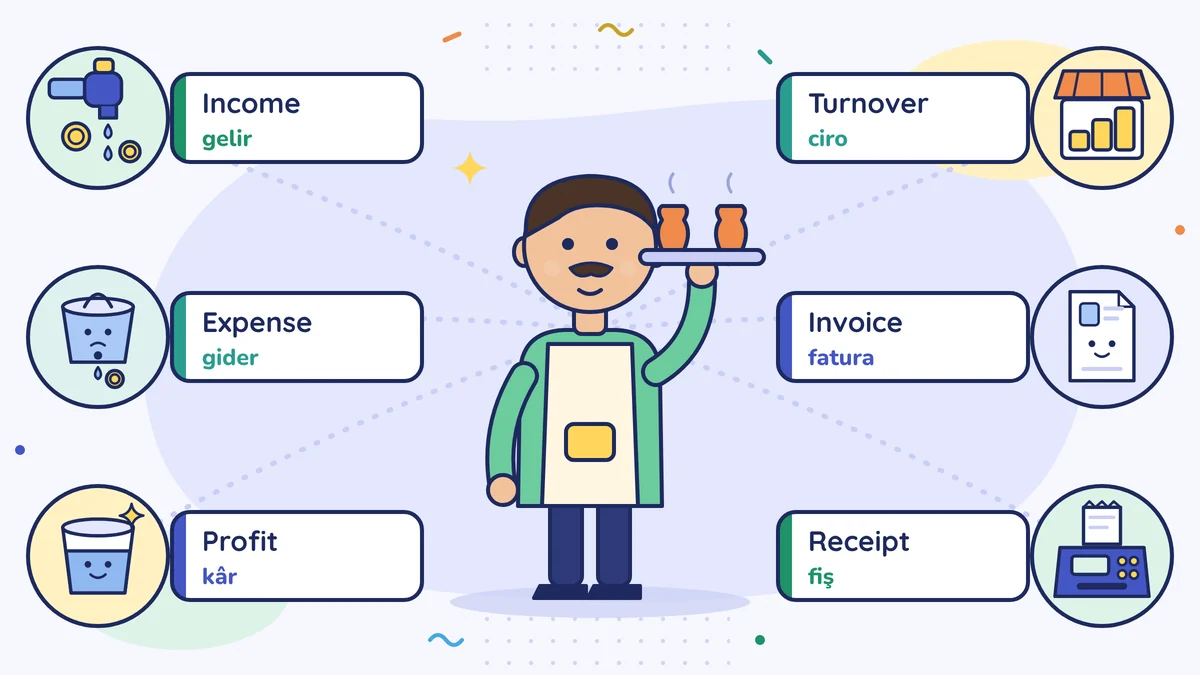
Income (gelir): water flowing from the tap
Income (gelir) is the money you get in return for the goods or services you sell. The more the tap is open, the more water fills the bucket; the more you sell, the bigger your income. A sale made on credit (veresiye), where the money has not arrived yet, is also income. The water is still in the pipe, but it is on its way.
Mini example: This month Hasan Abi made 60,000 lira of sales in total from tea, coffee and toasted sandwiches. His monthly income is 60,000 lira. We also saw the same idea through a corner shop in the lesson How money moves (in Turkish).
Expense (gider): the hole in the bucket
An expense (gider) is money you spend to keep the business going: rent, tea and sugar, electricity, your employee's salary. Yes, water drains out of the hole; but the shop runs thanks to that spending. If you don't pay the rent, the shutters come down.
There is one distinction: an expense is spending that is related to the business. The groceries Hasan Abi buys for his home are not an expense. We explained which spending can be recorded as an expense in a separate article (in Turkish).
Mini example: The same month, rent came to 15,000, supplies to 20,000, and electricity and water to 3,000 lira. Total expenses are 38,000 lira.
Profit (kâr): what is left in the bucket
Profit (kâr) is the money left when you subtract expenses from income. While the bucket was filling, water was also draining out of the hole; the water left over is profit. If expenses are bigger than income, what is left goes below zero; this is called a loss (zarar).
Mini example: 60,000 income minus 38,000 expenses makes 22,000 lira profit. But these 22,000 lira are not money that will go into Hasan Abi's pocket. In most businesses, part of the profit goes to the state as tax. (Since 2021, no income tax has been taken on these earnings from small tradespeople taxed under the simplified method, basit usul; ask your mali müşavir which method you are under.) What is more, profit shows up in the accounts but may not be in the cash box (kasa). We explained this at length in the article Profit but no money (in Turkish).
Turnover (ciro): the total in the shop window
Turnover (ciro) is the total of the sales you make in a given period. Expenses have not been subtracted yet. Saying "My turnover is 60,000" means "I made 60,000 lira of sales"; it does not mean "this much is left in my pocket". Turnover can grow while profit shrinks; you can even make a loss.
In everyday speech, turnover and income are often used to mean the same thing. There is a small trap: if someone tells you "my turnover is this much", ask whether that is with or without VAT (KDV). The two figures are different. In the accounting records, turnover is the amount without VAT, because VAT is not your share but the state's.
Mini example: Hasan Abi's turnover for three months is 180,000 lira. Once rent and supplies are subtracted, the profit left may be far below this figure; it is too early to celebrate just by looking at turnover.
Invoice (fatura): the sale's ID card
An invoice (fatura) is the official record of a sale: who sold what to whom, for how much, and how much VAT is in it. Just as an ID card (nüfus cüzdanı) puts a person on record, an invoice puts a sale on record. The seller issues it, the buyer keeps it. When you make a sale you issue an invoice; when you buy goods you ask for one.
Where an invoice is most useful is in recording expenses. If Hasan Abi has no document for the coffee beans he bought, he usually cannot show that spending as an expense. Keep this sentence in mind: "Spending without a document is usually treated as if it did not exist in the records." There is also a limit: if a purchase you make for your business is over 12,000 lira in 2026, a receipt is not enough; you are required to ask for and take an invoice. If the amount is smaller, an invoice is still given to a customer who asks for one.
Mini example: Hasan Abi bought 5,000 lira of coffee beans from a wholesaler and asked for an invoice. The wholesaler issued the invoice, and Hasan Abi put it in his folder. At the end of the month he will give it to his mali müşavir.
Receipt (fiş): the invoice's little sibling
A receipt (fiş) is a small document, usually printed by the cash register (yazar kasa), that shows a retail sale. You had a tea at a café, and the cashier handed you the receipt. A receipt is also a document of the sale; but the buyer details found on an invoice are usually not on a receipt.
As a seller, you must give the customer a receipt or an invoice; this is not up for negotiation. As a buyer, whether you can record a receipt as an expense, and whether you can deduct the VAT on it, depends on the type and amount of the spending. In most cases an invoice is safer. Don't throw away a receipt you are unsure about; show it to your mali müşavir.
Mini example: At the café a customer paid a 150 lira bill, and the cash register gave a receipt. A company at the next table placed a group order for 3,000 lira and asked for an invoice; Hasan Abi issued an invoice to it.
All six in one sentence
Income (gelir) came into Hasan Abi's café, expenses (gider) went out, and the difference was profit (kâr). Total sales are called turnover (ciro). Behind every sale stands an invoice (fatura) or a receipt (fiş). You can now translate your mali müşavir's first sentence: "Your sales are good but your spending is high, so little is left. Gather your documents."
Do this this week
Write the six words on a sheet of paper, and next to each one put a figure or an example from your own business: this month's income, one expense item, your estimated profit. Then look at the last five invoices or receipts you have and say which is which.
Common mistakes
- Reading profit off turnover. Turnover is total sales; profit cannot be worked out before expenses are subtracted.
- Always treating a receipt as if it were an invoice. A receipt is a document too, but it is not good for everything; if you are not sure, ask your mali müşavir.
- Thinking the money in the cash box is profit. Part of the money in the cash box belongs to the VAT collected from customers, to unpaid rent and to tax; set that part aside and don't spend it.
Sources
- Tax Procedure Law (Vergi Usul Kanunu), Law No. 213 (invoice and document rules)
- Revenue Administration (Gelir İdaresi Başkanlığı, GİB)
- General Communiqué No. 588 on the Tax Procedure Law (588 Sıra No'lu VUK Genel Tebliği), 2026 invoice limit 12,000 TL (KPMG summary)
- Information for taxpayers under the simplified method (GİB Defter Beyan)
- TÜRMOB
Translated from the Turkish lesson. Last checked against Turkish rules: 7 October 2026. Not yet reviewed by a licensed accountant.
This is general information about Turkish rules, not financial, tax or legal advice. Rules change; check the date and the sources, and ask a licensed accountant (mali müşavir) about your own situation. Disclaimer