İŞKUR on-the-job training programme, trainees and the incentive checklist
In İŞKUR's on-the-job training programme, İŞKUR pays the participant's allowance and insurance; but in return you promise to hire at the end of the programme. Who can take part, how big is the promise, how does a vocational high school student work? At the end, the incentive list to go through before hiring.
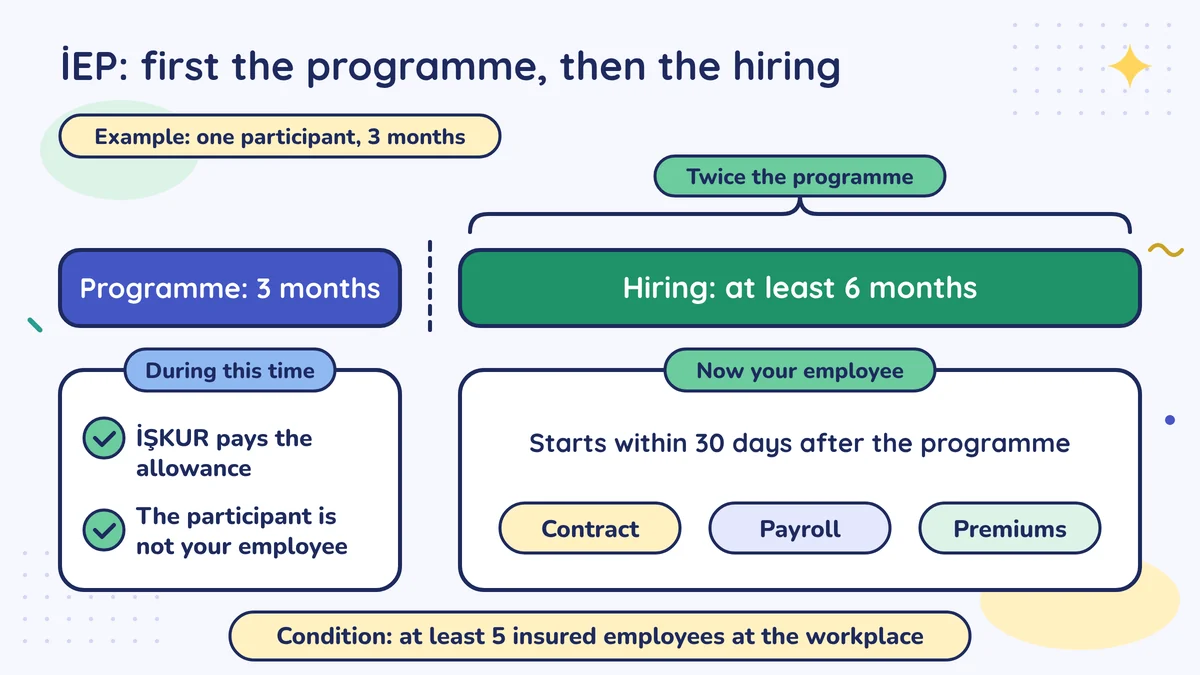
In the on-the-job training programme, a job seeker registered with İŞKUR learns the trade at the workplace for a few months; İŞKUR pays their allowance and insurance premiums. In return the employer undertakes, under the general rule, to hire at least 60% of the participants, for at least 60 days and for twice the length of the programme actually completed. To take part in the programme, at least 5 insured employees are required at the workplace; so it is usually not suitable for an employer hiring their first employee.
İsmail Usta the carpenter's workshop
İsmail Usta's furniture workshop has six insured employees. Orders have increased and one more person is needed. But finding a ready-trained craftsman on the market is hard. Someone from İŞKUR called: "Would you like to train a young person through the on-the-job training programme?" The first question that came to İsmail Usta's mind was: "What does it cost me, and what am I promising in return?"
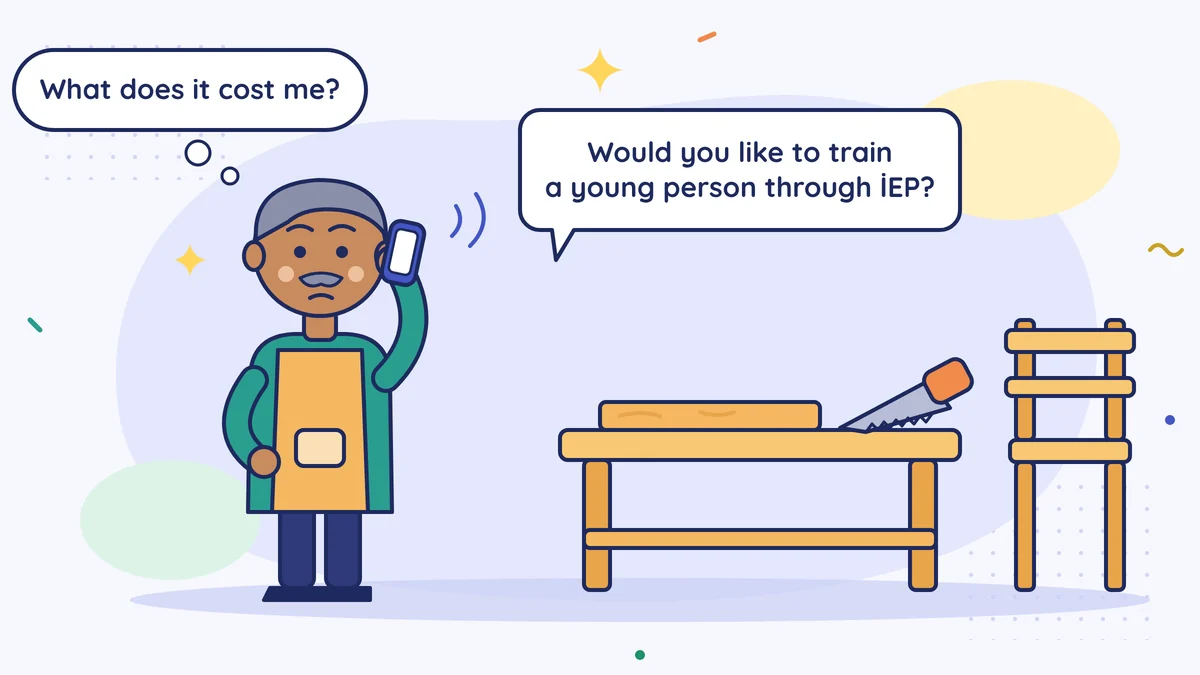
Like a test drive, but with a promise to buy
Before buying a car you take it for a test drive. The on-the-job training programme (İşbaşı Eğitim Programı, İEP for short) is also a kind of test drive for the employer: a job seeker learns the trade at your workplace for a few months, and you get to know them. The difference is this: before the drive, you promise to hire some of the participants afterwards.
What does İEP mean for the employer?
- The participant is not your employee; they are a participant in an İŞKUR programme. No employment contract is made, no payslip is produced, and the insurance registration is done by İŞKUR, not by you.
- İŞKUR pays the participant an allowance (official name zaruri gider, necessary expenses) for each day they attend. During the programme İŞKUR also pays the general health insurance and the work accident and occupational disease premiums. No wage comes out of your pocket.
- Your cost is time and effort: you assign one of your craftsmen as trainer, you have the participant work only in the trade in the contract, and you enter their attendance into İŞKUR's online system every week, by midnight on Saturday at the latest.
Who can take part?
The main rules İŞKUR has announced to employers:
- At the start of the programme and throughout it, the workplace must have at least 5 insured employees. The number of participants cannot exceed the number of employees.
- While the programme runs, your monthly number of insured employees must not fall more than 10% below the number at the start.
- The participant cannot be your first- or second-degree blood relative (mother, father, child, sibling, grandchild, grandfather, grandmother) or your spouse.
- Someone who worked insured under the same tax number in the year before the programme cannot be a participant. So you cannot take your own former employee back through İEP.
- If a participant has not received occupational health and safety training, you must give them this training, at least at the basic level, before the programme starts.
- At least 5 and at most 8 hours a day; at most 6 days and 45 hours a week. The length of the programme varies by sector: in most sectors at most 3 months, in manufacturing and IT at most 6 months.
The conclusion is clear: someone hiring their first employee cannot take part in İEP because of the 5-insured-employee condition. In the rules İŞKUR has announced to employers there is no exception for workplaces with fewer employees; ask the job and vocational counsellor at the İŞKUR provincial directorate whether this changes in future. İŞKUR's recruitment service, on the other hand, does not look at the number of employees: you can give your job advertisement to İŞKUR and ask for candidates to be referred.
What are you promising in return? The employment obligation
Since the change in January 2024 the general rule is this: when the programme ends, you hire at least 60% of the participants in the same trade, for at least 60 days and for no less than twice the length of the programme actually completed.
- The hiring must start within 30 days after the programme ends.
- If a person you hired leaves before the obligation period is over, you must take on a suitable person in their place within 30 days.
- You notify the İŞKUR provincial directorate of the hiring within 60 days of the start date.
Example: İsmail Usta runs a 3-month programme with one participant. When the programme ends, he has to hire that young person for at least 6 months (twice 3 months). During these 6 months the young person is a normal employee: contract, employment start notification, payroll, premiums. So İEP is not a free worker; it is a promise of a real hire afterwards.
By joining the programme, you accept the administrative and financial sanctions that will apply if you do not follow the rules; the details are written in İŞKUR's regulation and in the contract. Before signing the contract, ask in writing which sanctions there are, and keep the answer.
For the person you hire after İEP, an SGK incentive such as the youth and women employment incentive may open up; ask your mali müşavir (accountant) in particular how the programme affects the "uninsured in the last 6 months" condition.
Vocational high school students and apprentices, briefly
Under Vocational Education Law No. 3308, vocational high school students and apprentices of vocational education centres (MESEM) can receive training at a business under a contract made with the school.
- You pay the student a wage. The wage has a lower limit in the law; it is set as a percentage of the net minimum wage, and the rate varies with the workplace's number of employees.
- Part of this wage may be refunded to the employer by the state.
- This wage paid to the student is exempt from tax (3308 art. 25).
- As a rule the student's work accident and occupational disease insurance premium is paid not by you but by the school or the public body it is attached to. No long-term (pension) insurance premium is paid.
- The training at the business is carried out by a master trainer or training staff; the school tells you who can do this job.
The rates and the state contribution have changed often. Ask the school's coordinating teacher and your mali müşavir for the current amount.
Incentive checklist: ask before hiring
| Question | Ask whom |
|---|---|
| Do I have overdue debt at SGK at any of my workplaces? | Mali müşavir |
| Have the returns and premiums gone on time in recent months? | Mali müşavir |
| Is anyone working unregistered? If so, register them first. | You |
| Has the candidate turned 18, have they worked insured in the last 6 months? | Candidate, mali müşavir |
| Is the candidate registered with İŞKUR? If not, can they register through e-Devlet before starting work? | Candidate |
| Does the candidate have a vocational certificate or diploma suited to the job? | Candidate |
| Are they receiving unemployment benefit, and how long is left? | Candidate, İŞKUR |
| With this person, will I be above the average of the last 6 months? | Mali müşavir |
| Would İEP or student training suit my business? | İŞKUR, school |
| Will the employment start notification go at least one day before work starts? If something is being waited for, postpone the start of work, not the notification. | You, mali müşavir |
| Which law number will be selected on the first return? | Mali müşavir |
Use this list together with the checklist before hiring.
In the end İsmail Usta applied for one participant. In the last week of the programme he had the young person's employment start notification prepared and asked his mali müşavir the first question: "Which incentive will be selected for this lad?"
Do this this week
Print the checklist at the end of the lesson or save it on your phone. Before your next hire, go through every line one by one with the candidate and your mali müşavir. If you are considering İEP, find out from the İŞKUR provincial directorate the name of the job and vocational counsellor who looks after your workplace.
Common mistakes
- Seeing the İEP participant as cheap labour. The participant may only work in the trade in the contract, and there is an obligation to hire at the end of the programme.
- Trying to take on a former employee or a close relative through İEP. People who worked insured under the same tax number in the last year, first- and second-degree blood relatives, and the spouse cannot be participants.
- Looking at the checklist after the employment starts. Most incentive conditions are checked on the start date; correcting them afterwards is usually not possible.
Sources
- İŞKUR: Basic rights and obligations of employers under the on-the-job training programme (PDF)
- İŞKUR: Conditions for using vocational training courses and on-the-job training programmes changed (January 2024; employment obligation of 60% and twice the length)
- İŞKUR: Basic rights and obligations of participants under the on-the-job training programme (PDF; general health insurance and work accident premiums, necessary expenses allowance)
- Cott: İŞKUR on-the-job training programme 2026 (periods, employer conditions)
- Vocational Education Law No. 3308 (mevzuat.gov.tr; art. 25)
- Alomaliye: Incentive for the employment of youth, women and holders of vocational certificates 2026
Translated from the Turkish lesson. Last checked against Turkish rules: 9 October 2026. Not yet reviewed by a licensed accountant.
This is general information about Turkish rules, not financial, tax or legal advice. Rules change; check the date and the sources, and ask a licensed accountant (mali müşavir) about your own situation. Disclaimer