How money moves: income, expenses and what is left
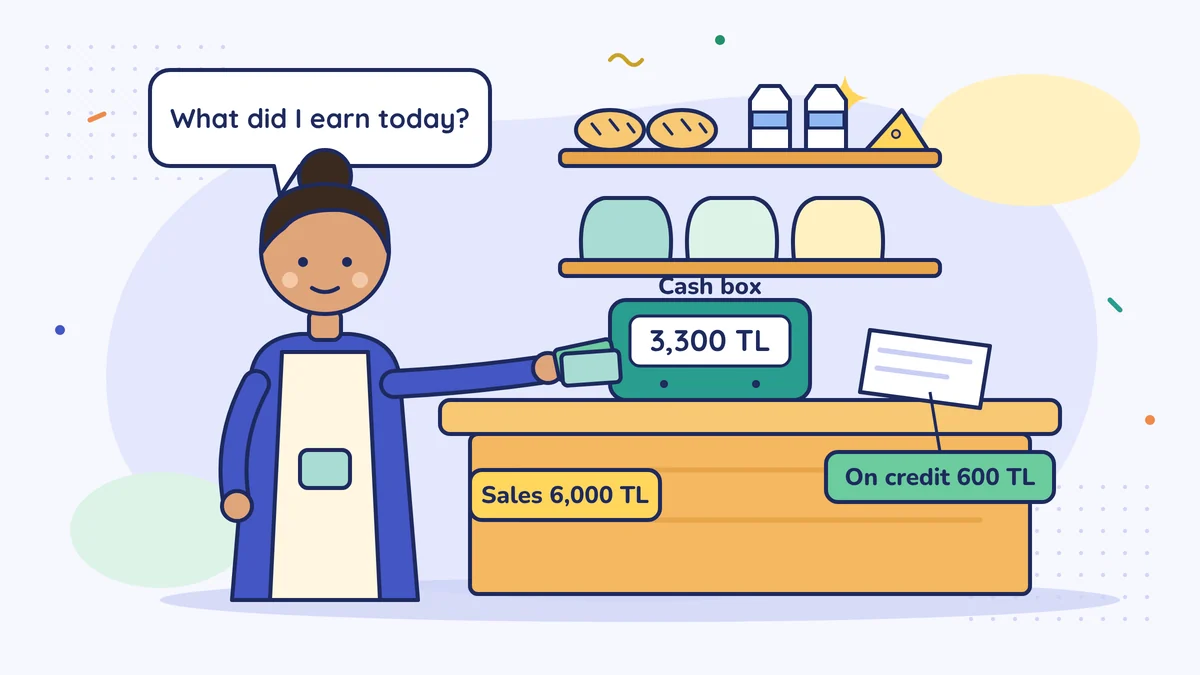
There are 3,300 lira in the cash box. So how much did you earn today? In this lesson we follow a day in a corner shop to see what income, expenses and profit are, and why the money in the cash box is not profit.
Income is what you get for what you sell; in a trading business it is recorded on the day of the sale, even if the money has not come in yet. An expense is what you spend to keep the business running; when you take expenses away from income, what is left is profit, and in most businesses part of the profit goes to the state as tax. The money in the cash box and profit are not the same thing.
Ayşe Hanım's day
The rules described in this lesson are those of Turkish law.
Ayşe Hanım runs a corner shop (bakkal) in her neighbourhood. When she opened the shop in the morning, the cash box was empty. She bought 2,500 lira of goods from the wholesaler (bread, milk, cheese, dried beans and grains) and paid for them from the cash box. By evening she had made 6,000 lira of sales. Her neighbour Hatice Hanım took 600 lira of this on credit (veresiye), so that money has not come in yet. In the afternoon, 400 lira also came in for goods she had given on credit yesterday.
In the evening she counted the cash box: 3,300 lira. (To keep it simple, nobody paid by card today; all the money that came in was cash. Money paid by card goes into the bank, not the cash box.)
The question looks simple: how much did Ayşe Hanım earn today? Most people would say, "There are 3,300 in the cash box, so I earned 3,300." But that is not right. Let's look at it step by step.
Income: what you get for what you sell
Income (gelir) is what you get in return for the goods or services you sell. Ayşe Hanım's income today is 6,000 lira.
Notice that not all of these 6,000 lira went into the cash box. Hatice Hanım's 600 lira credit sale is also part of today's income, because the goods were sold today. The money will come later. On the other hand, the 400 lira that came in this afternoon is not today's income. That sale was made yesterday, so it is recorded as yesterday's income. What came in today is only the money for yesterday's receivable. In short, in a trading business, income is recorded on the day you make the sale, not on the day the money arrives. For self-employed professionals such as doctors and lawyers, the rule is different: income is recorded on the day the money is received. Ask your mali müşavir (certified public accountant) which one your business falls under.
In everyday language, total sales are called turnover (ciro). In accounting it is also called revenue (hasılat). When your mali müşavir says "your turnover this month is 180,000 lira", they mean your total sales for that month. Turnover is not profit; no expenses have been taken out of it yet.
A note: to keep things simple, this lesson leaves out VAT (KDV, value added tax). In real life, if you are a VAT payer, that is, a business that adds VAT to its sales, the VAT inside the money you take from the customer is not your income. You collect it on behalf of the state. You deduct the VAT you paid when buying goods (this is called VAT deduction, KDV indirimi) and pay the rest to the state. The sales amount recorded in the books is also the amount without VAT. We explain this in the article What is VAT? (in Turkish) and in the lesson What is tax?.
Expenses: what you spend to keep the business running
An expense (gider) is money you spend to be able to do the work. Ayşe Hanım's expenses today are these:
- The cost to her of the goods she sold: 2,500 lira. To keep it simple, we assume she sold all the goods she bought this morning today. In reality, the expense is the cost of the goods you sold, not of the goods you bought. Goods left on the shelf are not an expense yet; we will see this in the lesson Stock: money waiting on the shelf.
- The shop's monthly rent is 9,000 lira. Divided by day, that is 300 lira.
- Electricity, water and telephone come to 3,000 lira a month. Divided by day, that is 100 lira.
The rent and the bills were not paid today; they will be paid at the end of the month. But the shop was used today too, so today's share is today's expense. Dividing by day is only to help you understand your business. In the books, rent and bills are recorded month by month, each with its own document.
One more condition: an expense must be related to the business. The detergent Ayşe Hanım bought for her home is not an expense; it is personal spending. We explain in detail which spending can be recorded as an expense in the article Which spending can be recorded as an expense? (in Turkish).
What is left: profit
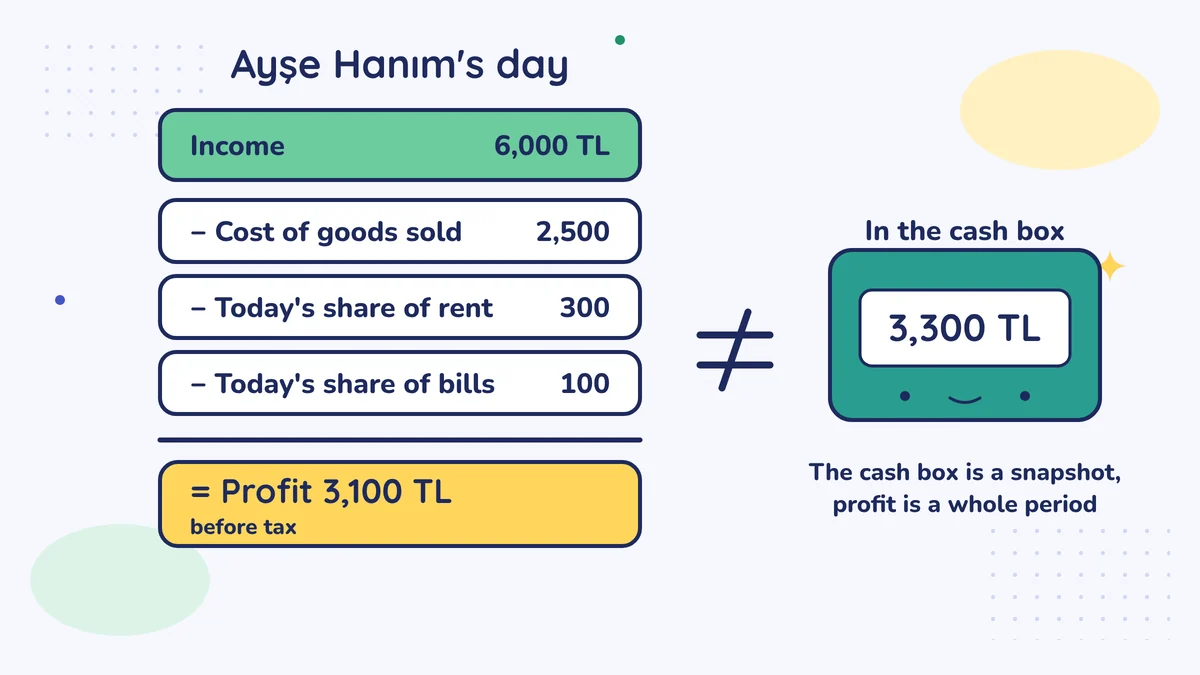
When you take the expenses away from the income, what is left is called profit (kâr):
| Item | Amount (lira) |
|---|---|
| Income (sales) | 6,000 |
| Cost of the goods sold | −2,500 |
| Today's share of the rent | −300 |
| Today's share of electricity, water, telephone | −100 |
| Profit (before tax) | 3,100 |
Not all of these 3,100 lira belong to Ayşe Hanım either. In most businesses, part of the profit goes to the state as tax: income tax (gelir vergisi) for a sole proprietorship, corporate tax (kurumlar vergisi) for a company. Tax is calculated on yearly earnings, not daily earnings. Some small tradespeople (those in the system called simplified taxation, basit usul) do not pay income tax on their earnings. Ask your mali müşavir whether you fall under this system.
Ayşe Hanım also pays her own Bağ-Kur premium. Bağ-Kur is not a tax; it is a premium paid for pension and health cover for the self-employed. We explain how much money to set aside for tax in the lesson Setting money aside for tax. Rates and amounts change every year; ask your mali müşavir for the current ones.
Why is the cash box 3,300 and the profit 3,100?
There are 3,300 lira in the cash box and the profit is 3,100 lira. There is a difference of 200 lira. This is where the difference comes from:
- Yesterday's 400 lira credit sale came into the cash box today, but it is not today's income. The cash box looks 400 higher than the profit.
- The 400 lira that is today's share of rent and bills has not been paid yet; it is still in the cash box. The cash box looks 400 higher.
- Hatice Hanım's 600 lira credit sale was counted as income but did not go into the cash box. The cash box looks 600 lower.
400 + 400 − 600 = 200. That is the difference.
So the cash box is a snapshot of one moment; profit is the account of a period. An employer who sees money in the cash box and spends all of it will not find the money for the rent at the end of the month. We cover this topic in detail in the lesson Profit but no cash.
Keep three words in mind
- Income: what you get for what you sell. It is recorded on the day of the sale, even if the money has not come in.
- Expense: what you spend to keep the business running. It must be related to the business.
- Profit: the difference between the two. In most businesses, part of it goes to the state as tax.
When your mali müşavir says "turnover" (ciro), they mean total sales; when they say "profit" (kâr), they mean what is left. Once these three words fall into place, the rest of the school will be much easier.
Do this this week
On Monday morning, write down the money in the cash box on a sheet of paper. Draw a line down the middle of the sheet: on the left, write the sales you make this week (including credit sales and card payments); on the right, write what you spend for the business. On Friday evening, add up both sides and find the difference. Then look at how much the cash box has grown since Monday. If the two do not match, look for where the difference comes from: credit sales, card payments, unpaid bills.
Common mistakes
- Thinking the money in the cash box is profit. The cash box also holds money for rent and bills that have not been paid yet.
- Forgetting credit sales. A sale whose money has not come in is still income; it goes into that day's earnings.
- Thinking personal spending is an expense. Groceries for your home are not related to the business and are not recorded as an expense.
Sources
- Income Tax Law (Gelir Vergisi Kanunu), Law No. 193, art. 37–40: commercial earnings (art. 39: under the business account method, revenue is the money collected plus receivables that have arisen), deductible expenses
- Income Tax Law (Gelir Vergisi Kanunu), art. 46 and repeated art. 20/A: earnings under simplified taxation (basit usul) and the earnings exemption; art. 67: cash basis for self-employment earnings
- Tax Procedure Law (Vergi Usul Kanunu), Law No. 213, art. 176–178: first-class (balance sheet basis) and second-class (business account basis) traders
- GİB (Revenue Administration), Tax Guide for Taxpayers with Commercial Earnings (Ticari Kazanç Elde Eden Mükellefler İçin Vergi Rehberi)
Translated from the Turkish lesson. Last checked against Turkish rules: 13 October 2026. Not yet reviewed by a licensed accountant.
This is general information about Turkish rules, not financial, tax or legal advice. Rules change; check the date and the sources, and ask a licensed accountant (mali müşavir) about your own situation. Disclaimer